Food Safety
search
Ask Food Safety AI
cart
facebook twitter linkedin instagram youtube
  • Sign In
  • Create Account
  • Sign Out
  • My Account
Food Safety
  • NEWS
    • Latest News
    • White Papers
  • PRODUCTS
  • TOPICS
    • Contamination Control
    • Food Types
    • Management
    • Process Control
    • Regulatory
    • Sanitation
    • Supply Chain
    • Testing and Analysis
  • PODCAST
  • EXCLUSIVES
    • Food Safety Five Newsreel
    • eBooks
    • FSM Distinguished Service Award
    • Interactive Product Spotlights
    • Videos
  • BUYER'S GUIDE
  • MORE
    • NEWSLETTERS >
      • Archive Issues
      • Subscribe to eNews
    • Store
    • Sponsor Insights
    • ASK FSM AI
  • WEBINARS
  • FOOD SAFETY SUMMIT
  • EMAG
    • eMagazine
    • Archive Issues
    • Editorial Advisory Board
    • Contact
    • Advertise
  • SIGN UP!
NewsRegulatoryFDAUSDA

Top U.S. Food Safety Officials Discuss Regulatory Landscape at Food Safety Summit
By Bailee Henderson
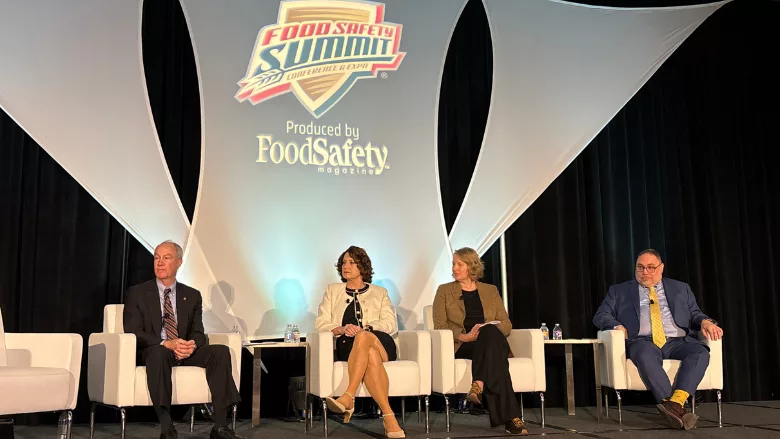
town hall panelists on stage at the 2026 food safety summit
Image credit: Bailee Henderson
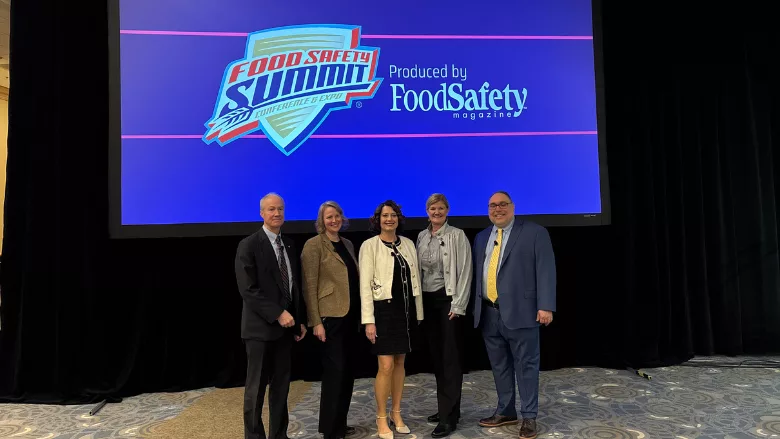
town hall panelists on stage at the 2026 food safety summit
Image credit: Bailee Henderson
town hall panelists on stage at the 2026 food safety summit
May 14, 2026

On Thursday, May 14, leading officials from the U.S. Food and Drug Administration (FDA), the U.S. Department of Agriculture’s Food Safety and Inspection Service (USDA-FSIS), the U.S. Centers for Disease Control and Prevention (CDC), and the Association for Food and Drug Officials (AFDO) took the stage at the 2026 Food Safety Summit Town Hall to answer attendees’ questions and provide insight into the current U.S. food safety regulatory landscape.

The Town Hall was moderated by Gillian Kelleher, CEO of Kelleher Consultants LLC and Chair of the Food Safety Summit Educational Advisory Board. Panelists included Mindy Brashears, Ph.D., USDA Under Secretary for Food Safety; Donald Prater, Principal Deputy Associate Commissioner for Food in FDA’s Human Foods Program (HFP); Steven Mandernach, J.D., Executive Director of the Association of Food and Drug Officials (AFDO); and Gwen Biggerstaff, Sc.D., M.S.P.H., Deputy Division Director of CDC’s National Center for Emerging and Zoonotic Infectious Diseases’ Division of Foodborne, Waterborne, and Environmental Diseases (NCEZID's DFWED).

FDA’s Leadership Shake-Up and New Resources

Mr. Prater took the stage first, sending regards from Kyle Diamantas, J.D., FDA’s new Acting Commissioner, mentioning the leadership change that happened at the agency earlier this week. Mr. Diamantas was FDA’s Deputy Commissioner for Human Foods just before assuming the Acting Commissioner role due to the departure of the previous Commissioner, Marty Makary, M.D.

Directing attendees to new resources released by the agency on Wednesday, Mr. Prater encouraged the use of root cause analyses (RCAs) and industry collaboration on the development of food safety best practices.

USDA-FSIS Priority Pathogens: Salmonella and Listeria

Dr. Brashears remarked on the shared goal of ensuring food safety, which spans both sides of the political aisle, before delving into her main priorities as head of USDA-FSIS: Salmonella and Listeria monocytogenes.

On reducing foodborne salmonellosis attributed to USDA-regulated products, Dr. Brashears said, “USDA-FSIS already has tools in [its] toolbox that [the agency] can use to take action on Salmonella,” mentioning pathogen performance standards. She also touched on the ongoing evaluation of existing quantification methods and the identification of the most highly pathogenic Salmonella strains present in food samples.

“We want to find the most pathogenic strains so we can make a difference,” said Dr. Brashears. “We also want to find the products that cause the most problems.”

Looking for quick answers on food safety topics?
Try Ask FSM, our new smart AI search tool.
Ask FSM →

Beyond poultry, Dr. Brashears also teased Salmonella programs for pork and beef products, rolling out late this year or in early 2027.

L. monocytogenes was another priority mentioned by Dr. Brashears. She described the data collection efforts initiated at the agency following the Boar’s Head listeriosis outbreak of 2024 and subsequent changes to the Listeria Rule. She also alluded to a new program to enhance Listeria sampling and testing, rolling out in the next few months.

Joint CDC–SLTT Efforts to Monitor Foodborne Pathogens

Next, Dr. Biggerstaff described the state–federal collaboration that enables foodborne illness outbreak response and pathogen monitoring and surveillance. She explained that states are on the “front lines,” while CDC collects and connects pathogen monitoring and illness data. Much of what CDC is able to accomplish is build on voluntarily reported data from state, local, tribal, and territorial (SLTT) partners, Dr. Biggerstaff emphasized.

Dr. Biggerstaff also mentioned CDC’s capacity-building efforts at SLTT health departments and described the current resource constraints. “CDC is only able to provide about 40 percent of what is requested,” she stated. However, she explained that these resource constraints are also driving data modernization efforts to lower barriers to SLTT participation in national data reporting systems.

Improving Federal–SLTT Information-Sharing

Finally, Mr. Mandernach described the role SLTT agencies play in food safety regulatory oversight and enforcement. He applauded the Retail Foods Program at FDA, saying, “It’s the best functioning retail team many of us have seen in our careers,” enabled by the HFP reorganization bringing the agency’s food policy and field programs under one umbrella.

Mr. Mandernach also highlighted the importance of FDA’s BRIDGE Project, which is transitioning most domestic manufacturing food inspections to states, and described the ways in which state inspections are equivalent to those directly conducted by FDA.

Additionally, Mr. Mandernach advocated for expanded federal–state information-sharing authorities before and during foodborne illness outbreaks to improve detection and response. He stated AFDO’s support for an active bill, the Federal and State Food Safety Information Sharing Act, which was discussed during a Congressional hearing in April.  

“Working together with the full range of stakeholders is how we will really bend the foodborne illness curve,” concluded Mr. Mandernach.

AI: “We’re Sitting on the Precipice of Change”

In response to an attendee question, Mr. Prater discussed the importance of harnessing artificial intelligence (AI) for food safety, calling it “as much of a game-changer” as whole genome sequencing (WGS). “Better food safety means better data and better analytics,” he said, describing how quantitative analytical techniques are helping FDA make sense of enormous quantities of data—which was once like “finding a needle in a haystack.”

Alongside harnessing the “mountain” of data collected by federal and SLTT regulatory activities, Mr. Prater also said that FDA is working to unlock industry data as well.

“These are going to be the tools that help us solve outbreaks, develop best practices, and conduct root cause analyses,” Mr. Prater said.

KEYWORDS: Association of Food and Drug Officials (AFDO) CDC Food Safety Summit SLTTs

Share This Story

Baileehendersonmay23

Bailee Henderson is the Digital Editor of Food Safety Magazine, where she covers industry-relevant current events, regulatory affairs, and scientific developments. She also produces the Food Safety Five Newsreel. Notably, Bailee's coverage for Food Safety Magazine has been featured in national televised news segments including CBS Sunday Morning and MSNBC's Rachel Maddow Show. She can be reached at hendersonb@bnpmedia.com.

Recommended Content

JOIN TODAY
to unlock your recommendations.

Already have an account? Sign In

  • people holding baby chicks

    Serovar Differences Matter: Utility of Deep Serotyping in Broiler Production and Processing

    This article discusses the significance of Salmonella in...
    Methods
    By: Nikki Shariat Ph.D.
  • woman washing hands

    Building a Culture of Hygiene in the Food Processing Plant

    Everyone entering a food processing facility needs to...
    Food Prep/Handling
    By: Richard F. Stier, M.S.
  • graphical representation of earth over dirt

    Climate Change and Emerging Risks to Food Safety: Building Climate Resilience

    This article examines the multifaceted threats to food...
    International
    By: Maria Cristina Tirado Ph.D., D.V.M. and Shamini Albert Raj M.A.
Manage My Account
  • eMagazine Subscription
  • Subscribe to Newsletters
  • Manage My Preferences
  • Website Registration
  • Subscription Customer Service

More Videos

Sponsored Content

Sponsored Content is a special paid section where industry companies provide high quality, objective, non-commercial content around topics of interest to the Food Safety Magazine audience. All Sponsored Content is supplied by the advertising company and any opinions expressed in this article are those of the author and not necessarily reflect the views of Food Safety Magazine or its parent company, BNP Media. Interested in participating in our Sponsored Content section? Contact your local rep!

close
  • the use of dual-energy X-ray food inspection technology to identify foreign contaminants.
    Sponsored byEagle by METTLER TOLEDO

    Precision Inspection Starts with the Right X-ray Detector

  • This image depicts a worker cleaning stainless steel machinery in a food processing plant
    Sponsored byCintas

    Employee Uniforms: A Frontline Defense Against Food Contamination

  • This image depicts a healthcare professional managing a large volume of paperwork and transitioning to a digital workflow.
    Sponsored bySafetyChain

    The Invisible Plant Tax Starts with Your Records

Popular Stories

packages of beef at retail

Scientists Tackle Food Waste with More Accurate ‘Sell By’ Dates Based on Meat Microbial Activity

scientists using molecular model

Updated EU Food Chemical Safety Information Database Now Available

close-up of woman in suit writing on clipboard

FDA Launches One-Day Inspectional Assessments


Events

May 28, 2026

Advanced Sanitation Strategies for Allergen Risk Reduction in Food Processing

Live: May 28, 2026, at 2:00 pm EDT: From this webinar, attendees will learn why validation and verification are necessary for allergen control, and how analytical tools can support allergen management programs.

June 3, 2026

How to Build a Better Food Safety Training Program

Live: June 3, 2026 at 2:00 pm EDT: Join this webinar to learn how AI is impacting food safety training, and how you can leverage AI in your programs.

June 4, 2026

Building a Stronger Food Safety Program in a Changing GFSI Landscape

Live: June 4, 2026 at 11:00 am EDT: Attend this webinar to understand how GFSI requirements are evolving and what those changes signal for quality programs at food and beverage facilities.

View All

Products

Global Food Safety Microbial Interventions and Molecular Advancements

Global Food Safety Microbial Interventions and Molecular Advancements

See More Products

Related Articles

  • gloved hands of a foodservice worker assembling a burger

    Survey of U.S. Food Handlers Reveals Food Safety Knowledge Strengths, Opportunities to Improve Training

    See More
  • US capitol

    A 2025 Timeline of U.S. Federal Food Safety Changes Under the Trump Admin

    See More
  • Dynamic Panel of Government and Industry Leaders to Discuss The New Food Safety Environment at 2016 Food Safety Summit

    See More

Related Products

See More Products
  • 1119053595.jpg

    Food Safety for the 21st Century: Managing HACCP and Food Safety throughout the Global Supply Chain, 2E

  • 1119160553.jpg

    Food Safety: Innovative Analytical Tools for Safety Assessment

  • 9781498721776.jpg

    Handbook of Food Processing: Food Safety, Quality, and Manufacturing Processes

See More Products

Events

View AllSubmit An Event
  • June 4, 2026

    Building a Stronger Food Safety Program in a Changing GFSI Landscape

    Live: June 4, 2026 at 11:00 am EDT: Attend this webinar to understand how GFSI requirements are evolving and what those changes signal for quality programs at food and beverage facilities.
  • March 3, 2026

    FDA/USDA Regulatory Updates: Food Safety Work Plans for 2026

    On Demand: In this high-level, exclusive webinar, FDA Deputy Commissioner for Human Foods Kyle Diamantas and USDA Under Secretary for Food Safety Mindy Brashears, Ph.D. will share their agencies' regulatory priorities and work plans for 2026 and beyond.
View AllSubmit An Event

Related Directories

  • Food Safety News

    Food Safety News advances public health by delivering timely, accurate, and comprehensive coverage of foodborne illness outbreaks, recalls, and regulatory developments that impact the safety of our global food supply.
×

Never miss the latest news and trends driving the food safety industry

Newsletters | Website | eMagazine

JOIN TODAY!
  • RESOURCES
    • Advertise
    • Contact Us
    • Directories
    • Store
    • Want More
  • SIGN UP TODAY
    • Create Account
    • eMagazine
    • Newsletters
    • Customer Service
    • Manage Preferences
  • SERVICES
    • Marketing Services
    • Reprints
    • Market Research
    • List Rental
    • Survey/Respondent Access
  • STAY CONNECTED
    • LinkedIn
    • Facebook
    • Instagram
    • X (Twitter)
  • PRIVACY
    • PRIVACY POLICY
    • TERMS & CONDITIONS
    • DO NOT SELL MY PERSONAL INFORMATION
    • PRIVACY REQUEST
    • ACCESSIBILITY

Copyright ©2026. All Rights Reserved BNP Media, Inc. and BNP Media II, LLC.

Design, CMS, Hosting & Web Development :: ePublishing