Food Safety
search
Ask Food Safety AI
cart
facebook twitter linkedin instagram youtube
  • Sign In
  • Create Account
  • Sign Out
  • My Account
Food Safety
  • NEWS
    • Latest News
    • White Papers
  • PRODUCTS
  • TOPICS
    • Contamination Control
    • Food Types
    • Management
    • Process Control
    • Regulatory
    • Sanitation
    • Supply Chain
    • Testing and Analysis
  • PODCAST
  • EXCLUSIVES
    • Food Safety Five Newsreel
    • eBooks
    • FSM Distinguished Service Award
    • Interactive Product Spotlights
    • Videos
  • BUYER'S GUIDE
  • MORE
    • NEWSLETTERS >
      • Archive Issues
      • Subscribe to eNews
    • Store
    • Sponsor Insights
    • ASK FSM AI
  • WEBINARS
  • FOOD SAFETY SUMMIT
  • EMAG
    • eMagazine
    • Archive Issues
    • Editorial Advisory Board
    • Contact
    • Advertise
  • SIGN UP!
NewsContamination ControlFood TypeProcess ControlMicrobiological ControlIntervention ControlsProcessing TechnologiesProduce

Study Evaluates Pathogen Reductions on Microgreens Treated with UV-C
By Food Safety Magazine Editorial Team
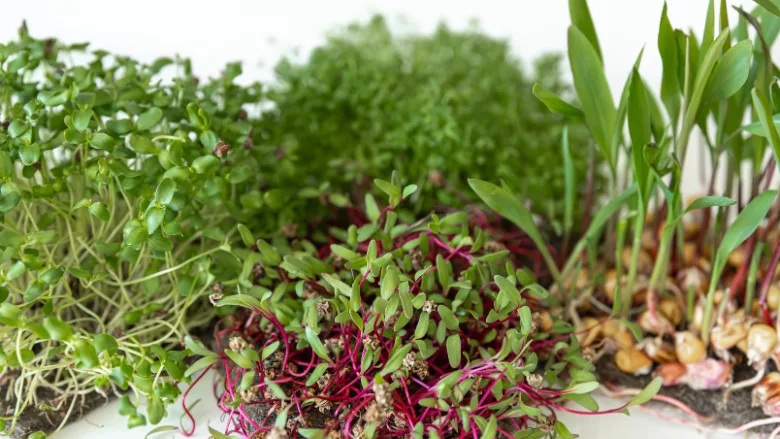
various types of microgreens
Image credit: pvproductions via Freepik
April 9, 2026

A recent study evaluated the effectiveness of post-harvest ultraviolet-C (UV-C) treatment for reducing key foodborne pathogens on microgreens, finding that while the intervention achieved measurable reductions, it did not completely eliminate microbial food safety risks.

Microgreens are considered particularly vulnerable to microbial contamination because pathogens can transfer from contaminated seeds, irrigation water, or soilless substrates directly to the edible portion of the plant. The authors noted that post-harvest sanitizer treatments are generally not preferred due to the fragility of microgreens, prompting investigation into alternative interventions such as UV-C.

Published in MDPI’s Foods, the study was conducted by researchers from Muş Alparslan University and Atatürk University in Türkiye, as well as Colorado State University.

Study Design

Researchers first inoculated nutrient-soaked agricultural perlite with Salmonella enterica, Shiga toxin-producing Escherichia coli O157:H7 (STEC), and Listeria monocytogenes at concentrations of 10⁵ to 10⁶ colony forming units per gram (CFU/g). Sunflower and radish microgreens were grown in the contaminated soilless substrate to evaluate pathogen transfer and subsequent inactivation.

Following harvest, microgreens were subjected to UV-C treatment applied either unidirectionally or bidirectionally at distances of 10, 20, and 30 centimeters (cm), and exposure times ranging between five and 120 seconds. UV-C doses ranged from 0.03 to 2.07 kilojoules per square meter (kJ/m²).

Pathogen Reduction and Treatment Efficacy

The study found that UV-C treatment reduced pathogen populations under most conditions. The highest level of microbial inhibition was achieved with bidirectional exposure at 10 cm for 120 seconds, resulting in reductions of up to 3.1 log CFU/g for S. enterica, 3.0 log CFU/g for STEC, and 2.0 log CFU/g for L. monocytogenes.

The authors reported a strong inverse relationship between UV-C application distance and efficacy, with significantly lower reductions observed as distance increased. Bidirectional treatment consistently provided greater reductions than unidirectional exposure, likely due to improved surface coverage and reduced shadowing effects.

Looking for quick answers on food safety topics?
Try Ask FSM, our new smart AI search tool.
Ask FSM →

Among the tested pathogens, Salmonella was identified as the most sensitive to UV-C irradiation, while L. monocytogenes exhibited the greatest resistance. The researchers attributed these differences, in part, to structural characteristics such as cell wall thickness and DNA repair capacity.

Influence of Microgreen Type and Surface Characteristics

Differences in treatment efficacy were also observed between microgreen types. Sunflower microgreens showed slightly greater pathogen reductions compared to radish microgreens under identical conditions. The authors suggested that broader and smoother cotyledons in sunflower microgreens may facilitate more uniform UV-C penetration, whereas the more complex surface structure of radish microgreens may shield microorganisms from exposure.

Regrowth During Refrigerated Storage

Despite initial reductions, the study found that UV-C treatment did not provide a lasting antimicrobial effect. During 14 days of refrigerated storage at 4 °C, pathogen populations increased by 0.3–1.7 log CFU/g.

The authors suggested that sublethal injury and mild tissue damage caused by UV-C treatment may release nutrients, creating a favorable environment for surviving microorganisms to recover and proliferate. Similar increases were observed for total mesophilic aerobic bacteria and yeast and mold populations, indicating that microbial growth can continue under refrigeration.

Implications for Food Safety

The findings demonstrate that UV-C treatment can significantly reduce pathogen populations on microgreens as a post-harvest intervention. However, the authors emphasized that UV-C alone cannot fully address microbial food safety concerns associated with these products.

They concluded that while UV-C may serve as a useful mitigation strategy in both commercial and small-scale production, it should be used in combination with other preventive measures, including the use of safe inputs and strict hygiene practices. Further research was recommended to evaluate combined preservation approaches that could improve long-term microbiological control on microgreens.


KEYWORDS: microgreens study UV

Share This Story

Fsm purple logo 200x200

The Food Safety Magazine editorial team comprises Bailee Henderson, Digital Editor ✉ and Adrienne Blume, M.A., Editorial Director.

Recommended Content

JOIN TODAY
to unlock your recommendations.

Already have an account? Sign In

  • people holding baby chicks

    Serovar Differences Matter: Utility of Deep Serotyping in Broiler Production and Processing

    This article discusses the significance of Salmonella in...
    Methods
    By: Nikki Shariat Ph.D.
  • woman washing hands

    Building a Culture of Hygiene in the Food Processing Plant

    Everyone entering a food processing facility needs to...
    Sanitation
    By: Richard F. Stier, M.S.
  • graphical representation of earth over dirt

    Climate Change and Emerging Risks to Food Safety: Building Climate Resilience

    This article examines the multifaceted threats to food...
    Risk Assessment
    By: Maria Cristina Tirado Ph.D., D.V.M. and Shamini Albert Raj M.A.
Manage My Account
  • eMagazine Subscription
  • Subscribe to Newsletters
  • Manage My Preferences
  • Website Registration
  • Subscription Customer Service

More Videos

Sponsored Content

Sponsored Content is a special paid section where industry companies provide high quality, objective, non-commercial content around topics of interest to the Food Safety Magazine audience. All Sponsored Content is supplied by the advertising company and any opinions expressed in this article are those of the author and not necessarily reflect the views of Food Safety Magazine or its parent company, BNP Media. Interested in participating in our Sponsored Content section? Contact your local rep!

close
  • This image depicts a healthcare professional managing a large volume of paperwork and transitioning to a digital workflow.
    Sponsored bySafetyChain

    The Invisible Plant Tax Starts with Your Records

  • Salmon on rice cracker
    Sponsored byThermoFisher

    Food Microbiology Testing Methods: Listeria species

  • The image displays a person selecting packaged fresh chicken meat from a supermarket display cooler.
    Sponsored byCorbion

    Developing a Future-Proof Food Safety Strategy for Meat and Poultry Products

Popular Stories

slices off a block of cheddar cheese on a wooden cutting board

Raw Farm Recalls Unpasteurized Cheese While Denying Link to E. coli Outbreak

smiling woman employee with hair net using tablet in food manufacturing facility

Monitoring and Recordkeeping: The Heart of HACCP

researchers working in a lab using a microscope

FDA’s Human Foods Program Publishes Priority Scientific Needs to Advance Food Safety


Events

April 16, 2026

Recordkeeping and Document Management for Food Safety Compliance

Live: April 16, 2026, at 2:00 pm EDT: From this webinar, attendees will learn why recordkeeping and document control are essential to food safety and business management.

May 11, 2026

The Food Safety Summit

Stay informed on the latest food safety trends, innovations, emerging challenges, and expert analysis. Leave the Summit with actionable insights ready to drive measurable improvements in your organization. Do not miss this opportunity to learn from experts about contamination control, food safety culture, regulations, sanitation, supply chain traceability, and so much more.

May 12, 2026

Leveraging AI for Food Safety: From Strategy to Impact

Live Streaming from Food Safety Summit: This dynamic workshop brings together leaders from industry, academia, and government to demonstrate how AI can be practically applied in food safety—from data strategy to daily execution.

View All

Products

Global Food Safety Microbial Interventions and Molecular Advancements

Global Food Safety Microbial Interventions and Molecular Advancements

See More Products

Related Articles

  • Milk Treated with UV Radiation is Safe: EFSA Panel

    See More
  • milk production

    The Use of UV-C Light in Combination With Hydrogen Peroxide to Disinfect Packages in ESL and Aseptic Beverages

    See More
  • crops being watered at sunrise

    Sanitizer-Treated Irrigation Water Has Antimicrobial Benefits in Crop Fields, Study Suggests

    See More

Related Products

See More Products
  • Food-Forensics-3D.jpg

    Food Forensics Handbook Practice, Instrumentation, Case Studies

  • 9781498721776.jpg

    Handbook of Food Processing: Food Safety, Quality, and Manufacturing Processes

  • food safety.jpg

    Food Safety Contaminants and Risk Assessment

See More Products

Events

View AllSubmit An Event
  • March 26, 2026

    Continuous Pathogen Control: Enhancing Sanitation and Environmental Monitoring in Food Processing

    On Demand: This session explores the role of continuous airborne pathogen control technology in supporting sanitation and environmental monitoring programs within food processing environments.
View AllSubmit An Event

Related Directories

  • Cognituv

    Cognituv delivers evidence-based, intelligent IoT-enabled UV-C disinfection solutions, partnering with facility managers with our proven process to elevate hygiene and improve quality. Our USA-made products focus on reducing risk and improving efficiency for enhanced sustainable operations.
  • OneVision Corp.

    We develop, manufacture, sell and support can seam inspection and weighing systems to food and beverage canners, can makers, and specialty manufacturers (oil filter, aerosol cans, composite cans). Founded in 1994, we've installed and support more than 350 can seam inspection systems around the world.
×

Never miss the latest news and trends driving the food safety industry

Newsletters | Website | eMagazine

JOIN TODAY!
  • RESOURCES
    • Advertise
    • Contact Us
    • Directories
    • Store
    • Want More
  • SIGN UP TODAY
    • Create Account
    • eMagazine
    • Newsletters
    • Customer Service
    • Manage Preferences
  • SERVICES
    • Marketing Services
    • Reprints
    • Market Research
    • List Rental
    • Survey/Respondent Access
  • STAY CONNECTED
    • LinkedIn
    • Facebook
    • Instagram
    • X (Twitter)
  • PRIVACY
    • PRIVACY POLICY
    • TERMS & CONDITIONS
    • DO NOT SELL MY PERSONAL INFORMATION
    • PRIVACY REQUEST
    • ACCESSIBILITY

Copyright ©2026. All Rights Reserved BNP Media, Inc. and BNP Media II, LLC.

Design, CMS, Hosting & Web Development :: ePublishing