EWG Publishes 2026 ‘Dirty Dozen’ List of ‘Pesticide-Contaminated’ Produce—but is it Scientifically Sound?
Experts argue it does not reflect key exposure science and risk assessment principles, and is therefore misleading.
The Environmental Working Group (EWG) has published its annual Dirty Dozen and Clean Fifteen for 2026, which list the most and least “pesticide-contaminated” produce commodities sold in the U.S. For the first time, the 2026 report shines a light on per- and polyfluoroalkyl (PFAS) pesticides.
The Shopper’s Guide to Pesticides in Produce has come under scrutiny in previous years due to gaps in its ranking methodology and assertions that the Dirty Dozen deters consumers from consuming produce.
In 2025, EWG updated its ranking methodology to include some pesticide toxicity information—although exposure scientists and produce industry groups still say EWG’s updated methodology is lacking, and that the Shopper’s Guide is misleading about the health risks of conventionally grown produce.
EWG: “Benefits of Produce Consumption Outweigh Risks of Pesticide Exposure”
EWG often upholds organic produce as a safer alternative to conventional produce in its Shopper’s Guide communications. When asked to comment on evidence that the Dirty Dozen may deter people from buying produce entirely, especially low-income shoppers, EWG scientist Varun Subramaniam, M.S. said, “In all of our Shopper’s Guide messaging, we reiterate that it is crucial to eat plenty of fruits and vegetables, whether they’re organic or not. The benefits of produce consumption, both organic and conventional, outweigh the risks of pesticide exposure.”
“Switching entirely to organic produce is not feasible for most Americans,” he acknowledged. “The good news is that some organic produce can be found at similar prices to conventional products in the freezer section as a more affordable alternative. Apart from shopping organic, another effective action that everyone can take is to wash all produce.”
EWG’s New Dirty Dozen Ranking Methodology
A peer-reviewed article published by EWG scientists in 2025 described the updated methodology EWG now uses for its Shopper’s Guide rankings.
EWG analyzes pesticide residue data from the U.S. Department of Agriculture’s (USDA’s) Pesticide Data Program (PDP), including 54,344 samples of 47 fruits and vegetables in the 2026 dataset. Using this data, EWG ranks fruits and vegetables based on the “abundance, diversity, intensity, and toxicity” of pesticides that are present, Mr. Subramaniam told Food Safety Magazine.
Looking for quick answers on food safety topics?
Try Ask FSM, our new smart AI search tool.
Ask FSM →
The toxicity metric is based on a modified hazard index approach, in which the concentration of a pesticide on a sample (or the sum of a pesticide and its metabolites) was divided by the toxicity reference value corresponding to each pesticide. For the toxicity reference value (i.e., a value that quantifies the toxicity of a pesticide), EWG used the U.S. Environmental Protection Agency’s (EPA’s) No Adverse Effect Levels (NOAELs) for pesticides. In lieu of an available NOAEL, values from EPA or the European Food Safety Authority (EFSA) risk assessments were reviewed.
Scientists Weigh in on EWG’s Approach
Despite updating its methodology in 2025, a key gap that is central to toxicologists’ criticisms remains unaddressed; that is, the presence of a pesticide residue does not directly translate to meaningful health risk.
Pesticide Detection Does Not Equal Health Risk
In a peer-reviewed study published in 2024 (Jacobs et. al.), researchers applied a uniform screening-level risk assessment approach to EWG’s 2022 Dirty Dozen to estimate pesticide exposures among U.S. consumers and characterize the associated chronic human health risks, using EPA dietary health-based guidance values (HBGVs). The estimated daily exposure for each pesticide-produce combination was below—and in many cases, well below—the corresponding HBGV for all exposure scenarios, demonstrating that excessive produce-specific pesticide exposure is unexpected, as the amount of produce that would need to be consumed on a chronic basis, even among children, far exceeds typical dietary intake.
“When drawing conclusions about potential consumer health risk, a distinction should be made between the mere detection of a pesticide residue versus the risk, which is dependent on the chemical toxicity and potency (i.e., the dose required to produce an effect) and on the magnitude, frequency, and duration of exposure,” the researchers explained. “Further, the toxicities of all pesticides are not equivalent, and reporting the detection of multiple pesticides without understanding the nature of the toxicity and the dose-response relationship of each can mischaracterize the potential exposure risk.”
“You Would Need to Eat Hundreds of Servings to Hit the Safety Threshold”
According to another analysis of EWG’s Dirty Dozen conducted by immunologist Andrea Love, Ph.D., EWG’s updated methodology still fails to consider important factors for potential exposure risk, including the dose of each residue, whether the substance is harmful at detected levels (or at all), and whether exposure to a pesticide from the consumption of produce is meaningful. Additionally, Dr. Love explained that “total pesticide residue count” is not a valid metric for cumulative exposure, because “every single chemical has different properties, interacts with our bodies in different ways, is excreted and processed differently, [and has a] different mechanisms of action.”
She echoed previous research demonstrating that the levels of pesticides found on Dirty Dozen produce are so low that they could not pose harm to human health. “You’d need to eat hundreds of servings of each food to even hit the safety threshold, which is already 100–1,000 times lower than a level that could theoretically cause harm,” Dr. Love said. She provided an example using spinach, the “dirtiest” commodity on the 2025 Dirty Dozen list (and on the 2026 list). “A woman could safely eat 145 pounds of conventional spinach every day (774 servings), even if every serving contained the highest level of pesticide residue ever recorded,” before achieving levels of exposure considered harmful.
EWG Methodology Lacks Risk Assessment
Additionally, in the same peer-reviewed study that explained its updated ranking methodology, EWG compared USDA PDP data and U.S. Centers for Disease Control and Prevention (CDC) National Health and Nutritional Examination Survey (NHANES) data, concluding that produce consumption weighted by pesticide contamination is associated with higher levels of urinary pesticide metabolites. EWG cited this conclusion as evidence of the usefulness of its new toxicity value for its Dirty Dozen rankings.
In a review of this study commissioned by the Alliance for Food and Farming (which, it must be noted, is a produce industry interest group and a known detractor of EWG’s Shopper’s Guide), experts determined that there was not a statistically significant association between produce consumption weighted by pesticide contamination and levels of urinary pesticide metabolites recorded in NHANES data, except when “removing an unjustified singular type of produce [i.e., potatoes] out of 43 types and including irrelevant foods to assess dietary consumption. Moreover, the study mentions the importance of utilizing pesticide toxicity values to assess health risk, yet does not conduct a risk assessment despite containing all the necessary data.”
“The methodology utilized to develop the dietary pesticide exposure score and support the alleged conclusion should not be applied to assess impact on health outcomes,” the review concluded.
EWG: “Legal Does not Mean Safe”
The majority of conventionally grown U.S. produce falls below regulatory safety thresholds—for example, 99 percent of foods included in the most recent USDA PDP were compliant with EPA maximum residue limits (MRLs).
Commenting on this, Mr. Subramaniam said, “Even low concentrations of residues can contribute to health harm. Legal does not necessarily mean safe. The legal limits that EPA sets for pesticides on produce are often outdated and fail to fully incorporate all of the latest research linking pesticides to health harm.”
He continued, “EPA regulates pesticides individually; however, humans are exposed to cocktails of multiple pesticides at once. We know that combinations of multiple pesticides can often trigger health harms at lower concentrations than in isolation. This is a massive blind spot for EPA’s regulation, and consequently, for the safety of our produce. EPA also frequently waives toxicity data requirements for pesticide registration, meaning that legal limits are often based on an incomplete dataset of how a chemical may interact with the body and cause harm.”
Mr. Subramaniam cited several pesticides that are approved for use in the U.S. that are considered unsafe by the European Food Safety Authority (EFSA) and are therefore banned in the EU; for example. bifenthrin, trifluralin, and flufenacet.
“Currently, regulation is neither sufficiently health protective nor science-grounded. Until our policies on pesticides can truly center human health, tools such as the Shopper’s Guide are crucial for folks to understand what they’re putting in their bodies,” Mr. Subramaniam concluded.
EWG’s 2026 Rankings
The Dirty Dozen
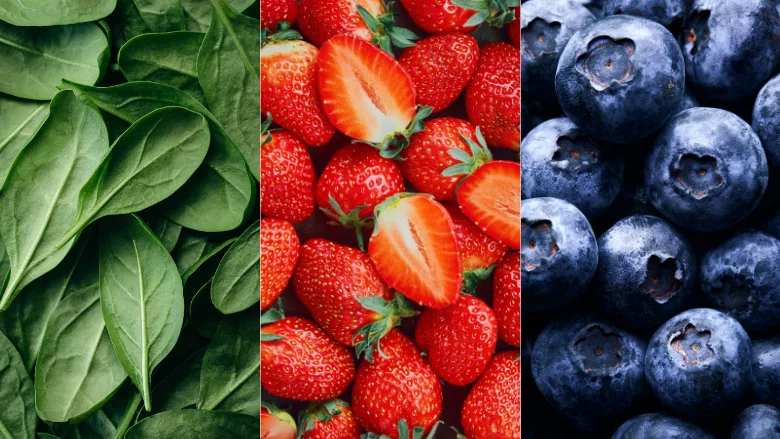
According to EWG’s 2026 Shopper’s Guide, a total of 203 pesticides were found on the produce listed in the Dirty Dozen, and pesticides were found on 96 percent of samples of all 12 types of produce. Additionally, PFAS pesticides were detected on 63 percent of all Dirty Dozen produce samples. Every type of produce, except potatoes, had on average four or more pesticides detected on individual samples. Potatoes had two, on average. The 2026 Dirty Dozen are:
- Spinach
- Kale, collard, and mustard greens
- Strawberries
- Grapes
- Nectarines
- Peaches
- Cherries
- Apples
- Blackberries
- Pears
- Potatoes
- Blueberries.
EWG also mentioned green beans and peppers because of their place just below the list and because they ranked highly on overall toxicity. Topping the list on the basis of the level and toxicity of detected pesticides were green beans, spinach, bell and hot peppers, and kale, collard, and mustard greens.
The Clean Fifteen
In contrast, almost 60 percent of samples of produce listed on the Clean Fifteen had no detectable pesticide residues. Additionally, 16 percent of samples had residues of two or more pesticides, and no sample from the top four Clean Fifteen items had residues of more than three pesticides. The 2026 Clean Fifteen are:
- Pineapple
- Sweet corn (fresh and frozen)
- Avocados
- Papaya
- Onions
- Sweet peas (frozen)
- Asparagus
- Cabbage
- Cauliflower
- Watermelon
- Mangoes
- Bananas
- Carrots
- Mushrooms
- Kiwi.
Pineapple, papaya, avocado, sweet corn, and onion are among the fruit and vegetables with the lowest rankings, including overall toxicity.
What About PFAS Pesticides?
As PFAS “forever chemicals” come under increasing scrutiny due to emerging evidence about their potential health harms and their indefinite persistence and bioaccumulation in the environment and humans, EWG’s 2026 Shoppers Guide specifically calls out PFAS pesticides for the first time. As the name suggests, PFAS pesticides are pesticides that are also considered PFAS, characterized by their persistent carbon-fluorine bonds.
According to EWG, based on 2026 Shopper’s Guide figures, residues of the PFAS pesticide fludioxonil were found in 14 percent of all produce samples and in nearly 90 percent of peaches and plums. Additionally, fluopyram and bifenthrin, also PFAS pesticides, were among the ten most frequently detected chemicals.
On the topic of PFAS pesticides, Mr. Subramaniam told Food Safety Magazine, “Americans should be concerned about the level and widespread detections of PFAS pesticides for many reasons: 1) most PFAS pesticides break down into trifluoroacetic acid (TFA), which is highly persistent and known to contaminate soil, water, and bodies; 2) PFAS pesticides are increasingly being linked to reproductive toxicity, liver damage, and other health harms; and 3) we simply don’t have enough research at the moment to assess the short- and long-term impacts of PFAS pesticides on human health.”