EWG’s 2025 ‘Dirty Dozen’ List of Most Pesticide-Contaminated Produce Uses New Methodology

Image credit: Freepik
Every year, the Environmental Working Group (EWG) publishes its Dirty Dozen and Clean Fifteen lists of the most and least pesticide-contaminated fruits and vegetables. The recently published 2025 report features an updated ranking methodology that considers the toxicity of individual pesticides detected on different produce, in addition to the number, concentration, and amount of pesticides that are present.
EWG’s Updated Methodology
To compile its Dirty Dozen and Clean Fifteen lists, EWG analyzes pesticide residue data from the U.S. Department of Agriculture’s (USDA’s) Pesticide Data Program (PDP); the most recent USDA PDP report covers samples collected and tested in 2023. The 2025 Dirty Dozen report includes PDP data from more than 53,000 non-organic samples of 47 fruits and vegetables. Since USDA samples a different variety of crops every year for its PDP program, EWG used the most recent PDP data that was available for each of the 47 produce types included in the Dirty Dozen report.
Additionally, for the first time, in its ranking methodology for the 2025 Dirty Dozen report, EWG also included pesticide toxicity information published by government agencies. To calculate the toxicity of pesticides on a crop, EWG added the pesticide-toxicity ratio values (i.e., the concentration of a pesticide detected to a value that quantifies the toxicity of that pesticide) into a total value that represents the overall toxicity of all pesticides on a crop. EWG used the U.S. Environmental Protection Agency’s (EPA’s) No Adverse Effect Levels (NOAELs) for pesticides, acquired through a Freedom of Information Act (FOIA) request. In lieu of an available NOAEL, other government agency risk assessment documents from either EPA or the European Food Safety Authority (EFSA) were reviewed.
In addition to toxicity for individual pesticides, EWG considered in its rankings for each produce type the percent of samples with at least one detectable pesticide, the average number of different pesticides on a single sample, and the average total concentration of pesticides found on a crop.
Produce With the Most and Least Pesticides in 2025
Despite concerns about pesticides in produce and the publication of the annual Dirty Dozen list, EWG provides the caveat that its guide should not deter people from buying produce. “A diet that is high in fruit and vegetables, whether conventional or organic, is important for health,” EWG says.
The Dirty Dozen
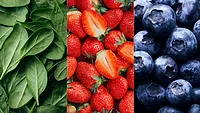
EWG’s 2025 “Dirty Dozen,” or the 12 fruits and vegetables were most contaminated with pesticides, are:
- Spinach
- Strawberries
- Kale, collard, and mustard greens
- Grapes
- Peaches
- Cherries
- Nectarines
- Pears
- Apples
- Blackberries
- Blueberries
- Potatoes.
Although not in the official Dirty Dozen, EWG highlighted bell and hot peppers, as well as green beans, as crops that ranked highly based on overall pesticide toxicity.
In total, 203 pesticides were detected on samples of the Dirty Dozen produce, with all crops (except cherries) contaminated by more than 50 pesticides each. Pesticides were found on 96 percent of Dirty Dozen samples, with every produce type averaging four or more pesticides per individual sample (except potatoes, averaging two per sample). The produce types with the highest level of pesticide toxicity were green beans, spinach, bell and hot peppers, and kale, collard, and mustard greens. Additionally, 93 percent of blackberry samples had detectable pesticides, with an average per sample of four pesticides.
Looking for quick answers on food safety topics?
Try Ask FSM, our new smart AI search tool.
Ask FSM →
EWG also called attention to the presence of chlorpropham on potatoes, a commodity that has PDP data available from as recently as 2023. The approval for chlorpropham was ended in the EU in 2019 due to health risks to consumers and agricultural workers.
Moreover, certain pesticides that have been banned in the U.S. due to health concerns continue to be detected on produce because of their persistence in the environment. For example, 2022 USDA PDP data for green beans revealed the presence of acephate, which was banned in 2011.
The Clean Fifteen
In contrast, EWG’s “Clean Fifteen” for 2025 are:
- Pineapple
- Sweet corn (fresh and frozen)
- Avocados
- Papaya
- Onions
- Sweet peas (frozen)
- Asparagus
- Cabbage
- Watermelon
- Cauliflower
- Bananas
- Mangoes
- Carrots
- Mushrooms
- Kiwi.
Nearly 60 percent of the Clean Fifteen produce samples had no detectable pesticide residues, and only 16 percent of crops had residues of two or more pesticides. No individual sample from any crop on the Clean Fifteen averaged more than three pesticides. Avocado, papaya, pineapples, onion, and sweet corn were among the fruit and vegetables with the lowest rankings, including overall toxicity. EWG also highlighted bananas for their low overall pesticide toxicity.
Criticisms of the Dirty Dozen: “Harmful to Consumers and Farmers”
Alongside the release of the Dirty Dozen each year, the Alliance for Food and Farming (AFF) strongly opposes EWG’s list, asserting that it does more harm than good. This year, AFF cited research conducted by researchers at the Illinois Institute of Technology’s Center for Nutrition Research (a study that was partly funded by a donation from AFF), which concluded that EWG's messaging results in low-income consumers stating they will be less likely to purchase any produce, regardless of whether it is organic or conventional. AFF also states that “peer-reviewed research has shown [that the Dirty Dozen list] has no scientific credibility,” and “is not based upon the fundamental tenets of toxicology or risk analysis,” referencing a 2011 study by the University of California–Davis. As previously noted, EWG’s 2025 report is the first to consider toxicity in its Dirty Dozen ranking.
Additionally, USDA PDP reports continuously show that more than 99 percent of products sampled through the program have pesticide residues below tolerances set by EPA, with a significant portion of samples having no detectable residues. At the same time, some stakeholders, such as Consumer Reports, believe EPA tolerances for pesticide residues are too high and not fully protective of human health. EWG also believes that “legal does not mean safe” when it comes to compliance with regulatory standards and tolerances for pesticide residues.
EPA, however, is “confident that the fruits and vegetables [eaten in the U.S.] are safer than ever,” as the agency continually evaluates the safety of new and existing pesticides as required by the Food Quality Protection Act. “Just because a pesticide residue is detected on a fruit or vegetable, that does not mean it is unsafe,” says EPA. “USDA’s PDP detects residues at levels far lower than those that are considered health risks.”
EWG claims that its Dirty Dozen and Clean Fifteen lists are intended to help consumers make informed choices when purchasing produce, rather than deter produce consumption.