FDA Tells Industry to Stop Using Kratom-Derived, Opiate-Like Concentrate in Drinks, Edibles
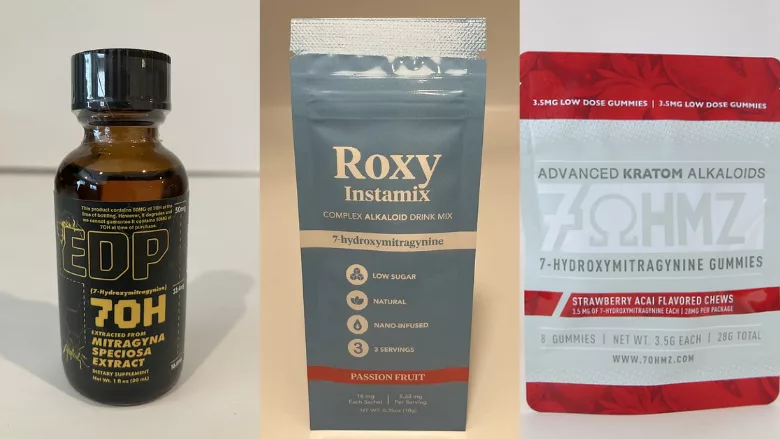
Image(s) credit: the U.S. Food and Drug Administration via Flickr
As food and beverage products containing kratom grow in popularity, the U.S. Food and Drug Administration (FDA) has sent warning letters to several manufacturers of products containing concentrated amounts of 7-hydroxymitragynine (7-OH), a “novel, potent opioid” derived from kratom. FDA has shared its concern about the growing number of such products available for purchase online and in gas stations, corner stores, and smoke shops across the U.S.
What is Kratom? What is 7-OH?
Kratom is an herbal extract that comes from the leaves of the Southeast Asian evergreen tree Mitragyna speciose. Traditionally, the leaves of the tree are chewed or brewed to achieve a stimulant effect. In the U.S., kratom powder and capsules—as well as drinks, gummies, and other edible products containing kratom extract—can be purchased online or in smoke shops, gas stations, and corner stores.
Although kratom is not controlled in the U.S. under the Controlled Substances Act, it is illegal in five states: Alabama, Arkansas, Indiana, Vermont, and Wisconsin. It was illegal in Rhode Island until July 2, 2025, when the Rhode Island Kratom Act was signed into law, legalizing and regulating the sale of kratom in the state. Similarly, Arizona, Georgia, Nevada, and Utah have also passed kratom consumer protection legislation.
Kratom is often likened to opioids due to its opium-like effects, which are produced by the substance acting on opioid receptors in the brain. Its use can lead to dependency. Users of kratom report stimulant effects in low doses, and sedative effects and high doses.
Research has shown that the major active alkaloid found in kratom, mitragynine, is converted to the active metabolite 7-OH when consumed. 7-OH is a potent opiate receptor agonist.
Kratom’s Effects and Adverse Events Linked to Kratom
According to Mayo Clinic, Poison Control centers in the U.S. received more than 3,400 reports about use of kratom from 2014–2019. Excessive consumption of kratom can lead to negative side effects like weight loss, dry mouth, nausea and vomiting, constipation, liver damage, muscle pain, high blood pressure, trouble breathing, tremors, seizures, hallucinations and delusions, drowsiness and dizziness, and depression. At the same time, Mayo Clinic also recognizes that of the problems linked to pain medicines happen when people take them at high doses or for a long time. Due to a lack of research, experts do not know what level of kratom can cause issues or lead to overdose. The number of deaths associated with kratom is “small compared with deaths from other drugs,” says Mayo Clinic, and is almost always associated with other drugs or substances that might have been harmful.
Advocates for kratom often claim it is a less-harmful alternative to other drugs—especially opiates—for those with substance abuse disorder. It can also act as a pain reliever, users report.
Looking for quick answers on food safety topics?
Try Ask FSM, our new smart AI search tool.
Ask FSM →
However, per Mayo Clinic, studies have found that some kratom marketers add more of the active ingredient to their products than is naturally found in kratom. Additionally, because kratom products lack regulation and the labeling is often vague, it is not possible to know how much kratom may be in a product.
FDA Issues Warning Letters to Firms Marketing Products With Potent Kratom Concentrate 7-OH
On July 15, FDA announced that it recently issued seven warning letters to companies for illegally marketing products containing 7-OH. Although 7-OH occurs naturally in trace amounts in kratom, FDA’s warning letters focused on concentrated 7-OH products such as tablets, gummies, drink mixes, and shots, which may be dangerous.
7-OH is not lawful in dietary supplements and cannot be lawfully added as an ingredient to conventional foods. Additionally, there are no FDA-approved drugs containing 7-OH, and it is illegal to market any drugs containing 7-OH. FDA warns that consumers who use 7-OH products are exposing themselves to products that have not been proven safe or effective for any use. FDA has received adverse event reports associated with 7-OH containing products.
The companies that received warning letters from FDA are marketing products that contain 7-OH as an added ingredient or have enhanced levels of 7-OH. Some products are considered by FDA to be adulterated conventional foods or dietary supplements, because 7-OH does not meet the relevant safety standard. Other products are considered unapproved new drugs with unproven claims such as relieving pain and managing anxiety.
FDA issued warning letters to:
- Shaman Botanicals LLC
- My Smoke Wholesale
- Relax Relief Rejuvenate Trading LLC dba RRR Trading or EDP Kratom
- Thang Botanicals Inc. dba 7ΩHMZ, 7-OHMZ, or 7OHMZ
- Royal Diamond Imports Inc. dba Roxytabs.com
- Hydroxie LLC
- 7Tabz Retail LLC.
The letters requested that the recipients respond within 15 business days.
Links to each of the warning letters can be found here. Images of the products being illegally marketed by the seven companies that received warning letters can be viewed here.
Update, July 30, 2025: FDA has recommended 7-OH to the U.S. Drug Enforcement Agency (DEA) for scheduling under the Controlled Substances Act.
Update, December 3, 2025: FDA seized approximately 73,000 units of 7-OH products, worth around $1 million, from three firms in Missouri. The seizure included foods and dietary supplement products—including liquid shots and tablets—containing concentrated 7-OH as an added ingredient.