BIZTRACKS
Researchers Develop Rapid Onsite Test for 16 Foodborne Pathogens
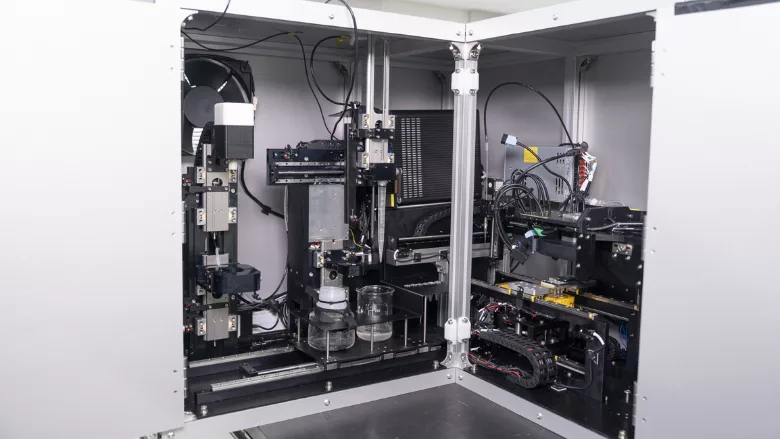
The Korea Institute of Machinery and Materials (KIMM) has developed a fully automated rapid diagnostic platform capable of detecting 16 foodborne pathogens within one hour. The simple device can be operated with the press of a button and is designed for onsite use by non-specialists.
Conventional culture-based pathogen detection methods can take several days, and existing molecular approaches often require specialized skills and equipment. KIMM’s platform automates the full workflow—from pathogen separation through nucleic acid purification, amplification, and results interpretation—reducing diagnostic time by more than half.
The system isolates target organisms from food matrices using hydrodynamic forces generated by a high‑speed rotating propeller. Multi-layer membrane filtration removes debris and supports rapid processing of large-volume samples exceeding 200 milliliters (ml). Purified nucleic acids then undergo high‑speed thermal amplification, completing 40 cycles in approximately 15 minutes.
A low-cost complementary metal-oxide-semiconductor (CMOS)-based multi-fluorescence sensor enables simultaneous detection of multiple targets within a single well, supporting identification of all 16 foodborne pathogens specified by Korea’s Ministry of Food and Drug Safety. The system’s reagent chemistry supports multi-signal fluorescence detection to enhance sensitivity in a compact format.
All diagnostic steps are executed through a one-button, automated process supported by built-in analysis software, eliminating the need for expert training. The system is positioned for deployment in environments such as schools, foodservice operations, food manufacturing facilities, and local government testing centers.
The platform is undergoing demonstration testing at two sites using more than four categories of food products. Trials to date have verified onsite applicability and analytical accuracy, with substantial improvements in processing time relative to existing approaches. The system is advancing toward potential field adoption following completion of validation work.
The diagnostic technology was developed under Korea’s 2023 Customized Public-Demand Living Safety Research and Development Program (Phase 2), funded by the Korean Ministry of the Interior and Safety. The project supports the development of integrated, high-precision, rapid diagnostic systems for detecting foodborne pathogens within the food industry.
The work was led by Chanyong Park, Dongkyu Lee, and Changha Woo.
Looking for quick answers on food safety topics?
Try Ask FSM, our new smart AI search tool.
Ask FSM →