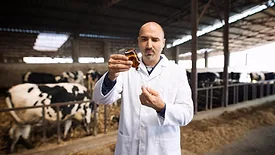
At the 2024 Farm Progress Show, U.S. Department of Agriculture (USDA) Secretary Tom Vilsack revealed that the agency is beginning field trials for a vaccine to address the ongoing outbreak of Highly Pathogenic Avian Influenza (HPAI) H5N1—also known as “bird flu”—in cattle.
SÜDPACK recently introduced its new polyethylene terephthalate (PET) floatable lidding films, offering a sustainable alternative for the safe packaging of sliced meat, ham, and cheese in peelable, thermoformed, and modified atmosphere packagings.
USDA has released an updated guideline to strengthen animal-raising and environment-related label claims on meat and poultry products, such as “raised without antibiotics.” Due to specific concern over negative antibiotic claims, USDA may undertake future sampling and rulemaking to ensure label claims are truthful.
Providing food manufacturers with a standardized methodology for determining whether precautionary allergen labeling is appropriate for their products, the Allergen Bureau has introduced the latest version of its risk assessment tool, Voluntary Incidental Trace Allergen Labeling (VITAL®) 4.0.
The U.S. Department of Agriculture (USDA) has awarded a $300,000 grant to a University of Arkansas research project that aims to develop best practices for controlling pests and pathogens in soilless substrate used in hydroponic lettuce production.
In this episode of Food Safety Matters, we speak to Sarah L. Brew, J.D., distinguished food industry lawyer, about the June 2024 Supreme Court ruling on Loper Bright Enterprises v. Raimondo, which overturned the Chevron U.S.A. Inc. v. Natural Resources Defense Council Inc. decision of 1984, and the new ruling’s regulatory implications for the food industry.
The Food and Agriculture Organization of the United Nations (FAO) recently published a report on the health impact of dietary exposure to toxic fatty acid esters from supplementary foods provided by humanitarian organizations to treat malnutrition.
The European Commission has published a draft regulation that, if adopted, would require EU Member States to conduct whole genome sequencing (WGS) analysis during foodborne illness outbreak investigations involving several important pathogens, and to report the results of WGS analyses.
To celebrate National Food Safety Month in September, the National Restaurant Association and ServSafe are offering special educational content for foodservice and food retail establishments to deeply explore the causes of foodborne illnesses and how to prevent and respond to outbreaks.
The Retail Food Safety Regulatory Association Collaborative’s Food Code Adoption Map is an interactive resource that shows the adoption of the U.S. Food and Drug Administration (FDA) Food Code in each state and U.S. territory.