USDA and University of Arkansas researchers concluded that the plant-derived antimicrobial compound could possibly offer a natural disinfection solution for controlling S. Infantis biofilms on plastic and stainless steel surfaces in poultry and food processing facilities.
This episode of Food Safety Five covers new research on the impact of spray application on sanitizer efficacy, ROI of WGS for foodborne pathogen surveillance, effect of common food additives on gut health and implications for safety assessment, and contribution of industrial poultry farming to global Campylobacter spread.
This article discusses the limits of "dry" sanitizers in low-moisture environments in terms of performance, cost, employee safety, and the hidden risks of moisture in hard-to-clean niches.
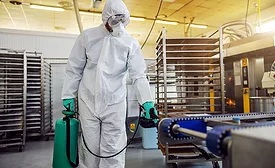
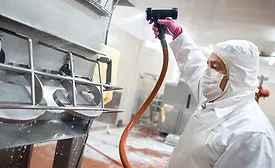
Longer application times, shorter nozzle distances, and spray patterns that deliver sufficient physical force to surfaces may contribute to improved microbial reduction. Sanitizer efficacy experiments could misrepresent real-world sanitation outcomes when shear stress and application time are not considered.
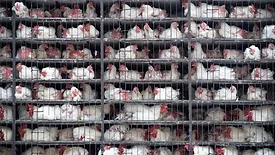
Transport cages are recognized as a potential source of cross-contamination in poultry slaughterhouses. The optimal washing water temperature and detergent concentration completely eliminated detectable Salmonella while greatly reducing indicator organisms. The identified parameters may improve food safety and operational efficiency.
IAFNS-supported researchers have developed a low-moisture cleaning solution that is not only effective and less of a hazard for workers and plants, but also has the potential to save cleaning time.
Studies funded by the Center for Produce Safety (CPS) are investigating ways to improve produce packinghouse brush sanitation, including the use of antimicrobial light and choosing the best time to replace brushes.
A new study demonstrated the efficacy of far-UV-C light at 222 nm for inactivating human norovirus on surfaces. As it is safe for humans, researchers believe UV-C 222 could enable real-time, continuous disinfection in enclosed foodservice settings and food processing environments.
Element Six and Oxi Tech Solutions have partnered to develop an ozone-powered, synthetic diamond-enabled sanitation solution, which the company says enhances the safety, eco-friendliness, and effectiveness of industrial cleaning.
 RSS
RSS