Adopted by the Pan American Health Organization (PAHO), the strategy sets goals to increase the number of countries in the region conducting foodborne illness surveillance, making food safety decisions informed by risk assessments, and participating in regional cooperation and coordination.
A new FAO technical brief explains how plastic pollution moves through agrifood systems and creates interconnected risks to food safety and human, animal, plant, and environmental health.
Based on an analysis of 2.8 million samples collected in 41 countries over 25 years, the global pooled prevalence of foodborne and zoonotic bacteria, viruses, and parasites was 15 percent.
The FSRN Pilots Award is a rapid call for relevant short-term projects with funding needs from £2,000 to £10,000. Cross-sector and cross-disciplinary projects are encouraged.
Acrylamide is a harmful contaminant that forms during thermal processing. An analysis of 17 years of EU RASFF data showed that UPFs accounted for 85 percent of related notifications. Cereals, baked goods, and potato chips were most frequently implicated.
Dr. Gunnar Sigge, Stellenbosch University Associate Professor and Department of Food Science Chair, has assumed the role of President. Dr. Jeffrey Varcoe, Senior Vice President of Science and Technical Excellence at The J.M. Smucker Company, is now IFT President-Elect.
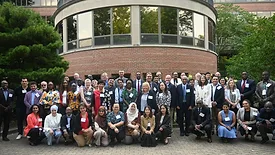
As discussed at the 2024 Global Food Safety Symposium at Michigan State University, resilient food safety systems are not built by one technology, one regulation, or one training program. They come from sustained investment in people, partnerships, scientific excellence, and institutions that can respond to evolving risks.
In an effort to address the “silent pandemic” of antimicrobial resistance (AMR), a recently concluded UK Animal and Plant Health Agency (APHA)–FAO project has helped partners across Africa and Asia to improve their AMR detection, analysis, and mitigation capabilities.
Regulation (EU) 2025/179, which came into effect on August 23, requires EU Member States to conduct WGS on five key pathogens during foodborne illness outbreak investigations. An interview with EFSA’s Dr. Frank Verdonck unpacks the new rule and previews the upcoming Science Meets Policy conference.
Controlling foodborne antimicrobial resistance requires a One Health approach centered on food hygiene. Although antimicrobial stewardship can slow the emergence and enrichment of resistant bacteria, existing environmental reservoirs mean that resistant bacteria can contaminate food regardless of antimicrobial use.
 RSS
RSS