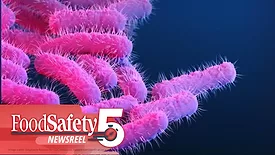
During an October 29 Senate confirmation hearing, Dr. Mindy Brashears, the presidential nominee for USDA Under Secretary for Food Safety, has provided insight into what her priorities will be if she is confirmed for the position—with Salmonella topping her list, followed by Listeria.
An analysis conducted by Cornell University researchers sought to better understand the genomic characteristics associated with an important reoccurring, emerging, and persistent (REP) Salmonella strain, S. Infantis REPJFX01, to help inform targeted interventions.
ECDC has provided an update on a multi-year, multi-national outbreak of Salmonella Strathcona linked to tomatoes from Sicily, Italy, which has grown to 437 confirmed cases in 17 European countries, plus the UK, the U.S., and Canada.
The Cornell College of Agriculture and Life Sciences (CALS) Food Safety Laboratory has developed the Salmonella Serovar Wiki—a web resource for global food safety professionals to rapidly access information about a given Salmonella serovar.
This episode of Food Safety Five discusses a UK proposed ban on Bisphenol A (BPA) in food contact materials, as well as two studies with global relevance: a successful clinical trial for a novel Salmonella vaccine and research demonstrating how nanoplastics enter the edible parts of crops.
A 2024 European foodborne illness outbreak caused by a rare Salmonella serotype, linked to leafy greens grown near a buffalo farm, exposed gaps in biosecurity, surveillance, and data transparency across the agri-food system.
A new study assessed the efficacy of a commercial lytic bacteriophage cocktail as a preharvest agricultural water treatment against Salmonella Infantis, and found modest but consistent pathogen reductions across diverse water conditions.
Information collected during a foodborne illness outbreak investigation can be used to inform and improve future investigations and prevention activities
An aim of FDA's Coordinated Outbreak Response, Evaluation, and Emergency Preparedness Office's (CORE+EP) is to share the findings of foodborne illness outbreak investigations, highlighting relevant topics such as the importance of global partnerships in farm investigations, and the benefits of historical environmental surveillance for future outbreak investigations.
The Trivalent Salmonella Conjugate Vaccine (TSCV), which simultaneously addresses typhoid fever and foodborne illness caused by non-typhoidal Salmonella enterica, elicited strong immune response in 100 percent of participants in the randomized, placebo-controlled clinical trial.
A CDC analysis of multistate foodborne illness outbreak investigation data for 2023 reveals the foods and pathogens that caused the greatest number of outbreaks and illnesses. A single salmonellosis outbreak linked to cantaloupe accounted for 407 illnesses.