Food Safety NEXT Executive Roundtable Examines AI Solutions for Supply Chain Risk Management
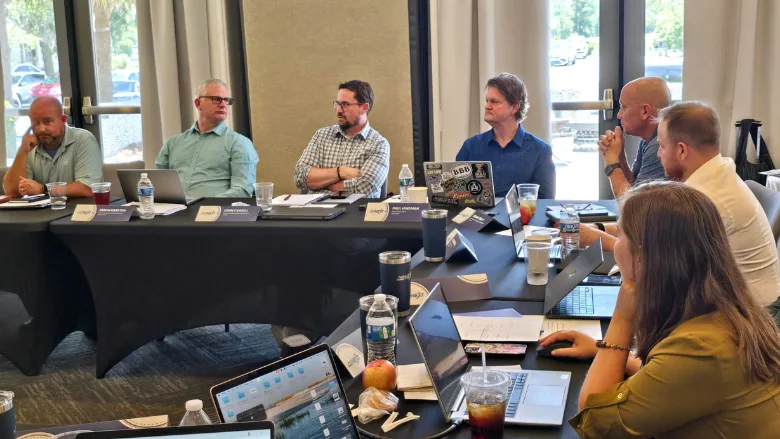
At a Food Safety NEXT (FS NEXT) Industry Roundtable on June 25, senior business leaders came together to share, collaborate, and innovate meaningful improvements for supply chain risk management using enterprise artificial intelligence (AI). The Roundtable, sponsored by Active Food Safety LLC, SignalFlare.ai, Douglas Products, Provision Analytics, and Deloitte, was held at the Sea Palms Resort on St. Simons Island, Georgia. Food Safety Magazine is the exclusive media partner for Food Safety NEXT.
Executives represented leading businesses in the foodservice and culinary operations sectors. During the day's focused discussions, food safety and other business functional leaders candidly shared their successes, challenges, and questions about the use of AI in supply chain risk management.
Out of Silos, Toward Better Collaboration
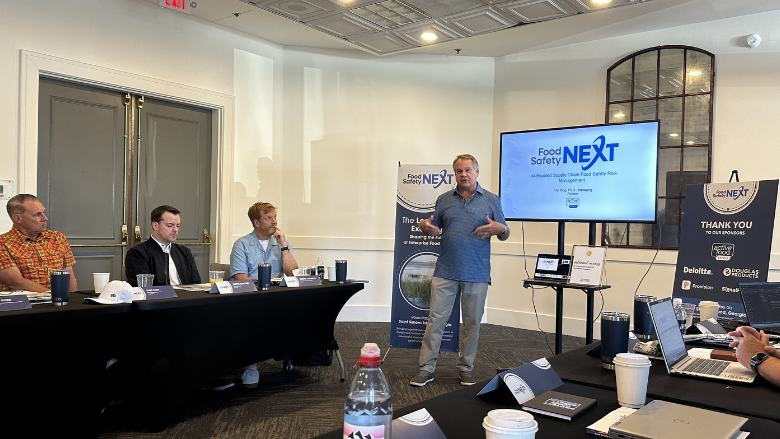
FS NEXT organizer and co-founder Hal King, Ph.D. opened the Roundtable on June 25 (Figure 1) by acknowledging the value of helping foodservice businesses improve food safety by sharing insights from food safety and other business functional leaders in forums like the Roundtable, and also in his 2023 book, Food Safety Leadership in the Business of Food Safety. These efforts and the mission of FS NEXT, Dr. King explained, are prompted by what he sees as a gap in enterprise food safety management and corporate governance at companies experiencing high-profile food safety incidents. Dr. King explained that the use of AI now gives industry the opportunity to enhance the corporate governance of food safety management through its ability to connect the different business functions through specifications, data analytics, and execution of food safety management systems.
Figure 1. Dr. Hal King introduces the goals and agenda for the Food Safety NEXT Roundtable on June 25
FS NEXT and this first Roundtable serve this goal by convening food safety leaders with leaders from other business functions (e.g., supply chain, finance, legal, operations, human resources) to help shape the future of enterprise food safety management. Bringing together the expertise of these leaders in one place encourages the building of competencies in food safety understanding and application across all levels of the organization.
The Future of Food Safety Management with AI
The first session of the Roundtable examined enterprise AI and the signals needed from the data for effective supply chain risk management. While some foodservice businesses are in various stages of AI adoption, others are at a progressive level. Roundtable participant Chick-fil-A leverages AI quantitative risk modeling to describe risks in critical pathways from supplier to service. This allows for enhanced food safety decision-making by leaders. Coincidentally, FIVE GUYS, another Roundtable participant, is developing an AI Center of Excellence and exploring options to further expand the use of AI in their business.
Other foodservice operators representing major national and international corporations are actively seeking enterprise AI solutions. One business mentioned the idea of using AI to help address variations in supplier specifications—a perennial supply chain concern for large foodservice organizations.
Dr. King mentioned that AI agents—i.e., software programs that can act semi-autonomously to make decisions and meet goals—will be very powerful in the future. They may even be given identities, similar to a fingerprint, so that different AI agents' work can be identified and tracked. Work is also being done at the Confidential Computing Summit to design a World Wide Web-like system for AI agents that would revolutionize the deployment, interaction, and problem-solving capabilities of these agents in enterprise management.
Looking for quick answers on food safety topics?
Try Ask FSM, our new smart AI search tool.
Ask FSM →
Dr. King noted that while AI is the "connective tissue," a better understanding of its capabilities, applications, and oversight is necessary to successfully apply AI to supplier risk management. Other Roundtable attendees emphasized that AI must complement, but not replace, operational judgement, and that signals and trust are needed to ensure data integrity.
"How do you get control of [AI] before it gets out of control?" Paul Hineman of Smart Batch and Active Food Safety posited during the group discussion. "We need to create the AI sandbox, but set the rules on how to develop, apply, and use it."
Case Study: Papa John's
Roundtable participant Papa John's explained how the business uses AI to connect, centralize, standardize, and intelligently interpret the data it already has, rather than simply collecting more data. The company, which operates in 50 countries and territories under a franchise model, is looking for more ways to apply AI on the supply side, including standards alignment and market risk analysis across global locations.
Papa John's is also using AI to examine signals to predict top supply chain origin risks. Key early warning signals include elements of supplier performance, operations and logistics, external and environmental risk signals, and customer complaint and inspection trends. AI can analyze patterns and anomalies across fragmented data, giving early-warning signals that identify weak indicators and allow teams more time to act before risks escalate.
A well-defined data management strategy is essential for maintaining the integrity, consistency, and completeness of enterprise data, Papa John's explained. Some options for filling in data gaps include business-to-business (B2B) data and external/public data. At the same time, it is important not to get bogged down in data lakes, as these can quickly turn into data "swamps" if too much data is collected without first establishing a defined strategy for its use. Papa John's emphasized that they are early in their journey on how to better utilize and leverage AI, and they are only scratching the surface of what is possible; however, the company has identified it as a key strategic priority.
"Having a data management strategy is a real imperative," Papa John's said.
Data Architecture, Validation, and Governance
As the discussion moved to data architecture and governance, a Roundtable participant from Cracker Barrel noted that AI modules are often built for a broad range of users rather than specific users or purposes, and that problems have surfaced when working with multiple platforms that are not compatible with one another.
A representative from a decision intelligence company explained that AI provides the opportunity to use software that adapts to the user, rather than the user needing to adapt to the software. However, in order to be successful, the user must first orchestrate (i.e., delegate the work) and then context engineer (i.e., teach the AI about the user's world).
The representative gave the following example: "Imagine you are training a new hire. What terminology would they need to know, and where would they need to source information from to begin to be effective? Also, are there organizational or system-access blockers that would stop them from being effective, and what rules would you want them to follow?" Answering questions like these are the first steps in orchestrating and context engineering an AI.
The representative also shared several examples of where AI can take work off users' plates:
- Document data extraction (e.g., pulling values from a supplier COA or specification PDF, or turning an emailed certificate into a record)
- Information hand-offs (e.g., rolling a supplier specification change to QA, operations, and affected sites)
- Live monitoring/anomaly detection (e.g., tracking cold chain temperatures across locations, or detecting a forged COA that does not match the active specification)
- Reporting (e.g., supplier compliance status) and audits.
AI Solutions for Supplier Risk Management
The final two sessions of the Roundtable examined AI solutions for supplier risk management. First, a representative from a data analytics organization led Roundtable participants through an exercise that looked at AI analysis and interpretation of priority signals for the supply chain, product and safety signals, and external and corrective signals.
Ingredient substitution was given as an example for the supply chain. Suppliers are supposed to request and notify their buyers of ingredient substitutions, although they sometimes fail to do so, which can cause food safety issues like cross-contact with allergens or changes in the safety of a ready-to-eat product. Roundtable participants discussed the need for greater communication between the supplier side and the foodservice side, and how more transparency is needed when ingredient changes arise.
Businesses must identify the areas of their supply chains with the highest food safety risks (e.g., specific suppliers, ingredients, manufacturing sites, transportation steps, or geographic regions) and then benchmark those risks against comparable operations or industry standards. A participant from FIVE GUYS in Europe brought up the issue of recalls and withdrawals, and whether AI can be used to predict issues with suppliers in certain markets based on problems with specific food categories in specific markets.
Next, an advisory services representative guided participants through a mock pilot exercise (Figure 2) demonstrating how an AI-powered risk analysis system can monitor undeclared allergens and specification drift among high-risk suppliers. During the exercise, participants examined priorities for supply chain management, pinpointed areas of high and low risk, examined measures already in place to address supplier risk, and identified where new solutions could be applied using AI agents.
Figure 2. A mock pilot exercise examined undeclared allergens and specification drift among high-risk suppliers
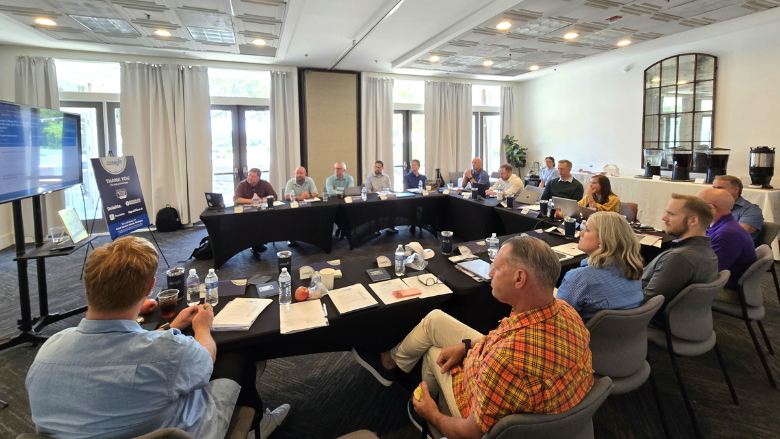
The group prioritized supplier onboarding, active monitoring, and deviation detection and response as the highest-priority areas. Participants then explored how AI capabilities could be applied to strengthen these functions, including identifying risks, monitoring supplier performance, and responding to potential food safety issues.
Coming Up: The Food Safety NEXT Exchange
Food Safety NEXT plans to host its first Exchange event in September 2027. The Exchange will focus on employee training and recipe/food safety execution in restaurants, as well as key technologies in training to align with food safety management systems. Food safety leaders from several leading foodservice brands will be invited to attend the Exchange, along with their training/education leaders.
FS NEXT is extending the invitation to the wider foodservice industry to attend the September 2027 Exchange to share insights, challenge assumptions, and forge relationships to drive improvements in the corporate governance of food safety management. Foodservice business leaders interested in attending may request an invitation here.