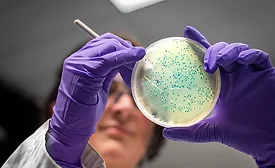
The company will pay the U.S. and states for “knowingly manufacturing infant formula purchased with taxpayer dollars [under state Medicaid and WIC programs] in an environment that put the products at unacceptable risk of microbial contamination.”
USDA and University of Arkansas researchers concluded that the plant-derived antimicrobial compound could possibly offer a natural disinfection solution for controlling S. Infantis biofilms on plastic and stainless steel surfaces in poultry and food processing facilities.
This episode of Food Safety Five covers new research on the impact of spray application on sanitizer efficacy, ROI of WGS for foodborne pathogen surveillance, effect of common food additives on gut health and implications for safety assessment, and contribution of industrial poultry farming to global Campylobacter spread.
The resource outlines the German Federal Institute for Risk Assessment’s (BfR’s) approach to risk assessment of NIAS in FCMs. It is primarily intended to support dossiers for new substances in Germany.
CDC has declared the unprecedented Cyclospora outbreak linked to Taylor Farms iceberg lettuce over. FDA continues its root cause investigation of the current outbreak as well as investigations into other U.S. cyclosporiasis outbreak clusters.
In eight sampling and testing assignments spanning several years and various targeted food commodities, the majority of samples tested were deemed to be satisfactory when analyzed for chemical contaminants, hygiene indicators, and pathogenic bacteria, viruses, and parasites.
University of California, Riverside researchers have identified key chemical reactions that occur when UV light is used to break down PFAS “forever chemicals” in water, which could inform the development and optimization of PFAS treatment technologies, or even more degradable fluorinated compounds.
EFSA’s Panel on Food Additives and Flavorings (FAF) found no safety concerns associated with the currently reported uses and use levels of acesulfame K (E 950), aspartame (E 951), and salt of aspartame-acesulfame (E 962).
The German Federal Institute for Risk Assessment (BfR) said the EU health-based guidance value for acute glycerol exposure from beverages can also be applied to solid foods, adding to recent discussions around glycerol intoxication in young children and safe levels of exposure.
Based on an analysis of 2.8 million samples collected in 41 countries over 25 years, the global pooled prevalence of foodborne and zoonotic bacteria, viruses, and parasites was 15 percent.
 RSS
RSS