Food Safety
search
Ask Food Safety AI
cart
facebook twitter linkedin instagram youtube
  • Sign In
  • Create Account
  • Sign Out
  • My Account
Food Safety
  • NEWS
    • Latest News
    • White Papers
  • PRODUCTS
  • TOPICS
    • Contamination Control
    • Food Types
    • Management
    • Process Control
    • Regulatory
    • Sanitation
    • Supply Chain
    • Testing and Analysis
  • PODCAST
  • EXCLUSIVES
    • Food Safety Five Newsreel
    • eBooks
    • FSM Distinguished Service Award
    • Interactive Product Spotlights
    • Videos
  • BUYER'S GUIDE
  • MORE
    • NEWSLETTERS >
      • Archive Issues
      • Subscribe to eNews
    • Store
    • Sponsor Insights
    • ASK FSM AI
  • WEBINARS
  • FOOD SAFETY SUMMIT
  • EMAG
    • eMagazine
    • Archive Issues
    • Editorial Advisory Board
    • Contact
    • Advertise
  • SIGN UP!
Process ControlSanitationWhite PapersIntervention ControlsFacilitiesSSOPs

Sponsored Content

Expert Advice on Cleaning Power Transmission Belts from Megadyne

megadyne belt with donuts

Image Credit: Megadyne

August 28, 2024

Proper cleaning of power transmission belts is essential in the food industry for both safety and operational efficiency. Megadyne, a leading provider of power transmission solutions, provides key insights into effective cleaning practices to maintain belt performance and hygiene.

Sasha Kolouch, Megadyne Global ISM Food & Beverage, highlights the importance of understanding the difference between ‘cleaning references’—which detail how cleaning agents interact with belts—and ‘cleaning instructions’ from detergent suppliers, which explain how to apply their products. This distinction helps ensure the use of appropriate methods and agents for optimal performance and safety.

timing belt

Image Credit: Megadyne

Kolouch explains that cleaning requirements vary between belts used in wet and dry processing environments. Megadyne addresses these needs with easy-to-clean, food-grade belts resistant to common agents, disinfectants, and sanitizers, preserving belt integrity and hygiene while minimizing contamination risks.

Key Considerations for Customers 

Using incorrect cleaning methods can lead to chemical and physical damage, contamination, moisture issues, and misalignment. These problems can result in belt degradation, slippage, corrosion, and reduced lifespan. Misalignment and improper tension from poor cleaning can also cause accelerated wear and unexpected failures, posing safety and operational risks.

6 Expert Tips for Effective Belt Cleaning

  1. Safety First: Disconnect equipment and use personal protective equipment (PPE).
  2. Belt Material: Choose non-toxic, non-absorbent, food-grade belts resistant to chemicals and microbial growth.
  3. Cleaning Agents: Use solvents compatible with the belt material to prevent damage.
  4. Inspection: Check for wear, cracks, and fraying, and ensure proper belt alignment and tension during cleaning.
  5. Frequency: Adhere to the manufacturer’s maintenance schedule to extend belt life and prevent issues.
  6. Environment: Dispose of cleaning agents and waste following local regulations.

Ensuring Food Safety 

“The food industry demands the highest standards of hygiene,” says Kolouch. “Megadyne XMD (X-ray and metal-detectable) belts meet these stringent safety standards by working with detection systems to filter out foreign debris, thus reducing contamination risks.”
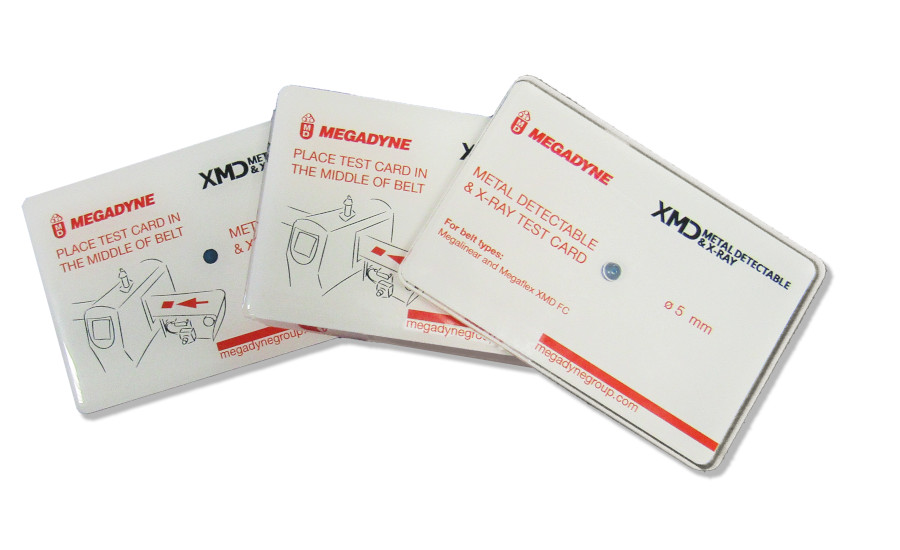
testcards

Image Credit: Megadyne

Megadyne XMD detectable belts come with test cards to confirm detection capabilities and identify the minimum detectable size of belt fragments. 

For further details, contact our team of experts.

Looking for quick answers on food safety topics?
Try Ask FSM, our new smart AI search tool.
Ask FSM →


KEYWORDS: belts and conveyors CIP/COP sanitation

Share This Story

Recommended Content

JOIN TODAY
to unlock your recommendations.

Already have an account? Sign In

  • people holding baby chicks

    Serovar Differences Matter: Utility of Deep Serotyping in Broiler Production and Processing

    This article discusses the significance of Salmonella in...
    Food Type
    By: Nikki Shariat Ph.D.
  • woman washing hands

    Building a Culture of Hygiene in the Food Processing Plant

    Everyone entering a food processing facility needs to...
    Personal Hygiene/Handwashing
    By: Richard F. Stier, M.S.
  • graphical representation of earth over dirt

    Climate Change and Emerging Risks to Food Safety: Building Climate Resilience

    This article examines the multifaceted threats to food...
    Best Practices
    By: Maria Cristina Tirado Ph.D., D.V.M. and Shamini Albert Raj M.A.
Manage My Account
  • eMagazine Subscription
  • Subscribe to Newsletters
  • Manage My Preferences
  • Website Registration
  • Subscription Customer Service

More Videos

Sponsored Content

Sponsored Content is a special paid section where industry companies provide high quality, objective, non-commercial content around topics of interest to the Food Safety Magazine audience. All Sponsored Content is supplied by the advertising company and any opinions expressed in this article are those of the author and not necessarily reflect the views of Food Safety Magazine or its parent company, BNP Media. Interested in participating in our Sponsored Content section? Contact your local rep!

close
  • NEVIFIT 3 Compartment BPA-FREE
    Sponsored byCorbion

    The Risks of Ready-to-Eat: Five Ways to Protect Today's Prepared Meals

  • a group of workers in a food production facility
    Sponsored bySkillUp by Registrar Corp

    How to Build a Better Training Program: Data and Insights from the Global Food Safety Training Survey

  • the use of dual-energy X-ray food inspection technology to identify foreign contaminants.
    Sponsored byEagle by METTLER TOLEDO

    Precision Inspection Starts with the Right X-ray Detector

Popular Stories

green powder/moringa in wooden mortar

FDA Opens Third Salmonella–Moringa Outbreak Investigation of the Year

FoodSafetyMattersFinal-900x550-(002).jpg

Ep. 218. Dr. Brady Carter: Water Activity, Shelf-Life Validation, and Food Safety Controls

fermented meat

Study is First to Analyze Trends in Foodborne Illness Outbreaks Linked to Non-Dairy Fermented Products

a practical guide to spoilage investigation webinar

Events

June 4, 2026

Building a Stronger Food Safety Program in a Changing GFSI Landscape

Live: June 4, 2026 at 11:00 am EDT: Attend this webinar to understand how GFSI requirements are evolving and what those changes signal for quality programs at food and beverage facilities.

June 10, 2026

A Practical Guide to Spoilage Investigation and Prevention

Live: June 10, 2026 at 11:00 am EDT: Join this webinar to learn how to identify spoilage root causes, reduce risk, and apply data-driven strategies for prevention.

June 16, 2026

Sustainable Food Contact Materials: Where Regulation Meets Analytical Testing

Live: June 16, 2026 at 11:00 am EDT: This webinar explores how sustainability regulations are changing food contact material requirements, including packaging compliance, unintended substances, and per- and polyfluoroalkyl substances.

View All

Products

Global Food Safety Microbial Interventions and Molecular Advancements

Global Food Safety Microbial Interventions and Molecular Advancements

See More Products

Related Articles

  • Christmas cake

    Safe, Sweet, and Ready for the Holidays with Megadyne's Power Transmission Belts

    See More
  • woman working on an ipad

    The Vital Role of Power Transmission Belts in Ensuring Food Safety

    See More
  • washdown

    Expert advice on sanitary plant design

    See More

Related Products

See More Products
  • food-safety-making.jpg

    Food Safety: Making Foods Safe and Free From Pathogens

  • 9781498721776.jpg

    Handbook of Food Processing: Food Safety, Quality, and Manufacturing Processes

  • 1119258073.jpg

    FSMA and Food Safety Systems: Understanding and Implementing the Rules

See More Products

Related Directories

  • Megadyne

    Megadyne Group specializes in the development and manufacture of power transmission belts, matched components, and complete belt systems tailored to diverse industrial applications. As a trusted partner to original equipment manufacturers (OEMs) and aftermarket distributors, Megadyne operates manufacturing facilities across Europe, North America, and Asia. Our comprehensive product range includes thermoset and thermoplastic polyurethane belts, rubber timing and V-belts, flat belts, multi-rib belts, engineered specialty belts, pulleys, clamping plates, timing bars, and customized solutions designed to meet specific customer requirements. Megadyne delivers innovative, end-to-end solutions across a broad spectrum of industries, including material handling, elevators, machine tools, food processing, packaging, fitness equipment, wood, marble, and ceramics, to name just a few sectors where our products are trusted.
×

Never miss the latest news and trends driving the food safety industry

Newsletters | Website | eMagazine

JOIN TODAY!
  • RESOURCES
    • Advertise
    • Contact Us
    • Directories
    • Store
    • Want More
  • SIGN UP TODAY
    • Create Account
    • eMagazine
    • Newsletters
    • Customer Service
    • Manage Preferences
  • SERVICES
    • Marketing Services
    • Reprints
    • Market Research
    • List Rental
    • Survey/Respondent Access
  • STAY CONNECTED
    • LinkedIn
    • Facebook
    • Instagram
    • X (Twitter)
  • PRIVACY
    • PRIVACY POLICY
    • TERMS & CONDITIONS
    • DO NOT SELL MY PERSONAL INFORMATION
    • PRIVACY REQUEST
    • ACCESSIBILITY

Copyright ©2026. All Rights Reserved BNP Media, Inc. and BNP Media II, LLC.

Design, CMS, Hosting & Web Development :: ePublishing