Food Safety
search
Ask Food Safety AI
cart
facebook twitter linkedin
  • Sign In
  • Create Account
  • Sign Out
  • My Account
Food Safety
  • NEWS
    • Latest News
    • White Papers
  • PRODUCTS
  • TOPICS
    • Contamination Control
    • Food Types
    • Management
    • Process Control
    • Regulatory
    • Sanitation
    • Supply Chain
    • Testing and Analysis
  • PODCAST
  • EXCLUSIVES
    • Food Safety Five Newsreel
    • eBooks
    • FSM Distinguished Service Award
    • Interactive Product Spotlights
    • Videos
  • BUYER'S GUIDE
  • MORE
    • ENEWSLETTER >
      • Archive Issues
      • Subscribe to eNews
    • Store
    • Sponsor Insights
    • ASK FSM AI
  • WEBINARS
  • FOOD SAFETY SUMMIT
  • EMAG
    • eMagazine
    • Archive Issues
    • Editorial Advisory Board
    • Contact
    • Advertise
  • SIGN UP!
NewsContamination ControlRegulatoryMicrobiologicalUSDA

Study Supports USDA’s Serotype-Specific Regulatory Framework for Salmonella in Poultry
By Bailee Henderson
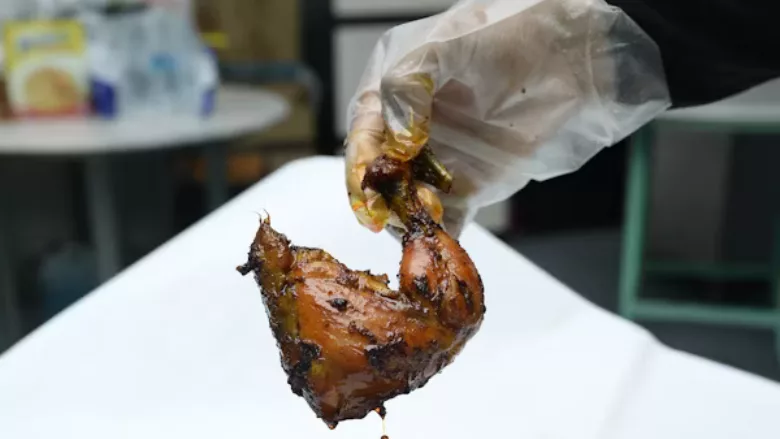
hand wearing foodservice glove holding charred chicken thigh

Image credit: Hazim Abd Halim via Unsplash

August 5, 2024

A recent study has demonstrated that targeting high-virulence Salmonella serotypes in risk management strategies and food safety regulation for poultry products could improve public health outcomes. These findings support the U.S. Department of Agriculture’s (USDA’s) recently published regulatory framework for Salmonella in raw poultry, which, if adopted as-is, will set an enforceable final product standard for five Salmonella serotypes of public health significance (S. Enteritidis, S. Typhimurium, S. I 4,[5],12:i:-, S. Hadar, and S. Muenchen).

The study was conducted in response to the same trend to which the new USDA regulatory framework responds—the fact that, in the U.S., Salmonella prevalence has declined since adopting prevalence-based Salmonella performance standards, but human illnesses have not decreased proportionally.

Historically, outbreak data support that some serotypes are more commonly associated with human illnesses. According to U.S. Centers for Disease Control and Prevention (CDC) FoodNet surveillance data, the three most common serotypes linked to human illness are S. Enteritidis (16 percent of cases), S. Typhimurium (14 percent), and S. Newport (10 percent). Moreover, genomic analyses show some serotypes share common determinants of high virulence (S. Enteritidis, S. Infantis, and S. Typhimurium). On the other hand, some Salmonella serotypes—especially S. Kentucky ST152—are frequently recovered from poultry carcasses, but are less likely to cause human illness than other serotypes.

Scientific literature has also demonstrated that foodborne Salmonella outbreaks are often associated with higher doses of the pathogen, and that mitigating high levels of contamination on poultry products may substantially reduce public health risk.

To investigate the risk of foodborne illnesses resulting from Salmonella contamination of poultry parts with different levels of all serotypes, as well as specific high-virulence and low-virulence serotypes, the researchers employed Quantitative Microbial Risk Assessment (QMRA) and modeled two different datasets for comparison. The first data source is 2012 Baseline parts survey, and the second is 2023 Hazards Analysis and Critical Control Points (HACCP) verification data collected by USDA’s Food Safety and Inspection Service (FSIS).

The researchers defined high levels of Salmonella contamination as products containing more than 1 colony forming unit per gram (CFU/g)—the same threshold for which poultry products would be considered “adulterated” by certain Salmonella serotypes under the new USDA regulatory framework.

Overall, the study concluded that high levels of contamination by high-virulence serotypes is relatively rare in finished chicken parts. At the same time, the risk assessment showed that the majority of public health risk from chicken parts is concentrated in those rare products with high levels of high-virulence serotypes. The study also found that limited public health benefits would be gained from the control of low-virulence serotypes (i.e., S. Kentucky ST152).

Looking for quick answers on food safety topics?
Try Ask FSM, our new smart AI search tool.
Ask FSM →

The findings support USDA’s serotype-specific regulatory framework for Salmonella in raw poultry parts, in contrast to regulatory policies centered solely on Salmonella prevalence. Not only would the public health benefits be limited should regulatory policy focus on prevalence alone, but it could also have negative consequences, such as facilitating increased prevalence and emergence of possibly high-virulence Salmonella serotypes as reductions of low-virulence serotypes are achieved.

The study was conducted by members of the industry-nonprofit-academia Coalition for Poultry Safety Reform, and was supported by a U.S. Poultry and Egg Association grant.


 

KEYWORDS: Salmonella study

Share This Story

Baileehendersonmay23

Bailee Henderson is the Digital Editor of Food Safety Magazine. She can be reached at hendersonb@bnpmedia.com.

Recommended Content

JOIN TODAY
to unlock your recommendations.

Already have an account? Sign In

  • people holding baby chicks

    Serovar Differences Matter: Utility of Deep Serotyping in Broiler Production and Processing

    This article discusses the significance of Salmonella in...
    Methods
    By: Nikki Shariat Ph.D.
  • woman washing hands

    Building a Culture of Hygiene in the Food Processing Plant

    Everyone entering a food processing facility needs to...
    Training
    By: Richard F. Stier, M.S.
  • graphical representation of earth over dirt

    Climate Change and Emerging Risks to Food Safety: Building Climate Resilience

    This article examines the multifaceted threats to food...
    Management
    By: Maria Cristina Tirado Ph.D., D.V.M. and Shamini Albert Raj M.A.
Manage My Account
  • eMagazine Subscription
  • Subscribe to eNewsletter
  • Manage My Preferences
  • Website Registration
  • Subscription Customer Service

More Videos

Sponsored Content

Sponsored Content is a special paid section where industry companies provide high quality, objective, non-commercial content around topics of interest to the Food Safety Magazine audience. All Sponsored Content is supplied by the advertising company and any opinions expressed in this article are those of the author and not necessarily reflect the views of Food Safety Magazine or its parent company, BNP Media. Interested in participating in our Sponsored Content section? Contact your local rep!

close
  • Salmonella bacteria
    Sponsored byThermoFisher

    Food Microbiology Testing Methods: Salmonella species

  • a diagram explaining indicator organisms
    Sponsored byHygiena

    How Proactive Listeria Testing Helps Prevent Six- and Seven-Figure Recalls

  • woman grocery shopping
    Sponsored byCorbion

    Designing Safety Into Every Bite: Proactive Risk Mitigation for Refrigerated Foods

Popular Stories

NRTE breaded stuffed chicken

USDA Indefinitely Delays Enforcement of Salmonella as Adulterant in Raw Breaded, Stuffed Chicken

digital map of europe

EU Publishes Food Fraud Tool Mapping Thousands of Cases Since 2016

non-conforming product

How to Handle Non-Conforming Product

Events

December 11, 2025

How to Develop and Implement an Effective Food Defense Strategy

Live: December 11, 2025 at 2:00 pm EDT: From this webinar, attendees will learn common areas where companies encounter challenges in their food defense strategies and how to address them.

May 11, 2026

The Food Safety Summit

Stay informed on the latest food safety trends, innovations, emerging challenges, and expert analysis. Leave the Summit with actionable insights ready to drive measurable improvements in your organization. Do not miss this opportunity to learn from experts about contamination control, food safety culture, regulations, sanitation, supply chain traceability, and so much more.

View All

Products

Global Food Safety Microbial Interventions and Molecular Advancements

Global Food Safety Microbial Interventions and Molecular Advancements

See More Products

Related Articles

  • raw chicken halves

    Consumer Reports Calls USDA’s Proposed Regulatory Framework for Salmonella in Poultry ‘Too Lax’

    See More
  • raw whole chicken

    USDA Withdraws Proposed Regulatory Framework for Salmonella in Poultry After Years of Development

    See More
  • chicken in pen

    USDA-FSIS Proposed Regulatory Framework for Reducing Salmonella in Poultry May Declare Salmonella an Adulterant

    See More

Related Products

See More Products
  • 9781138070912.jpg

    Trends in Food Safety and Protection

  • 1119160553.jpg

    Food Safety: Innovative Analytical Tools for Safety Assessment

  • 1118396308.jpg

    High Throughput Analysis for Food Safety

See More Products

Events

View AllSubmit An Event
  • August 12, 2025

    Systematic Approach to Hazard Analysis: Considering Product- and Process-Specific Risks

    On Demand: From this webinar, attendees will learn where and why hazard analysis can fail, especially for high-risk products like leafy greens and meat/poultry.
View AllSubmit An Event

Related Directories

  • Fayette Industrial

    At Fayette, we understand that cleanliness in your meat, poultry, pork, or ready-to-eat facility isn't just about passing inspections—it's about protecting your entire business. Our specialized contract sanitation services are tailored to your specific processing environment with rigorous pathogen prevention protocols and audit preparation that exceed regulatory standards.
  • EAS Consulting Group, a Certified Group Co.

    EAS Consulting Group is a global leader in regulatory solutions for industries regulated by FDA, USDA, and other federal and state agencies. Our network of 200+ independent consultants enables EAS to provide comprehensive consulting, training, and auditing services, ensuring proactive regulatory compliance for food, supplements, pharmaceuticals, medical devices, cosmetics, tobacco, hemp, and CBD.
×

Never miss the latest news and trends driving the food safety industry

eNewsletter | Website | eMagazine

JOIN TODAY!
  • RESOURCES
    • Advertise
    • Contact Us
    • Directories
    • Store
    • Want More
  • SIGN UP TODAY
    • Create Account
    • eMagazine
    • eNewsletter
    • Customer Service
    • Manage Preferences
  • SERVICES
    • Marketing Services
    • Reprints
    • Market Research
    • List Rental
    • Survey/Respondent Access
  • STAY CONNECTED
    • LinkedIn
    • Facebook
    • Instagram
    • X (Twitter)
  • PRIVACY
    • PRIVACY POLICY
    • TERMS & CONDITIONS
    • DO NOT SELL MY PERSONAL INFORMATION
    • PRIVACY REQUEST
    • ACCESSIBILITY

Copyright ©2025. All Rights Reserved BNP Media.

Design, CMS, Hosting & Web Development :: ePublishing