OP-ED
Corrective Actions as Preventive Intelligence: Embedding Root Cause Analysis Into Everyday Food Safety Management
Need to Know
- Foodborne illness outbreaks often result from multiple, persistent weaknesses in food safety systems, rather than a single isolated failure
- Root cause analysis should extend beyond microbial detection and monitoring data to examine factors such as training, maintenance, equipment design, sanitation, and management oversight
- Integrating root cause analysis into routine corrective actions can help identify why preventive controls failed and address underlying vulnerabilities before problems repeat or escalate
- Corrective action records can provide preventive intelligence by revealing recurring trends in sanitation, equipment performance, training, documentation, and other areas
- Embedding root cause analysis into everyday food safety management can shift corrective actions from restoring compliance toward continuous improvement and prevention
Foodborne illness outbreaks are rarely due to a single, isolated mistake. Instead, they typically result from multiple overlooked weaknesses that accumulate over time to create the "perfect storm." Individually, these factors, such as equipment that is difficult to clean, incomplete records, inadequate employee training, or recurring maintenance deficiencies, may appear minor and unlikely to cause harm. However, when multiple weaknesses occur simultaneously or persist over time, they can erode food safety controls, ultimately creating conditions that allow contamination and illness to occur.
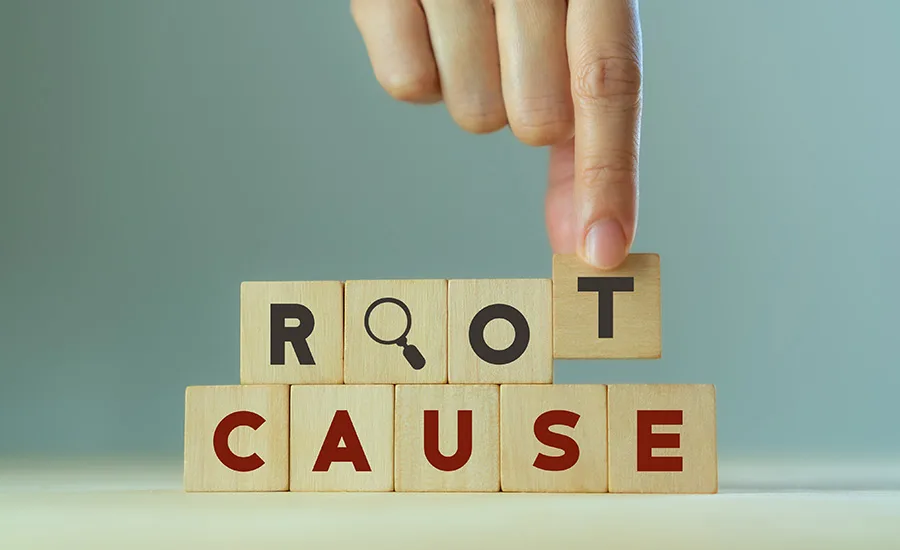
Root cause analysis (RCA) is a systematic approach used across nearly every major industry to identify the underlying factors that allow failures to occur.1 In the food industry, RCA is often applied reactively after a major recall, outbreak, or regulatory action. By the time investigators reconstruct the sequence of events, they often discover warning signs that had been present for weeks, months, or even years. In hindsight, the pattern becomes clear: "We should have seen this coming."
Looking Beyond Detection to Root Causes
One reason that warning signs may be overlooked is an overreliance on microbial data alone. In the food industry, whole genome sequencing (WGS) is a powerful tool used to identify and compare microbial isolates.2,3 However, WGS, like any other microbial detection tool, does not prevent recurrence on its own because it identifies what happened, not why it happened. For example, WGS may show that environmental isolates of Listeria monocytogenes collected over time within a processing facility are genetically related, indicating that a persistent strain has become established. While this finding confirms persistence, it does not explain how and why the organism survived, established a niche, and continued posing a risk.
Another reason that warning signs might be missed is that operators often place greater emphasis on collecting data than on analyzing it. Audits, environmental monitoring results, ATP testing, and maintenance records generate valuable information during routine monitoring activities, but data collection alone does not improve food safety. Its value lies in identifying trends, evaluating system performance, recognizing emerging vulnerabilities, and understanding why preventive controls might be weakening before a failure occurs.
RCA is more than microbial and monitoring data; it must also evaluate other potential contributing factors, such as employee training, preventive maintenance, equipment design, sanitation practices, and management oversight. Without a broader, systems-based investigation, operations may continue detecting the same contamination problem without identifying factors that allowed it to persist.
Making Root Cause Analysis Routine
We assert that RCA is most effective when it is part of your everyday food safety management system rather than reserved for outbreaks, recalls, or regulatory investigations. In high-risk industries, RCA already extends well beyond an immediate failure; it is embedded in the system. For example, the aviation industry does not focus solely on the mechanical failure that contributed to an accident; rather, it continuously evaluates maintenance systems, training programs, communication processes, equipment performance, and organizational practices to identify conditions that could lead to future failures. Similarly, healthcare organizations investigating patient safety events examine workflow, communication, staffing, policies, and organizational culture to understand why errors occurred and how to prevent them from happening again.
Integrating RCA into your corrective action plan has the potential to transform everyday problems into opportunities for learning and continuous improvement. Rather than simply restoring compliance, routine application of RCA principles can help you improve understanding of your system's performance and identify emerging risks before they result in outbreaks or recalls. Consistently examining the how and why behind a failure builds a more resilient food safety management system and has the potential to reduce the likelihood of recurrence.
Looking for quick answers on food safety topics?
Try Ask FSM, our new smart AI search tool.
Ask FSM →
Turning Corrective Actions Into Preventive Intelligence
To operationalize this approach, we suggest viewing every corrective action as an opportunity for an RCA. Each deviation should be investigated to understand how the system is performing and identify weaknesses that may not be apparent through routine monitoring alone. When a preventive control does not perform as expected, your corrective action plan should demand answers to three fundamental questions:
- What happened?
- Why did it happen?
- What changes are needed to prevent recurrence?
The first question defines the problem, the second identifies the contributing factors, and the third drives meaningful improvement. Without understanding the underlying causes, corrective actions may restore compliance temporarily but fail to address how and why the failure occurred.
Embedding RCA into your corrective action plan shifts food safety management from reaction to prevention. Trends identified through corrective action records provide valuable insight into emerging risks and allow management to address vulnerabilities before they escalate into contamination events. Corrective actions are not simply records of problems resolved; they are a source of preventive intelligence that complements monitoring data. The goal is not only to detect failures but also to learn from them and continuously strengthen the controls designed to prevent recurrence.
For example, imagine that during routine monitoring, you discover that a refrigerator is operating at 48 °F (9 °C). The immediate corrective action may include evaluating product safety, restoring proper temperature, and determining whether affected products must be discarded. However, an enhanced corrective action plan (i.e., one that integrates RCA principles) should also ask:
- Was the temperature monitoring device inaccurate?
- Did employees fail to respond appropriately to an alarm?
- Were preventive maintenance procedures inadequate?
- Were standard operating procedures unclear or inconsistently followed?
The answers to these questions move beyond correcting the immediate problem to understanding how the system can be improved to prevent recurrence. Equally important, the answers to these questions must be documented in your corrective action records. Capturing this information allows you to identify recurring patterns so you can implement an intervention before it results in a significant failure. For example, repeated sanitation deviations in a specific processing area may reflect inadequate employee training, unclear standard operating procedures, equipment design limitations, or insufficient verification activities. These underlying factors would not necessarily be identified through monitoring activities, making it essential to ask why and record the answers.
Similarly, recurring equipment failures may reveal deficiencies in preventive maintenance programs, while repeated documentation errors may point to weaknesses in training, communication, or accountability. Over time, these records become a valuable source of information that supports continuous improvement and more effective prevention. When effectively managed, corrective actions can serve as an early warning system.
Moving From Correction to Prevention
This approach aligns with the intent of the Food Safety Modernization Act, which emphasizes anticipating and controlling hazards rather than relying solely on corrective responses after contamination occurs. You are already required to monitor preventive controls, address deviations, implement corrective actions, and verify their effectiveness.4,5 The goal is not simply to respond more effectively to failures but also to develop a system that prevents them through ongoing investigation, learning, and improvement. A strong food safety culture recognizes deviations as opportunities to strengthen processes, reflecting the continuous improvement principles embedded in food safety management systems such as ISO 22000 and Hazards Analysis and Critical Control Points (HACCP).6,7,8
Ultimately, the goal of RCA is to prevent future outbreaks by understanding the underlying conditions that allowed contamination to occur. Integrating RCA into your corrective action plan provides you with an ongoing, systematic approach for determining why preventive controls failed so you can identify opportunities for continuous improvement. An enhanced corrective action plan provides the necessary preventive intelligence that strengthens your food safety management system and helps prevent contamination before it results in foodborne illness.
References
- Andersen, B. and T. Fagerhaug. Root Cause Analysis: Simplified Tools and Techniques. 2nd Ed. ASQ Quality Press, 2006.
- Allard, M.W., E. Strain, D. Melka, et al. (2016). "Practical Value of Food Pathogen Traceability through Building a Whole-Genome Sequencing Network and Database." Journal of Clinical Microbiology 54, no. 8 July 2016): 1975–1983. https://doi.org/10.1128/jcm.00081-16.
- Jackson, B.R., C. Tarr, E. Strain, et al. (2016). "Implementation of Nationwide Real-Time Whole-Genome Sequencing to Enhance Listeriosis Outbreak Detection and Investigation." Clinical Infectious Diseases 63, no. 3 (August 2016): 380–386. https://doi.org/10.1093/cid/ciw242.
- U.S. Food and Drug Administration (FDA). Current Good Manufacturing Practice, Hazard Analysis, and Risk-Based Preventive Controls for Human Food. 21 CFR Part 117. September 17, 2015. https://www.ecfr.gov/current/title-21/chapter-I/subchapter-B/part-117.
- FDA. FSMA Final Rule for Preventive Controls for Human Food. 2016. https://www.fda.gov/food/food-safety-modernization-act-fsma/fsma-final-rule-preventive-controls-human-food.
- Yiannas, F. Food Safety Culture: Creating a Behavior-Based Food Safety Management System. Springer, 2009.
- International Organization for Standardization (ISO). "ISO 22000:2018 Food safety management systems—Requirements for any organization in the food chain." 2nd Ed. 2018.
- Codex Alimentarius Commission. General Principles of Food Hygiene (CXC 1-1969). Food and Agriculture Organization of the United Nations (FAO) and World Health Organization (WHO). 2022. https://openknowledge.fao.org/server/api/core/bitstreams/6866dc55-d2c0-48dd-a528-a4d634f1b0b4/content.