Building Leadership Buy-In for Food Safety
Need to Know
- Food safety gains leadership attention when risks are translated into business terms, including operational disruption, recall costs, regulatory exposure, and customer trust
- Agreement does not guarantee action; clear decisions, assigned ownership, timelines, and follow-through are necessary to turn leadership commitment into practice
- Training alone does not build capability; food safety knowledge must be reinforced through systems, practice, communication, and leadership behavior
- Embedding food safety into leadership KPIs, performance reviews, and investment decisions helps establish accountability across the organization
Food safety is not defined by what businesses say; it is defined by the decisions and actions taken, particularly in high-pressure situations. Leadership buy-in is often framed in terms of training programs, budgets, or compliance. In practice, it runs deeper than that.
Too often, food safety is still positioned as a compliance requirement—something that sits alongside the business, rather than shaping how it operates. This is a narrow and limited view. Food safety sits at the center of risk management, with implications for operational performance, customer trust, and, most importantly, consumer health.
The consequences of a food safety failure are substantial: production shutdowns, product recalls, reputational damage, and loss of regulator and consumer confidence. When food safety fails, it becomes a business failure. Our previous article, "The Business Case for Building Food Safety Skills," highlights this shift, positioning food safety as a driver of performance, trust, and growth. Yet, the shift required to embed food safety into everyday decision-making remains a persistent challenge across all sectors of the food industry.
To change this, conversations with senior leaders need to align with business priorities—both now and in the future. Food safety needs to be understood in terms of risk, performance, and accountability. Without that shift, it remains something that is managed alongside the business. With it, it becomes part of how the business is run.
This article draws on insights from Dr. Ben Chapman (Professor, North Carolina State University), Adam Wilkinson (HR/WHS Compliance Manager, Fleurieu Milk Company), Jovana Komlenic (Head of Food Safety Culture, FRoSTA), Kerstin Janson (Head of Quality, FRoSTA), Friederike Ahlers (Public Relations, FRoSTA), and Alodia Bourke (Head of Operations, Diageo Australia), whose collective experience bridges strategy, leadership behavior, and culture change. While each business operates in a different context, the approaches are complementary.
While the examples in this article come from different sectors of the food industry, the underlying challenges are not sector specific. Whether in manufacturing, foodservice, retail, or small-scale production, the same tension exists—balancing production demands, cost, and food safety risk. The principles explored here relate to how decisions are made, not just how systems are designed.
This article focuses specifically on decision-making at a senior leadership level. While frontline practices and workforce capability are critical, they are shaped by the conditions leaders create—through priorities, resource allocation, and the decisions made. The intention here is not to revisit what happens on the floor, but to examine how leadership decisions determine whether food safety expectations can be consistently applied in practice.
From Knowledge to Decision-Making
At Adelaide University, where the authors teach postgraduate coursework in this area, there is a strong emphasis on preparing future food safety and quality assurance professionals to make the appropriate connections between theory and practice. Students are challenged to present ideas in ways that resonate with senior leadership, connecting products, food law, standards, and systems to business impact and operational decisions. There is also a broader question for the food industry: Are we doing enough to prepare food safety and quality professionals for this reality?
Looking for quick answers on food safety topics?
Try Ask FSM, our new smart AI search tool.
Ask FSM →
Technical knowledge remains a core requirement. Increasingly, however, the ability to influence decisions, communicate risk in business terms, and engage senior leaders is just as critical. These skills are not always explicitly developed through formal education or industry forums. As a result, many capable professionals understand the science and the standards but are less prepared for the conversations that ultimately shape outcomes. This gap becomes most visible in how leadership engagement is secured. As food safety researcher Dr. Ben Chapman observes, "Genuine buy-in shows up in what leaders do, not what they say."
This is the shift—from stated commitment to observable action. It requires more than one-off conversations. It means consistently bringing food law obligations and certification expectations into leadership discussions, linking them directly to risk, performance, and accountability.
Decision-Making Under Pressure
When a food safety issue arises, the response is immediate. Senior leaders want answers quickly. The expectation is clear: identify the problem, resolve it, and keep the business moving. Production continues. Customers still need to be supplied.
The challenge is that operational urgency can compress the time available to fully characterize the risk, including its cause, scale, and potential consequences (Figure 1). Under these conditions, decisions may be influenced by what appears most pressing in the moment rather than by a complete understanding of the food safety risk.
How Risk is Understood and Prioritized
For those working in food safety and quality, this pattern is familiar. Even where intent is strong, decision-making does not always hold under pressure. As Dr. Ben Chapman explains, this is not usually about deliberate non-compliance: "It's rarely someone deciding to do the wrong thing. It's someone trying to keep up."
Under pressure, behavior is shaped less by knowledge than by the environment in which decisions are made, including time constraints, competing priorities, and measures of success. Senior leaders are understandably concerned about downtime, including how quickly an issue can be resolved and its potential financial and supply implications. These are legitimate considerations.
Food safety is part of the discussion. Legal obligations are considered, risks are outlined, and the importance of protecting the consumer is recognized. These conversations often lead to agreement; however, agreement is not the same as action, and in many cases, the discussion ends there. No clear decision is made. No ownership is assigned. No timelines are set. The issue is acknowledged but not progressed. Then, competing priorities take over. Production pressures remain, and the focus shifts back to keeping the business moving. What was agreed in principle is not translated into changes in practice.
Over time, this creates a familiar pattern: the same risks are raised, the same conversations are repeated, and the same gaps remain. This is not a failure of intent, but rather a failure to convert agreement into action through clear decisions, accountability, and follow-through.
Starting the Senior Leadership Conversation
For many food safety and quality assurance (FSQA) professionals and frontline leaders, the challenge is not understanding food safety; it is influencing how it is prioritized. Starting that conversation requires a shift in approach. Leading with standards, audit outcomes, or technical detail is rarely enough to secure attention at a senior level. These elements remain important, but they are not always how decisions are framed.
What makes the difference is how the message is positioned. Across food businesses, effective conversations tend to focus on three things: risk, impact, and action.
Risk. Not in abstract terms, but in clear, practical language:
- What could go wrong?
- What would it mean for the business?
- What is the likelihood and consequence?
Impact. This includes:
- Production disruption
- Cost of failure (recalls, rework, downtime)
- Customer trust and brand impact.
Leaders are already thinking in these terms. Aligning food safety to these priorities makes the conversation relevant. This aligns with research highlighted by Dr. Ben Chapman, who notes that leaders respond most strongly when risks are framed in the terms they manage—brand impact, recall costs, operational disruption, regulatory exposure, and customer trust. Translating food safety into these terms is what makes it actionable.
Action. What needs to change and what decisions are required? This is where many conversations fall short. Raising issues without defining the decision(s) required often leads to agreement on the potential severity, but with limited follow-through. In practice, action may involve:
- Bringing food regulatory obligations into leadership discussions
- Using workplace examples, near misses or trend data
- Linking capability gaps directly to operational risk
- Being clear about where current decisions may be introducing risk.
It also requires persistence. One conversation is rarely enough; what is agreed in principle is not always translated into what changes in practice. Buy-in is built over time through consistent messaging, evidence, and follow-through.
Even with engagement, food safety can be crowded out by competing priorities and other messages. At its core, this is not about simplifying food safety. It is about translating it, so that it can inform better decisions. Ultimately, food safety outcomes are not determined by what is written in procedures, but instead by the actions and decisions that are made every day.
What Leaders are Actually Buying Into
When leaders invest in food safety and training, they are not investing in training itself. They are investing in:
- Confidence that risks are understood and controlled
- Consistency in how decisions are made across the business
- Capability within the workforce
- Protection of the consumer and the brand.
That is what leadership buy-in represents.
Alodia Bourke's work highlights how to engage leadership through risk and performance. FRoSTA demonstrates how this is sustained through structure, communication, and systems. Fleurieu Milk Company shows what it looks like in practice, where leadership decisions hold under operational pressure. Together, they provide a practical model for how leadership buy-in is built, reinforced, and sustained. These contributors have shared their experience and provided practical guidance on what works and what does not when it comes to leadership, capability, and decision-making.
What Leadership Buy-In Looks Like in Practice
What does leadership buy-in actually look like in practice? Across any food business, the shift is not subtle. It becomes visible in how leaders show up, what they prioritize, and the standards they reinforce. Once engaged, leaders move from passive support to active involvement. At an operational level, this includes:
- Participating directly in food safety training
- Making food safety a standing item in leadership discussions
- Conducting site walks with a clear food safety lens
- Asking more proactive, risk-based questions
- Investing in capability across the business, not just within the FSQA function.
Just as importantly, communication changes.
At FRoSTA, food safety commitment is reinforced through structured, cross-functional involvement. Food safety culture teams bring together the Quality, Production, Technical, and Sanitation functions to review performance, discuss challenges, and drive improvement. Open communication channels, supported by tools such as video conference software and direct production–QA contact points, enable faster decisions and stronger alignment across the business. This creates visibility. Food safety is no longer confined to technical functions; rather, it becomes part of how the business operates day to day. That visibility is matched by accountability. Food safety becomes embedded in KPIs, performance discussions, and investment decisions. Expectations are clearer, and responsibility is shared.
At Fleurieu Milk Company, this commitment is demonstrated through consistent leadership behavior, even during periods of operational pressure. As Adam Wilkinson explained, "Even when we're busy… leadership still prioritizes food safety… without shortcuts." This does not require perfection, but it does require consistency: leaders follow through, processes are applied, and issues are addressed rather than overlooked.
Wilkinson explained, "The standard we walk past is the standard we are willing to accept." This mindset also shapes how employees engage with food safety. When teams understand the "why" behind food safety requirements, they are more likely to ask questions, raise concerns early, and take ownership of their responsibilities. Leaders can reinforce this behavior through recognition, feedback, and open dialogue that emphasizes learning and root cause identification rather than blame. The result is not simply better compliance, but stronger and more consistent food safety decision-making at every level of the organization.
Reframing Food Safety as a Business Issue
Across organizations, securing buy-in starts with changing how food safety is positioned. For Alodia Bourke, this meant shifting the conversation away from compliance: "I reframed food safety as a critical driver of brand protection, customer trust, and operational performance."
Bourke started by aligning food safety with what leadership already cares about—cost, risk, productivity, customer impact, and reputation. She used operational data, audit findings, and near misses to show what could happen if capability was not strengthened. That shifted the conversation from "nice to have" training to a business-critical investment—i.e., "walking the talk."
A similar approach is seen at FRoSTA, where food safety is made visible at every level through leadership meetings, factory forums, and regular presence on the floor. "The focus is consistently on explaining why it matters, linking it directly to business risk, customer trust, and operational stability," the FRoSTA team explained. In some cases, this includes making the financial impact of failure visible, such as the cost of product recalls.
Teams are shown what "good" looks like, understand the risks behind it, apply it in practice, and have it reinforced over time, supported by regular sharing of data and KPIs. The FRoSTA team emphasized, "With open and positive communication and involvement across all levels of the business, food safety becomes a shared responsibility. This creates the conditions for faster, more informed decisions—particularly when investment or operational changes are required."
At Fleurieu Milk Company, food safety does not need to be "sold" to leadership; rather, it has always been part of how the business operates. As the organization has grown, its approach has been strengthened by bringing in people with different experiences and skillsets. Ongoing training, regular communication, and structured reporting processes are the key. This consistency keeps food safety visible and ensures that leadership remains engaged—not because food safety is being pushed, but because it is evident in how the business operates day to day. In practice, food safety is sustained through consistent action, not one-off initiatives.
Across all three respondents, the pattern is consistent. Food safety gains traction when it is clearly linked to how the business performs—not when it is positioned as a compliance requirement.
Building Capability, Not Just Providing Training
Frontline leaders and FSQA professionals need to quantify both the cost of failure and the value of getting it right. Recalls, production downtime, customer complaints, and brand damage are visible costs. Less visible are the potential operational benefits associated with strong food safety performance, including improved efficiency, reduced waste, and more consistent operations. When translated into business terms, food safety becomes easier to prioritize (Figure 2).

As Dr. Ben Chapman highlights, training often focuses on knowledge, but performance is driven by behavior. The gap exists because training happens in isolation, while decisions happen within systems shaped by time pressure, process design, and competing priorities. Without alignment among training, system design, and reinforcement, training remains merely information, not practice.
At FRoSTA, capability is built through a simple but structured approach: "Demonstrate, explain, imitate, practice." This translates into first showing what good food safety looks like and explaining the background and risks, then allowing teams to apply this in practice and continuously reinforcing it through repetition and feedback. This reflects a broader principle: capability is developed through application and reinforcement, rather than one-off training events.
At Fleurieu Milk Company, this starts from day one. As the team explained, "Every team member, regardless of role, starts their food safety journey at induction. This sets a clear expectation early that food safety is a shared responsibility—not just a compliance requirement." The focus extends beyond knowledge to ensuring that expectations are clearly understood and consistently applied in practice.
Recognizing the Signals for Change
In many food businesses, the need to strengthen food safety does not stem from a single failure, but rather from patterns.
As Alodia Bourke noted, food safety was being treated as the responsibility of the technical function rather than as an area of leadership accountability. "We were seeing repeat audit findings, inconsistent behaviors, and variable engagement… leadership ownership was not strong enough," she explained.
At FRoSTA, a different but related issue emerged. The team said, "We recognized that continuous improvement is essential, especially in a complex frozen food environment where we develop and produce ready meals with many different ingredients." Food safety systems were in place, but the reasoning behind them was not always fully understood. As a result, learning did not consistently translate into behavior change.
"We identified opportunities to strengthen communication, transparency, and learning from small deviations or near misses," the FRoSTA team explained. "Our focus was not on blame, but on improving how we talk about challenges, how clearly expectations are communicated, and how lessons learned are shared across teams."
Balancing Competing Priorities
Food safety does not compete with production; rather, it defines the conditions under which production is acceptable. Under pressure, that clarity can blur.
As Alodia Bourke observed, "Food safety checks were sometimes shortened or deferred to meet output targets—not through intent, but through competing priorities."
This is where leadership buy-in becomes visible. At FRoSTA, the challenge was not the absence of systems, but how they were understood and applied. Food safety discussions had largely remained within technical functions, and the rationale behind key practices was not always clear across the business. As a result, procedures could feel disconnected from day-to-day operations and applied inconsistently.
By actively involving leaders in explaining the why behind food safety decisions, this began to shift. Conversations became more practical, engagement increased, and teams were better able to connect expectations to the realities of the work. The result was stronger, more consistent, and proactive behaviors.
At Fleurieu Milk Company, the expectation is clearer: "Even when we're busy… leadership still prioritizes food safety… without shortcuts." This is what real buy-in looks like.
Over time, the consequences of these decisions become evident. As Dr. Ben Chapman pointed out, if food businesses want different decisions under pressure, then incentives and systems must be aligned so that food safety becomes the expected and easiest choice, not the exception.
Production Downtime vs. Capability
When something goes wrong, the cost becomes visible. Production stops. Product is held. Investigations begin. Yet organizations often hesitate to invest time in the capability to protect production, only to lose far more time when failure occurs. The focus is often on the cost of training and downtime. Less attention is given to the cost of failure—when production must stop, under far less controlled conditions and with much wider consequences.
From Commitment to Accountability
Commitment to food safety is often easy to express. When a food safety failure occurs, the most common soundbite from a leader is that "food safety and customer safety are top priorities." Policies reflect it. Leaders will agree with it and nod along.
Accountability is different, however. It is reflected in what leaders are measured on, what decisions are challenged, and what is accepted in practice. Across organizations, a consistent pattern emerges. Food safety is rarely ignored, but it is sometimes overridden—not deliberately, but through everyday decisions. Production targets may take precedence as timelines are compressed, and risks become accepted or deferred. This is where accountability becomes visible. It is not defined by intent, but by action.
At an organizational level, accountability is reinforced when food safety is:
- Embedded in leadership KPIs
- Regularly reviewed at the senior management level
- Linked to investment and operational decisions
- Treated as a non-negotiable condition of production.
Without these structures, food safety remains a stated priority but not always a governing one.
As Ben Chapman noted, "People pay attention to what leaders inspect, not what they expect."
When food safety is consistently measured, reviewed, and acted on at the leadership level, it reinforces expectations throughout the organization. When it is not, other priorities can take precedence. This reflects a principle emphasized by quality leader W. Edwards Deming: "A bad system will beat a good person every time."1 In other words, most failures are not the result of individuals, but of the systems within which they operate. In food businesses, those systems are shaped by leadership decisions about priorities, resources, expectations, and accountability.
Food safety accountability, therefore, does not sit solely with the FSQA function; it extends to the leaders who determine what is prioritized, delayed, or accepted. Without leadership buy-in, food safety can become dependent on individual effort rather than embedded in how decisions are made across the business.
Speaking Up Is Not Enough
Encouraging employees to speak up is critical, but it is not sufficient. At FRoSTA, the focus is on understanding root causes rather than assigning blame. Alodia Bourke emphasized the importance of creating an environment where people feel safe in raising concerns. However, trust is only built when action follows.
At FRoSTA, values are translated into clear, observable behaviors that guide everyday decisions (Figure 3).
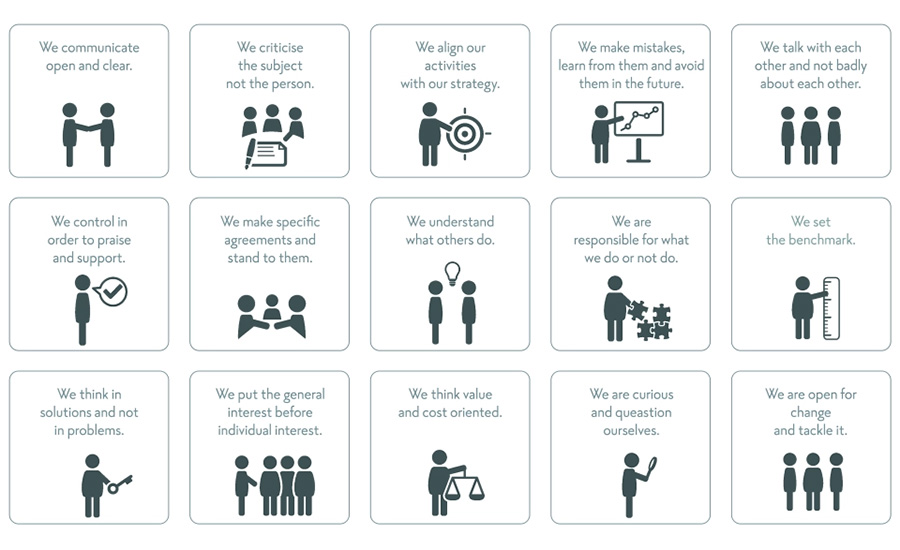
The behaviors illustrated in Figure 1—such as open communication, accountability, and learning from mistakes—provide clarity across all levels of the organization. What stands out is how directly they support food safety outcomes:
- Communication enables risks to be raised early
- Accountability ensures action
- Learning supports continuous improvement
- Alignment drives consistency.
This is how values move beyond statements and shape decisions.
Communication as the Connecting Mechanism
Across Fleurieu Milk Company, FRoSTA, and Diageo Australia, a consistent message emerges: Food safety is not strengthened through systems or training alone, but through the communication that connects them to everyday decisions and behaviors. Effective communication aligns priorities, reinforces expectations, and helps translate knowledge into consistent action across the organization.
Leaders do not invest in training for its own sake; they invest in outcomes. Leadership buy-in is built through:
- Understanding risk
- Consistent action
- Visible accountability
- Continuous communication
- Connecting food safety to business outcomes in clear, practical language that supports decision-making.
Communication, however, must be backed by action. If concerns are raised but not addressed, or food safety priorities give way under operational pressure, employees notice the disconnect between what leaders say and what they do.
This is where leadership becomes most visible. When a food business is under pressure, competing priorities force decisions to be made, and those decisions demonstrate what the organization truly values. In those moments, food safety culture is not defined by policies, training, or stated commitments. It is defined by the choices leaders make and the behaviors those choices reinforce.
Reference
- The W. Edwards Deming Institute. Quote by W. Edwards Deming, February 1993. https://deming.org/a-bad-system-will-beat-a-good-person-every-time/.