


Foreign Material By the Numbers: What the 2026 Benchmark Report Reveals
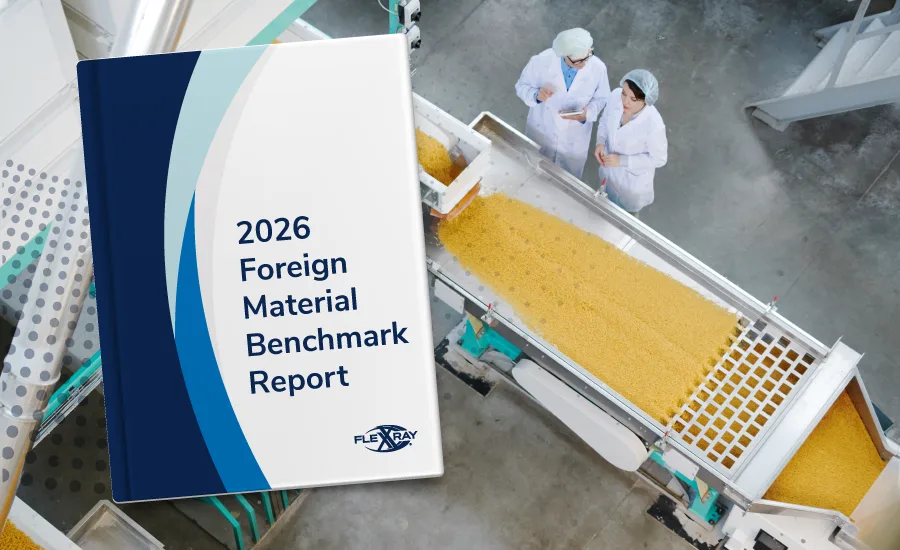
Foreign material contamination remains one of the most persistent operational risks in food manufacturing. A single event can shut down a line, tie up product on hold, and strain a supplier relationship long after the root cause is found. Individual facilities know their own history with these events well, but comparing that experience to the rest of the industry has never been easy.
FlexXray's Foreign Material Contamination in Food Benchmark Report exists to close that gap. Now in its third year, the 2026 survey of 170+ food safety and manufacturing professionals across the U.S. and Canada gives QA leaders a way to measure their own program against the industry rather than guess at how they compare.
Foreign Material Contamination Hasn't Slowed Down
More than half of respondents — 54.6% — said they experience a foreign material event monthly or more often, and nearly three-quarters see one multiple times a year.
Most working QA teams won't find that surprising. Ingredients pass through multiple suppliers before they ever reach a plant, equipment runs continuously under heavy wear, and packaging lines introduce their own points of risk. No facility, however well-run, designs contamination out of the process entirely.
Rather than treating each event as an isolated incident to react to, the data suggests it's more productive to treat contamination as a standing operational reality — something a facility builds a fast, practiced response to, rather than something it hopes to avoid altogether.
Where Contamination Starts, and Who Notices First
Asked where contamination most often originates, respondents pointed to two places: equipment wear and failure as the single leading cause, and supply chain-related sources — supplier ingredients, natural inclusions, organic material — as the largest category once combined. A shipment of raw protein carrying a bone fragment, or a blade on a high-speed line that's gone slightly out of spec, can each introduce a problem long before anyone on the floor sees it coming.
Notably, when an event does surface, it's still usually a person who catches it first — employee reporting remains ahead of any automated detection system as the most common signal. That's a reminder that training and floor-level attentiveness aren't a supplement to a detection program — they’re key pieces of it.
Taken together, this argues for prevention that looks in two directions at once: upstream, toward supplier agreements and incoming ingredient checks, and inward, toward the condition of the equipment running product every day.
The Contaminant Profile Is Shifting
For the first time in the report's three years, plastic overtook metal as the most frequently cited contaminant, 37% to 34%. It's a narrow margin, but still a shift worth noting.
Metal has functioned as the default assumption behind a lot of detection planning for years, largely because it's what most equipment on the market was originally built to catch. Metal detectors remain the most widely used detection technology, followed at some distance by sieves and screens, X-ray, and magnetic separation.
Most facilities run more than one method rather than relying on a single line of defense — but each of the leading technologies has limitations:
- Metal detectors and magnetic separation are built to find dense, conductive material, and have little to offer against low-density plastic.
- Sieves and screens catch physical size and shape rather than material type, which means thin or flexible plastic fragments can pass through without triggering a rejection.
- Conventional X-ray relies on density contrast to distinguish a contaminant from the product around it — and plastic is the kind of material that blends into that background.
None of this makes these systems ineffective. They remain the backbone of most detection programs for good reason, and layering several methods together is precisely how facilities compensate for any one technology's blind spot. But it's a good indication to periodically check equipment against current contaminant data, rather than assume last year's setup still matches this year's risk.
Spending Cools While Confidence Holds Steady
Investment intent softened this year: 57% of respondents plan to increase in-line detection spending by the end of 2027, down from roughly 70% who indicated the same over a three-year window in last year's survey. The direction points toward a more cautious short-term investment posture.
Confidence, meanwhile, barely moved. Only 23% of respondents call themselves "very confident" their equipment catches all foreign material, parallel to last year’s data. That reflects a difficult technical problem that the industry as a whole hasn't resolved, even as awareness of the gap has grown.
The Cost and Process of a Hold
Once an event is confirmed, FSQA teams lead the decision on what happens next, and internal remediation remains the default path in roughly 63% of cases. Asked what factors weigh most in that decision, respondents ranked them this way:
- Opportunity cost — the labor and downtime of tying up a line — by far the top consideration, at 71%.
- Brand impact and speed to reinspect, tied for second at 53% each.
- Cost of disposal, 45%.
- Internal technical capability, 37%.
- Customer or retailer expectations, 23%.
- Internal rescue standards, 14%.
Respondents could select up to three factors rather than rank them, so this reflects how often each was mentioned rather than a strict hierarchy. Even so, the gap between opportunity cost and everything else is wide enough to be meaningful: for most facilities, the immediate operational disruption of a hold outweighs longer-term brand or compliance concerns in the moment a decision has to be made.
Building a More Forward-Looking Program
Asked what technology they're currently evaluating, respondents named X-ray more than twice as often as any other option. At the same time, a meaningful share of respondents described explicit zero-defect goals or hard numeric thresholds for their programs. Held next to the equipment data above, that creates tension: ambitious targets sitting on top of technology that isn't built to catch every material with equal reliability.
A few practical steps stand out as ways to close that gap:
- Reassessing detection equipment against a facility's current contaminant mix
- Verifying a supplier's own detection capabilities directly, not just their certifications and audit history
- Setting internal targets that reflect what current technology can realistically deliver
- Layering third-party inspection or advanced imaging for the highest-stakes or most ambiguous holds
A Technology on the Horizon
A newer class of X-ray system — often called photon-counting or spectral detection — is gaining traction across the industry. Rather than relying on density contrast alone, these systems sort X-ray photons by energy, which is what makes them particularly effective against low-density plastics and rubber. The technology is becoming a standard feature in advanced detection setups, though not yet a universal one, and it narrows the gap on hard-to-detect materials considerably. With that said, the thinnest films and smallest fragments remain a challenge industry-wide, regardless of method.
Why This Report Matters
Taken as a whole, the 2026 findings describe an industry that has a well-established playbook for handling contamination when it happens, and is now working through a gradual shift in what it's actually up against. Neither the shift in most common contaminant types nor the more cautious investment outlook demands an immediate overhaul. But together, they're a fair push for any FSQA team to ask whether its current detection strategy still matches its current risk.
The full 2026 Foreign Material Contamination in Food Benchmark Report is available at flexxray.com.


