Food Safety
search
Ask Food Safety AI
cart
facebook twitter linkedin instagram youtube
  • Sign In
  • Create Account
  • Sign Out
  • My Account
Food Safety
  • NEWS
    • Latest News
    • White Papers
  • PRODUCTS
  • TOPICS
    • Contamination Control
    • Food Types
    • Management
    • Process Control
    • Regulatory
    • Sanitation
    • Supply Chain
    • Testing and Analysis
  • PODCAST
  • EXCLUSIVES
    • Food Safety Five Newsreel
    • eBooks
    • FSM Distinguished Service Award
    • Interactive Product Spotlights
    • Videos
  • BUYER'S GUIDE
  • MORE
    • NEWSLETTERS >
      • Archive Issues
      • Subscribe to eNews
    • Store
    • Sponsor Insights
    • ASK FSM AI
  • WEBINARS
  • FOOD SAFETY SUMMIT
  • EMAG
    • eMagazine
    • Archive Issues
    • Editorial Advisory Board
    • Contact
    • Advertise
  • SIGN UP!
NewsContamination ControlRegulatoryTesting & AnalysisMicrobiologicalMicrobiologicalUSDA

USDA Grants $611,000 to UAlbany Scientists to Develop Rapid Salmonella Detection Kit
By Food Safety Magazine Editorial Team
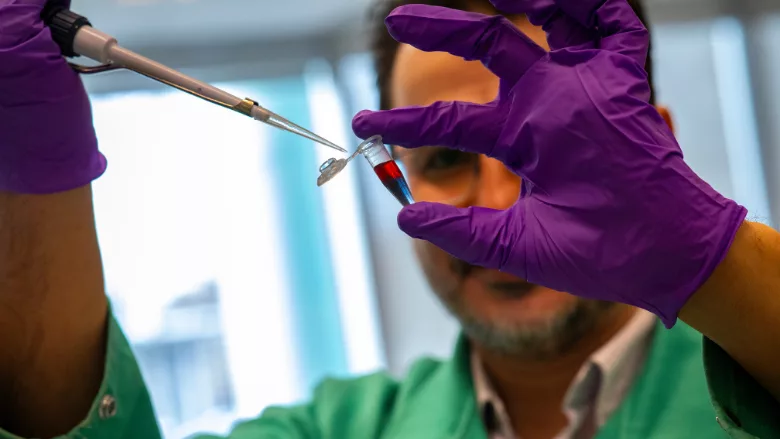
UAlbany salmonella detection kit

Image credit: Patrick Dodson, UAlbany

May 15, 2024

The U.S. Department of Agriculture’s National Institute of Food and Agriculture (USDA’s NIFA) has awarded $611,000 to University at Albany researchers to develop a rapid, portable, colorimetric Salmonella detection kit for food products. If successfully created, the test will reduce the time it takes to detect Salmonella in food from several days to as little as six hours.

The project will focus on detecting S. Enteritidis and S. Typhimurium, the two serotypes that are jointly responsible for half of all human Salmonella infections in the U.S. The team’s nano-diagnostic system will also serve as a template for foodborne bacterial detection beyond Salmonella.

The detection kit is based on a novel approach that relies on nanotechnology and artificial intelligence (AI), rather than leveraging reliable, yet time-consuming techniques used in conventional detection, like microbial culturing or whole genome sequencing (WGS).

The proposed diagnostic kit will include pre-filled vials, allowing the user to easily add a sample and induce the chemical reaction necessary to determine the presence or absence of Salmonella. When the processing is complete, color-coded results (purple for positive or red for negative) will be visible in a test tube solution or on a paper test strip.

The team is further exploring the development of an image analysis system, integrating machine learning techniques to interpret the color patterns exhibited on the nanoarray test strip. The innovative approach aims to empower users by providing automated assistance in result interpretation, enhancing the overall usability and accessibility of the Salmonella detection process. The feature is reminiscent to certain COVID-19 tests that allow a photo to be taken of a test strip for results interpretation, using a mobile phone. The AI in Complex Systems Lab at UAlbany will lead the development of a smartphone application specifically designed for image analysis, incorporating image recognition and machine learning techniques.

Looking for quick answers on food safety topics?
Try Ask FSM, our new smart AI search tool.
Ask FSM →


KEYWORDS: grants pathogen detection Salmonella UAlbany

Share This Story

Fsm purple logo 200x200

The Food Safety Magazine editorial team comprises Bailee Henderson, Digital Editor ✉ and Adrienne Blume, M.A., Editorial Director.

Recommended Content

JOIN TODAY
to unlock your recommendations.

Already have an account? Sign In

  • people holding baby chicks

    Serovar Differences Matter: Utility of Deep Serotyping in Broiler Production and Processing

    This article discusses the significance of Salmonella in...
    Meat/Poultry
    By: Nikki Shariat Ph.D.
  • woman washing hands

    Building a Culture of Hygiene in the Food Processing Plant

    Everyone entering a food processing facility needs to...
    Sanitation
    By: Richard F. Stier, M.S.
  • graphical representation of earth over dirt

    Climate Change and Emerging Risks to Food Safety: Building Climate Resilience

    This article examines the multifaceted threats to food...
    Management
    By: Maria Cristina Tirado Ph.D., D.V.M. and Shamini Albert Raj M.A.
Manage My Account
  • eMagazine Subscription
  • Subscribe to Newsletters
  • Manage My Preferences
  • Website Registration
  • Subscription Customer Service

More Videos

Sponsored Content

Sponsored Content is a special paid section where industry companies provide high quality, objective, non-commercial content around topics of interest to the Food Safety Magazine audience. All Sponsored Content is supplied by the advertising company and any opinions expressed in this article are those of the author and not necessarily reflect the views of Food Safety Magazine or its parent company, BNP Media. Interested in participating in our Sponsored Content section? Contact your local rep!

close
  • This image displays a multi-stage water filtration system designed to remove contaminants from drinking water.
    Sponsored byWaterdrop Filter

    The 4.0 ppt Era: Future-Proofing Your Food Supply Chain Against "Forever Chemicals"

  • The image displays a bottling plant production line, commonly used in the beverage industry for filling and packaging soft drinks.
    Sponsored byBIOIONIX

    Sustainability with ROI: A Beverage Producer Case Study in Water Savings

  • factory
    Sponsored byIFC

    A Clean Break to Reset the Environment with Chlorine Dioxide

Popular Stories

workers and inspector in processing facility

Gearing Up for an FDA Inspection

woman looking at box of packaged food in grocery store seeming pensive

RFK Jr. Says Federal Ultra-Processed Foods Definition is Coming in April

magnifying glass hovering over question mark on yellow background

FDA Redacts All Key Details in Summary of Fatal Listeriosis Outbreak Linked to Produce

Events

March 26, 2026

Continuous Pathogen Control: Enhancing Sanitation and Environmental Monitoring in Food Processing

Live: March 26, 2026, at 2:00 pm EST: This session explores the role of continuous airborne pathogen control technology in supporting sanitation and environmental monitoring programs within food processing environments.

March 31, 2026

Regulatory Risk, Ingredient Safety, and GRAS: What Companies Need to Act on Now

Live: March 31, 2026, at 11:00 am EDT: From this webinar, attendees will recognize patterns in food policy affecting dietary guidelines, UPFs, state legislative actions, and expected GRAS reform.

April 8, 2026

Foreign Material Contamination: Why In-Line Reinspection Isn't Enough

Live: April 8, 2026, at 11:00 am EDT: From this webinar, attendees will learn why re-inspecting with in-line equipment is not sufficient when it comes to potential foreign material contamination.

View All

Products

Global Food Safety Microbial Interventions and Molecular Advancements

Global Food Safety Microbial Interventions and Molecular Advancements

See More Products

Related Articles

  • red onion slices

    USDA Awards Researcher $150,000 to Develop Rapid AI Detection System for Salmonella on Onions

    See More
  • carrots

    USDA Grants MSU $611,000 to Research Heavy Metals Uptake in Food Crops, Identify Mitigation Strategies

    See More
  • chick hatching from an egg

    USDA Scientists Working on Method to Give Hens Ability to Pass on Salmonella Immunity to Chicks

    See More

Related Products

See More Products
  • food safety.jpg

    Food Safety Contaminants and Risk Assessment

  • 1119160553.jpg

    Food Safety: Innovative Analytical Tools for Safety Assessment

  • Food-Forensics-3D.jpg

    Food Forensics Handbook Practice, Instrumentation, Case Studies

See More Products

Events

View AllSubmit An Event
  • December 11, 2025

    How to Develop and Implement an Effective Food Defense Strategy

    On Demand: From this webinar, attendees will learn common areas where companies encounter challenges in their food defense strategies and how to address them.
View AllSubmit An Event

Related Directories

  • Anritsu - Product Inspection & Detection

    Anritsu manufactures product inspection and detection equipment for food and pharma industries. Part of the Product Quality Assurance division of Anritsu Corp., we advance quality control programs with high-performing and reliable solutions. Our X-Ray Systems, Checkweighers, Metal Detectors, Combo Systems, Rejectors, and QuiCCA Software provide a superior ROI and ensure compliance with stringent quality control programs while protecting your brand. Our local branches in the US, Europe, Brazil, and Mexico are equipped with in-house service & parts dept., we deliver, install, and maintain in record time. With over 200,000 installations, we are the brand that is trusted to protect the safety and security of your customers.
  • Romer Labs

    Romer Labs is a global leader in innovative diagnostic solutions for food and feed safety. With a focus on mycotoxins, food allergens, GMOs, and microbial contaminants, we strive to meet the ever-changing demands of our customers. Furthermore, we operate a global network of 6 ISO accredited laboratories.
×

Never miss the latest news and trends driving the food safety industry

Newsletters | Website | eMagazine

JOIN TODAY!
  • RESOURCES
    • Advertise
    • Contact Us
    • Directories
    • Store
    • Want More
  • SIGN UP TODAY
    • Create Account
    • eMagazine
    • Newsletters
    • Customer Service
    • Manage Preferences
  • SERVICES
    • Marketing Services
    • Reprints
    • Market Research
    • List Rental
    • Survey/Respondent Access
  • STAY CONNECTED
    • LinkedIn
    • Facebook
    • Instagram
    • X (Twitter)
  • PRIVACY
    • PRIVACY POLICY
    • TERMS & CONDITIONS
    • DO NOT SELL MY PERSONAL INFORMATION
    • PRIVACY REQUEST
    • ACCESSIBILITY

Copyright ©2026. All Rights Reserved BNP Media.

Design, CMS, Hosting & Web Development :: ePublishing