Food Safety
search
Ask Food Safety AI
cart
facebook twitter linkedin instagram youtube
  • Sign In
  • Create Account
  • Sign Out
  • My Account
Food Safety
  • NEWS
    • Latest News
    • Sponsored Insights
    • Sponsored White Papers
  • PRODUCTS
  • TOPICS
    • Contamination Control
    • Food Types
    • Management
    • Process Control
    • Regulatory
    • Sanitation
    • Supply Chain
    • Testing and Analysis
  • PODCAST
  • EXCLUSIVES
    • Food Safety Five Newsreel
    • eBooks
    • FSM Distinguished Service Award
    • Interactive Product Spotlights
    • Videos
  • BUYER'S GUIDE
  • MORE
    • NEWSLETTERS >
      • Archive Issues
      • Subscribe to eNews
    • Store
    • ASK FSM AI
  • WEBINARS
  • FOOD SAFETY SUMMIT
  • EMAG
    • eMagazine
    • Archive Issues
    • Editorial Advisory Board
    • Contact
    • Advertise
  • SIGN UP!
NewsContamination ControlFood TypeSanitationMicrobiological ControlBiofilm ControlCleaners/SanitizersMeat/Poultry

Study Shows Potential of Thymol for Controlling Salmonella Biofilms on Food-Contact Surfaces
By Food Safety Magazine Editorial Team
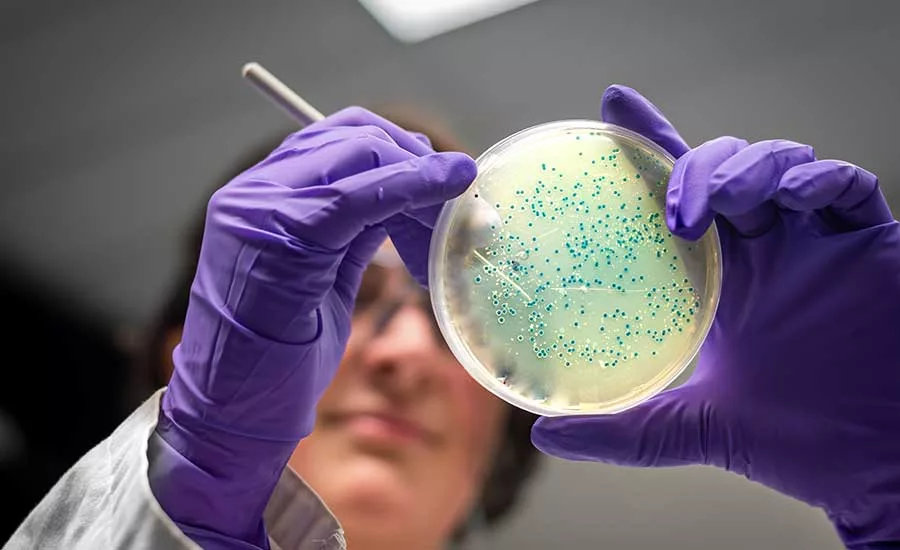
scientist looking at petri dish with cultured biofilm
Image credit: Manjurul/iStock/Getty Images Plus via Getty Images
September 15, 2026

Need to Know

  • Although the antimicrobial and antibiofilm activity of thymol, a plant-derived antimicrobial compound, is well-established, there is limited research on the effects of thymol on Salmonella Infantis biofilms
  • USDA-ARS and University of Arkansas, Fayetteville researchers investigated thymol’s ability to inhibit and inactivate S. Infantis biofilms on polystyrene and stainless steel surfaces, as well as its effects on genes and proteins involved in biofilm formation
  • Thymol showed inhibitory effects against S. Infantis at sub-inhibitory concentrations of 0.015 percent and 0.03 percent, with reductions up to 3.5 log CFU/mL depending on concentration and sampling time
  • On both surface types, treatment with 0.5 percent thymol reduced S. Infantis in mature biofilms to below detectable levels after ten minutes or less at both 20 °C and 37 °C; even the lowest concentration tested against established biofilms showed significant reductions
  • The researchers concluded that thymol could have potential as a natural disinfectant for controlling S. Infantis biofilms on plastic and stainless steel surfaces in poultry and food processing facilities.

A new study led by researchers at the U.S. Department of Agriculture’s Agricultural Research Service (USDA-ARS) and the University of Arkansas, Fayetteville has demonstrated the potential of thymol, a plant-derived antimicrobial compound, to inhibit and inactivate Salmonella Infantis biofilms on polystyrene and stainless steel surfaces commonly found in poultry and food processing environments.

Published in Poultry Science, the study investigated thymol’s efficacy against S. Infantis biofilms, as well as its effects on genes and proteins involved in biofilm formation. The poultry-associated pathogen is known to persist in processing environments partly because of its ability to form biofilms that are resistant to cleaning and disinfection. Although the antimicrobial and antibiofilm activity of thymol is well-established, there is limited research on the effects of thymol on S. Infantis biofilms.

Thymol Inhibited and Inactivated S. Infantis Biofilms

Researchers formed biofilms comprising S. Infantis isolated from ground chicken on polystyrene plates and stainless steel coupons. Biofilm formation was evaluated at 20 °C and 37 °C. The researchers found greater biofilm formation at 20 °C than at 37 °C, although the effect of temperature was significant only on polystyrene.

To investigate biofilm inhibition, the researchers exposed S. Infantis to sub-inhibitory thymol concentrations of 0.015 percent and 0.03 percent. At 20 °C, 0.03 percent thymol reduced S. Infantis counts by approximately 3–3.5 log colony forming units per milliliter (CFU/mL) on polystyrene. Reductions of approximately 0.5–3.5 log CFU/mL were observed on stainless steel with the two thymol concentrations, with results dependent on concentration and sampling time.

The researchers also tested thymol concentrations of 0.125, 0.25, and 0.5 percent against mature 48-hour S. Infantis biofilms. Increasing thymol concentration and exposure time generally increased biofilm inactivation.

On polystyrene, treatment with 0.5 percent thymol reduced S. Infantis to below detectable levels after five or ten minutes at both temperatures. On stainless steel, 0.5 percent thymol reduced S. Infantis to below detection limits after ten minutes at both temperatures. Overall, the highest thymol treatment achieved approximately 5–7 log CFU/mL reductions in mature biofilms.

Even the lowest concentration tested against established biofilms showed significant activity. Treatment with 0.125 percent thymol achieved approximately 4–5 log CFU/mL reductions after one minute on polystyrene, and approximately 2–3.5 log CFU/mL reductions after five minutes on stainless steel.

Looking for quick answers on food safety topics?
Try Ask FSM, our new smart AI search tool.
Ask FSM →

Fluorescence microscopy also showed increasing bacterial cell membrane damage as thymol concentrations increased.

Thymol Affected Biofilm-Related Gene and Protein Expression

The researchers also investigated how thymol affected the expression of genes important to S. Infantis biofilm formation. Treatment with 0.015 percent thymol significantly downregulated genes associated with extracellular polymeric substance (the structural and protective matrix encompassing a biofilm) by approximately twofold. Certain quorum-sensing genes (which help facilitate communication among bacteria within a biofilm) were also significantly downregulated.

Proteomic analysis identified 745 proteins in S. Infantis. Thymol-treated biofilms showed downregulation of proteins involved in bacterial chemotaxis and motility. Proteins involved in bacterial survival, cell wall maintenance, cellular repair, efflux pump transport, and adaptation to environmental stresses were upregulated, which the researchers associated with bacterial responses to thymol-induced stress.

Based on the findings, the researchers concluded that thymol could have potential as a natural disinfectant for controlling S. Infantis biofilms on plastic and stainless steel surfaces in poultry and food processing facilities.

However, the study did not evaluate thymol against S. Infantis on chicken carcasses or other food products. The researchers called for additional studies investigating these applications, as well as thymol's effects on mixed biofilms of Salmonella serovars prevalent in poultry environments.


KEYWORDS: antimicrobial Salmonella study University of Arkansas

Share This Story

Fsm purple logo 200x200

The Food Safety Magazine editorial team comprises Bailee Henderson, Director of Content Strategy and news editor ✉, and Adrienne Blume, M.A., Director of Editorial and Industry Engagement.

Recommended Content

JOIN TODAY
to unlock your recommendations.

Already have an account? Sign In

  • people holding baby chicks

    Serovar Differences Matter: Utility of Deep Serotyping in Broiler Production and Processing

    This article discusses the significance of Salmonella in...
    Contamination Control
    By: Nikki Shariat Ph.D.
  • woman washing hands

    Building a Culture of Hygiene in the Food Processing Plant

    Everyone entering a food processing facility needs to...
    Training
    By: Richard F. Stier, M.S.
  • graphical representation of earth over dirt

    Climate Change and Emerging Risks to Food Safety: Building Climate Resilience

    This article examines the multifaceted threats to food...
    Risk Assessment
    By: Maria Cristina Tirado Ph.D., D.V.M. and Shamini Albert Raj M.A.
Manage My Account
  • eMagazine Subscription
  • Subscribe to Newsletters
  • Manage My Preferences
  • Website Registration
  • Subscription Customer Service

More Videos

Sponsored Content

Sponsored Content is a special paid section where industry companies provide high quality, objective, non-commercial content around topics of interest to the Food Safety Magazine audience. All Sponsored Content is supplied by the advertising company and any opinions expressed in this article are those of the author and not necessarily reflect the views of Food Safety Magazine or its parent company, BNP Media. Interested in participating in our Sponsored Content section? Contact your local rep!

close
  • Man In Warehouse
    Sponsored byRentokil

    Mitigating Hidden Rodent Risks in Food Facilities

  • an industrial manufacturing or processing facility
    Sponsored bybioMérieux

    Get Ahead of Spoilage in Food Manufacturing with Metagenomics for Preventive Monitoring

  • an automated industrial production line used in a modern food factory
    Sponsored byIFC

    A Formula for Food Processing Pest Management

Popular Stories

iceberg lettuce growing

Cyclospora Outbreak Linked to Taylor Farms Lettuce Ends with Nearly 13,000 Illnesses, Two Deaths

cattle resting in field

Trump Executive Order Seeks Meat Inspection Modernization by Cutting ‘Unnecessary’ Requirements, Expanding State Programs

professional development training seminar

We Taught It. But Can They Use It?

allergens ebook

Events

September 22, 2026

From EFSA to Enforcement: Managing the Growing Complexity of EU MRLs

Live: September 22, 2026 at 11:00 am EDT: Attend this webinar to evaluate best practices for monitoring regulatory changes and protecting market access.

September 24, 2026

Benchmarking Foreign Material Contamination in 2026: What the Data Shows

Live: September 24, 2026 at 2:00 pm EDT:  From this webinar, attendees will learn what is driving investment decisions, and the factors FSQA and ops leaders weigh when making the case for new prevention technology.

September 29, 2026

How to Talk to Your Board of Directors About Food Safety

Live: September 29, 2026 at 11:00 am EDT: Attend this webinar to learn how to position food safety as a material enterprise risk with measurable financial, operational, and reputational impacts relevant to Board-level decision-making.

View All

Products

Global Food Safety Microbial Interventions and Molecular Advancements

Global Food Safety Microbial Interventions and Molecular Advancements

See More Products

Related Articles

  • digital illustration of a dna strand within a test tube

    USDA Study Shows WGS Could Detect Salmonella on Food-Contact Surfaces Earlier Than Culturing

    See More
  • food equipment sanitation

    Study Shows How Spray Application Affects Sanitizer Efficacy Against Listeria on Food-Contact Surfaces

    See More
  • blue light waves

    Study Shows Potential of Antimicrobial Blue Light for Listeria Inactivation in Food Processing Plants

    See More

Related Products

See More Products
  • 9781498721776.jpg

    Handbook of Food Processing: Food Safety, Quality, and Manufacturing Processes

  • 1119053595.jpg

    Food Safety for the 21st Century: Managing HACCP and Food Safety throughout the Global Supply Chain, 2E

  • 1118396308.jpg

    High Throughput Analysis for Food Safety

See More Products

Related Directories

  • OnSite Food Safety (Microbiologique)

    Rapid, simple gluten and allergen test kits. OnSite® Test Kits require no equipment and are useful for both commercial laboratories and for the food production industry.
  • International Association For Food Protection-IAFP

    The International Association for Food Protection (IAFP) represents a broad range of members with a singular focus — protecting the global food supply. Within the association, you will find educators, government officials, microbiologists, food industry executives and quality control professionals who are involved in all aspects of growing, storing, transporting, processing and preparing all types of foods.
×

Never miss the latest news and trends driving the food safety industry

Newsletters | Website | eMagazine

JOIN TODAY!
  • RESOURCES
    • Advertise
    • Contact Us
    • Directories
    • Store
    • Want More
  • SIGN UP TODAY
    • Create Account
    • eMagazine
    • Newsletters
    • Customer Service
    • Manage Preferences
  • SERVICES
    • Marketing Services
    • Reprints
    • Market Research
    • List Rental
    • Survey/Respondent Access
  • STAY CONNECTED
    • LinkedIn
    • Facebook
    • Instagram
    • X (Twitter)
  • PRIVACY
    • PRIVACY POLICY
    • TERMS & CONDITIONS
    • DO NOT SELL MY PERSONAL INFORMATION
    • PRIVACY REQUEST
    • ACCESSIBILITY

Copyright ©2026. All Rights Reserved BNP Media, Inc. and BNP Media II, LLC.

Design, CMS, Hosting & Web Development :: ePublishing