Study Shows How Spray Application Affects Sanitizer Efficacy Against Listeria on Food-Contact Surfaces
Need to Know
- Cornell University researchers combined computer-modeled fluid dynamics shear stress estimates with experimental microbial reduction measurements
- Longer application times, shorter nozzle distances, and spray patterns that deliver sufficient physical force to surfaces may contribute to improved microbial reduction
- Experiments measuring sanitizer efficacy could misrepresent real-world sanitation outcomes when shear stress and application time are not considered
- Findings challenged assumption that cleaning physically removes contamination while sanitizing primarily chemically inactivates remaining microorganisms
- Sanitation operator training and spray-equipment design could benefit from greater consideration of spray impingement and shear forces.
A new study authored by Cornell University researchers demonstrated that sanitizer application technique and fluid mechanics, including shear stress, can significantly affect microbial reductions on food-contact surfaces, suggesting that conventional static efficacy tests may not accurately represent sanitizer performance under real-world conditions.
Published in Applied and Environmental Microbiology, the study estimated shear stress (i.e., how a material reacts to a force that moves across its surface) using computational fluid dynamics (i.e., computer modeling to simulate and analyze how liquids flow). These estimates were paired with microbial reduction measurements from experiments applying 100 parts per million (ppm) sodium hypochlorite to Listeria innocua on stainless steel. Sanitizer efficacy was analyzed using pilot-scale manual spraying, controlled bench-scale spraying, and static coupon submersion.
The researchers explained that sanitizer efficacy testing has traditionally emphasized chemical inactivation under static conditions, such as by immersing inoculated surfaces in sanitizer. However, spray sanitation is a dynamic process in which physical forces can contribute to microbial removal, and the amount of shear stress experienced across a surface can vary depending on where and how sanitizer is applied.
Operator Technique Resulted in Significant Differences in Listeria Reduction
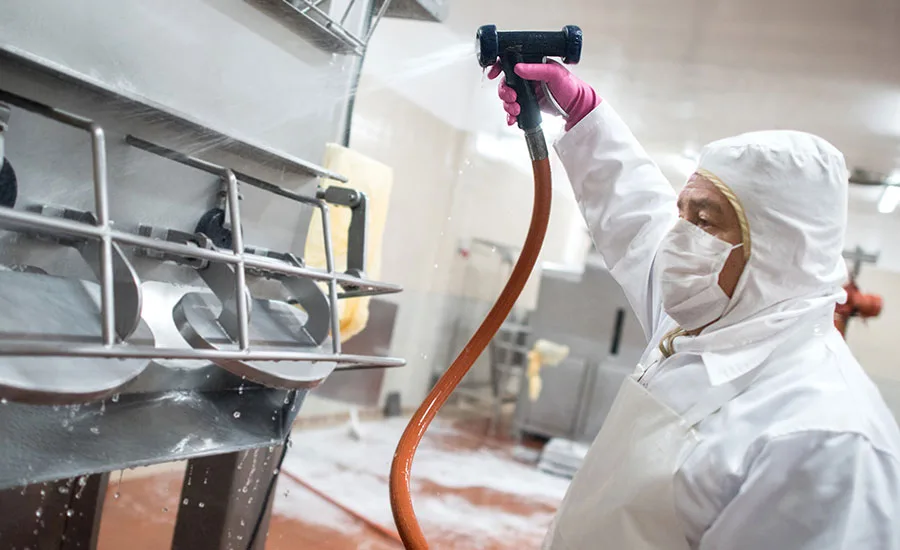
To evaluate variability during manual sanitizer application, three researchers familiar with industrial sanitation were instructed to treat an inoculated stainless steel surface using a pressurized sprayer containing 100 ppm sodium hypochlorite. The researchers were not told where the inoculation sites were located and received no instructions about application technique beyond safety protocols.
Each operator independently determined the spray pattern, treatment duration, and distance between the nozzle and surface. Despite all three operators achieving complete sanitizer coverage of the flat stainless steel test surface, microbial reductions differed significantly:
- The operator who sprayed for six seconds from a distance of 150 centimeters (cm) achieved the lowest reduction, at 1.9 ± 0.5 log colony forming units (CFU)/surface
- The operator who sprayed for 15 seconds from 45 cm achieved the greatest reduction, at 3.7 ± 0.7 log CFU/surface
- The third operator sprayed for 13 seconds from 75 cm and achieved a 2.1 ± 0.6 log CFU/surface reduction.
Notably, across the three operators:
- The average reduction was 2.6 ± 0.4 log CFU/surface
- None achieved a 5-log reduction, even though the experiment used an easy-to-clean, flat, stainless steel surface without niches and allowed a 120-second sanitizer contact time after spraying.
The findings indicated that longer application times, shorter nozzle distances, and spray patterns that deliver sufficient physical force to surfaces may contribute to improved microbial reduction.
Shear Stress Contributed to Physical Removal of Listeria
To investigate how fluid mechanics contributed to sanitizer efficacy, the researchers conducted controlled bench-scale experiments using a fixed sprayer positioned 38 cm from vertically mounted stainless steel surfaces. Three locations were evaluated: the point where the sanitizer spray directly struck the surface (the impingement point), a location directly adjacent to the impingement point, and a “fluid-film” location below the impingement point, where sanitizer flowed down the surface.
CFD modeling estimated shear stress at 25 pascals (Pa) at the impingement location, 75 Pa immediately adjacent to the impingement point, and only 4 Pa at the fluid-film location.
Looking for quick answers on food safety topics?
Try Ask FSM, our new smart AI search tool.
Ask FSM →
After a three-second application of 100 ppm sodium hypochlorite, L. innocua reductions differed substantially by location. The researchers observed reductions of:
- 7.5 ± 0.5 log CFU/surface at the impingement point
- 6.4 ± 0.7 log CFU/surface immediately adjacent to the impingement point
- 0.4 ± 0.1 log CFU/surface at the low-shear fluid-film location.
The difference between the fluid-film location and the two locations near spray impingement was statistically significant.
Significant Role of Physical Removal in Microbial Reduction
Experiments using water alone further demonstrated the role of physical removal. Water spraying produced reductions of:
- 3.4 ± 0.6 log CFU/surface at the impingement point
- 3.2 ± 0.5 log CFU/surface immediately adjacent to the impingement point
- 0.4 ± 0.8 log CFU/surface at the fluid-film location.
Although differences among the water treatments were not statistically significant, the researchers said that reductions exceeding 3 log CFU at locations directly exposed to the spray demonstrated that a substantial portion of microbial reduction could be attributed to physical removal rather than chemical inactivation.
The researchers suggested that the large differences between directly sprayed and fluid-film areas may partially explain the relatively low reductions achieved during manual application. Variable spray patterns could leave portions of a surface without direct sanitizer impingement, resulting in lower shear stress and less physical removal of microbial cells.
Application and Contact Time Affected Sanitizer Performance
Longer sanitizer exposure improved microbial reductions, including in areas subjected to relatively little shear stress.
At the fluid-film location:
- A three-second sanitizer spray with no additional contact time produced a 0.4 ± 0.1 log CFU/surface reduction
- Adding a 120-second contact time after the three-second spray increased the reduction to 2.0 ± 0.1 log CFU/surface
- Extending the actual spray application to 120 seconds, without an additional contact period, increased the reduction to 6.3 ± 0.3 log CFU/surface.
Static submersion produced different results:
- Submerging inoculated stainless steel coupons in sanitizer for three seconds resulted in a 2.3 ± 0.1 log CFU/surface reduction
- A three-second submersion followed by 120 seconds of contact time produced a 4.4 ± 0.6 log CFU/surface reduction
- 120 seconds of submersion resulted in a 6.0 ± 0.1 log CFU/surface reduction.
The researchers noted that submersion ensured complete and uniform sanitizer contact, whereas spray application produced spatially variable fluid dynamics and sanitizer coverage. Consequently, efficacy measured using submerged coupons or locations receiving direct spray impingement may not reflect the reductions achieved across an entire surface during manual sanitation.
Key Takeaways and Implications for Research, Industry
Overall, the researchers concluded that experiments measuring sanitizer efficacy could overestimate or underestimate real-world sanitation outcomes when shear stress and application time are not considered.
The study also challenged the simplified distinction that cleaning physically removes contamination while sanitizing primarily chemically inactivates remaining microorganisms. According to the researchers, physical cell dislodgment caused by sanitizer flow represented an important component of the microbial reductions achieved during spraying.
The findings suggested that sanitation operator training and spray-equipment design could benefit from greater consideration of spray impingement and shear forces. Increasing spray application time and allowing sufficient sanitizer contact time were also identified as important factors for maximizing microbial reduction.
The researchers emphasized that the discrepancy between controlled efficacy testing and practical application has implications for estimating the risk reduction provided by sanitation programs. Overestimating microbial reduction from sanitizer treatment, they said, could result in food safety policies that inadequately account for other sources of microbial reduction within sanitation programs.