BIZTRACKS
Tufts University Innovation Hub for Food and Materials Technologies Opening Fall 2026
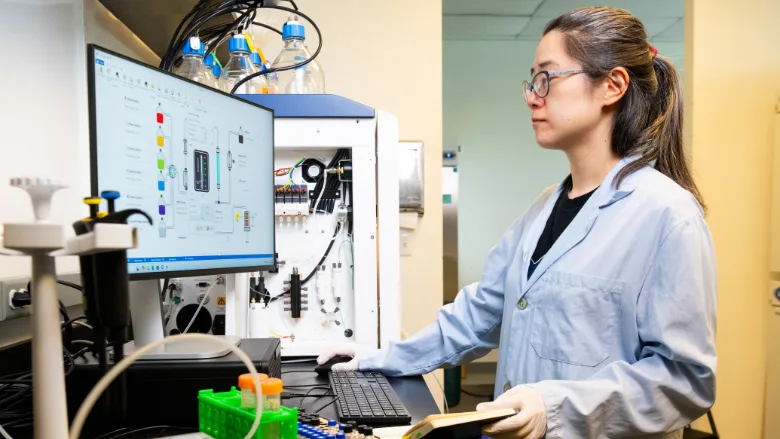
Lennie Cheung, Ph.D., a postdoctoral scholar at Tufts University, operates the amino acid analyzer.
Tufts University has launched the Innovation Hub for Food and Materials, a research and development center designed to provide shared infrastructure for developing and testing emerging food technologies, biomaterials, and other products.
Located in Medford, Massachusetts, the Hub will provide startups, established companies, entrepreneurs, academic researchers, and nonprofit organizations with access to resources for prototyping, characterization, culinary testing, and early-stage consumer testing.
The Hub draws on food technology and nutrition expertise from Tufts’ School of Engineering and Gerald J. and Dorothy R. Friedman School of Nutrition Science and Policy. Areas of expertise include novel ingredients, sustainable food production technologies, food processing solutions, and biomaterials.
A test kitchen will enable participants to evaluate how foods perform under conditions intended to approximate real-world settings and conduct chef and consumer testing.
Food Technology, Cell Culture, and Scale-Up Capabilities
The Innovation Hub will include a food and materials technology core facility with capabilities in cell culture, bioprocessing, food and material formulation, and scale-up production. The facility was supported in part by a $2.1 million grant from the Massachusetts Technology Collaborative (MassTech).
The Hub will also provide access to a cell bank containing animal and insect cells and a plant cell repository comprising more than 2,000 species.
A “technology sandbox” will allow companies developing research and development equipment, such as bioreactors, extrusion technologies, and materials characterization tools, to test and improve their technologies in an integrated setting.
Looking for quick answers on food safety topics?
Try Ask FSM, our new smart AI search tool.
Ask FSM →
The Hub will collaborate with the Tufts University Center for Cellular Agriculture, which conducts interdisciplinary research on cellular agriculture, alternative proteins, novel materials, plant-derived biomaterials, and hybrid plant-animal cell systems.
Additionally, the Hub will be integrated with the Tufts Food and Nutrition Innovation Institute, led by the Friedman School of Nutrition Science and Policy, which focuses on translational opportunities involving bioactive compounds, sustainable food systems, and novel ingredients.
Shared Infrastructure for Product Development
The Hub is intended to address a need for shared research and development infrastructure among academic and commercial organizations, according to Tufts.
The facility will also include a BioLabs-operated incubator with 46 laboratory benches and shared workspaces intended for early-stage life science and biotechnology companies.
Tufts has invested $4.6 million in shared research infrastructure and product development capabilities for the Innovation Hub, in addition to state and philanthropic support.
Interim space is available, and the fully equipped, 17,000-square-foot Innovation Hub for Food and Materials is scheduled to open in fall 2026.