Best Practice Considerations to Enhance the Effectiveness of Allergen Cleaning and Validation
The development and validation of effective cleaning practices are imperative to prevent allergen cross-contact

The use of shared manufacturing equipment and facilities for foods with different intended allergen formulations is quite common in the food industry. Few companies can afford to have separate processing lines or facilities for every single product that they manufacture containing allergenic ingredients. Thus, the development and validation of effective cleaning practices are imperative to prevent allergen cross-contact.
Conducting a Hazard Assessment
The first step in an allergen control plan is the hazard assessment. The focus should be placed on the priority allergenic foods as identified by the U.S. Food and Drug Administration (FDA) or other relevant regulatory authorities around the world (e.g., peanut, tree nuts, soybeans, wheat, sesame seeds, milk, eggs, fish, and crustacean shellfish in the U.S.) and ingredients or processing aids derived from those allergenic foods. While celiac disease is not an immunoglobulin E (IgE)-mediated food allergy, the management of cereal grains containing gluten (wheat, barley, rye, spelt, etc.) is another focus if a company manufactures gluten-free products.
The allergen load (i.e., amount of total protein from the allergenic source of concern) present in these food components is the second consideration about which allergenic source(s) to consider when conducting a cleaning validation study. Some ingredients have high levels of protein including whole foods and any high-protein ingredients such as non-fat dry milk, whey concentrate, gluten, sesame paste (tahini), and peanut butter, for example.
In contrast, some ingredients derived from these priority allergenic sources have very low levels of the protein and, therefore, have a low allergen protein load. Examples include highly refined oils from peanut, soybean, and fish; soy lecithin; and glucose syrup from wheat. In a few situations, the protein derived from the priority allergenic source may be hydrolyzed to the extent that the analytical detection of the protein itself is markedly diminished. Examples include soy, wheat, peanut, or milk protein hydrolysates or soy sauce.
Common test methods recognize intact proteins or large peptides but not their hydrolyzed or fermented counterparts. A careful, expert hazard assessment is often necessary in such situations as the degree of hydrolysis (i.e., the ratio of amino acids to total nitrogen content, expressed as DOH) in hydrolysates can be variable, and the hazard is dependent on the DOH. Usually, the allergenic source(s) with the highest intact protein load in the product formulation is selected for assessment of the effectiveness of the cleaning procedure. Additional validation might be needed if the form of a secondary ingredient is challenging to remove from processing equipment (e.g., peanut butter).
The form of the allergenic food is another consideration as these foods can be present as particulates, powders (flours), pastes, liquids, or sometimes aerosols (Figure 1). Particulates such as pieces of peanuts or tree nuts and sesame seeds present challenges, as these forms of the food are not distributed homogenously and individual particles can sometimes be sufficiently large to provoke reactions in sensitive consumers. Some forms of allergenic foods can be difficult to remove by cleaning, such as pastes (tahini, peanut butter, etc.) or baked-on residues.
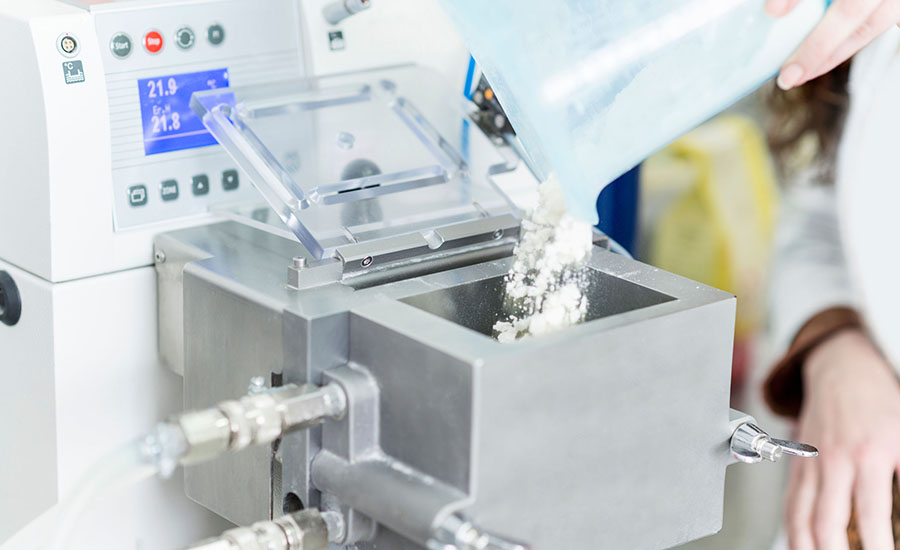
Furthermore, the form of the finished food product that contains the allergenic ingredient will also be an important consideration when developing an effective Sanitation Standard Operating Procedure (SSOP). Finished food products that may be more viscous or adhere to the food-contact surfaces of the equipment should be considered during the hazard assessment, as the food product matrix may play a critical role in the effectiveness of the SSOP for removal of the proteins from the allergenic source of interest. The hazard assessment should also consider which pieces of equipment have been exposed to the highest loads of the allergenic foods, and cleaning and validation procedures should be focused more heavily on such equipment.
Looking for quick answers on food safety topics?
Try Ask FSM, our new smart AI search tool.
Ask FSM →
Developing an SSOP
A Sanitation Standard Operating Procedure should be developed for each processing line that is exposed to any of the priority allergenic ingredients. Effective cleaning procedures vary according to equipment design, the form of the allergenic food, the protein load from the allergenic source, and the form of finished food product that contains the allergenic ingredient of concern.
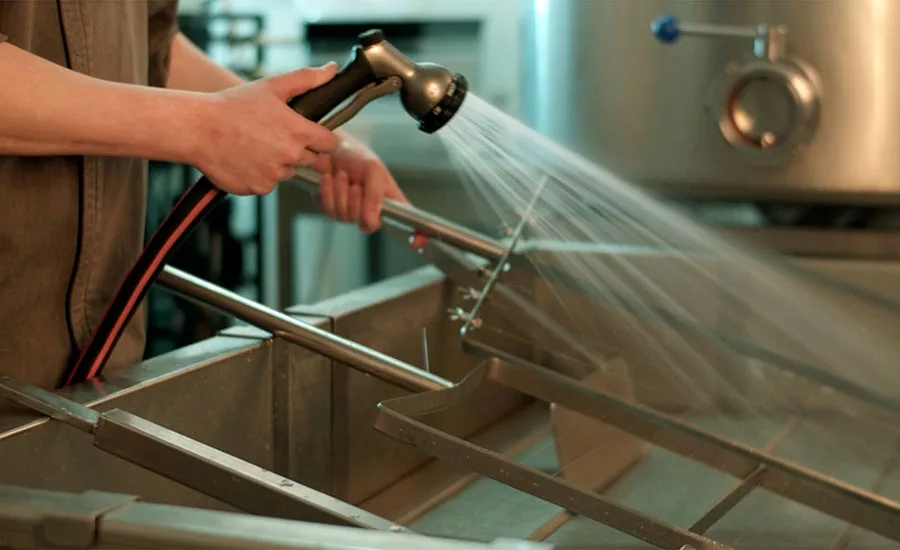
Clean-in-place (CIP) approaches can be effective in situations where physical removal, water, and cleaning chemistry (including detergents/surfactants, enzymes, and pH adjustments) can be used. Water and/or cleaning chemistry can also be used to remove allergen soils from equipment in situations where CIP designs do not exist. Care must be taken with the use of hoses in those situations, because pressurized water and the subsequent droplets can contaminate adjacent equipment. Shrouding of adjacent equipment can be effective.
Dry Sanitation
In situations where the use of water for cleaning is not possible, dry cleaning procedures must be used but can be more challenging. Vacuuming is an effective way to remove dry powders and flours. Brushes and scraping utensils are useful to dislodge residues that may adhere to surfaces (Figure 2). Wet wipes can be used in some circumstances, and alcohol wipes can sometimes be used to remove sticky resides that are not water-soluble such as peanut butter.
Caution should be exercised in the use of air hoses to remove dry residues, as this practice can disperse allergen residues to parts of the facility that would not otherwise be exposed to these allergens. This residue could potentially involve the movement of larger particles of food residue, dust, or aerosols that contain the allergenic source of concern. In the instance where particles of food residue could be dislodged by the use of compressed air, care must be taken to ensure that these particles, which could contain sufficient quantities of protein from the allergenic source of concern to cause allergic reactions, are not dispersed to adjacent production lines that do not handle the allergen of concern.
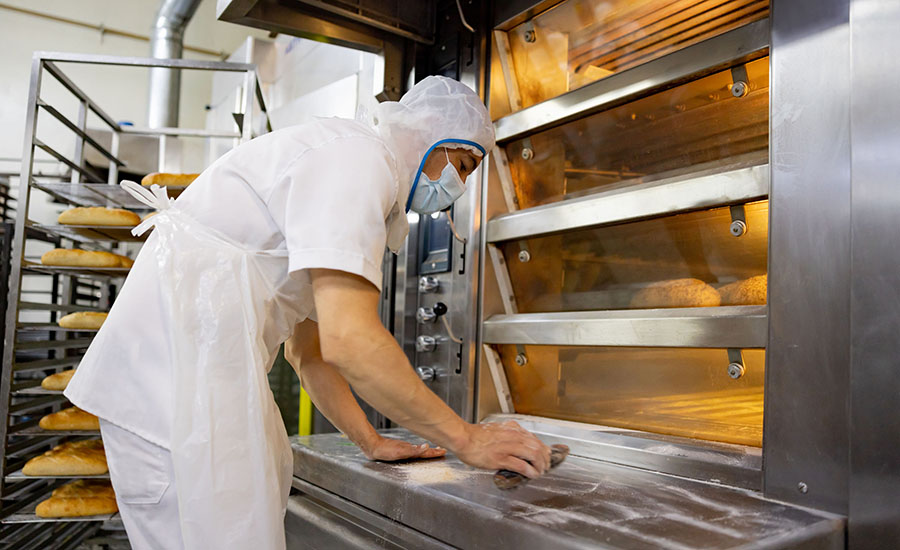
Airborne dusts and aerosols can occasionally be sources of concern but, in many cases, these residues do not settle onto adjacent processing lines at a rate that would create a hazard if those adjacent processing lines are operating. Dusts and aerosols can accumulate to hazardous levels on idle adjacent lines or on facility surfaces that are above foods such as lighting fixtures, air handling vents, and overhead piping. If an adjacent line is idle and exposed to dust, aerosols, or cleaning of other processing lines, then the idle line should be visually inspected and cleaned before resuming manufacturing.
COP Procedures
Clean-out-of-place (COP) procedures are also effective for the removal of allergen residues from parts of equipment that can be disassembled. As with CIP, water and cleaning chemistry offer good approaches for COP; however, physical removal of as much food soil as possible will allow the physical action and cleaning chemistry to penetrate and remove residual food soil and proteins from the allergenic source(s) of concern. Care must be taken to ensure that COP tanks are not over-loaded and that circulation is sufficient. It is also important to ensure that the turbulent flow of water and cleaning chemistry are able to flow through and around the equipment that is submerged in the COP tank. Piping with bends and elbows, for example, may limit the flow of the water and cleaning chemistry.
In some cases, dilution can be sufficient for allergen control. If the allergenic ingredient has a low protein load from the allergenic source (e.g., soy lecithin, wheat starch), then the next product should dilute the allergen residues to levels that do not pose risks to allergic consumers. Using risk-based approaches to make these decisions is critical, and all aspects of the corresponding risk assessment should be thoroughly documented.
Equipment Cleaning
In-process containers, totes, utensils, and maintenance tools can also be sources of allergen cross-contact and may be cleaned using COP approaches. Cleaning, from an allergen perspective, may be avoided in some circumstances, such as when separate, identifiable (e.g., color-coded) containers, utensils, or totes are used. The use of individual items for each allergen is considered best practice to manage this source of cross-contact residues. For larger totes used for partially processed product or rework, identifiable totes or disposable plastic liners may be used effectively. Maintenance staff can have a dedicated set of tools to use on processing lines that are exposed to high loads of allergenic ingredients. Otherwise, cleaning of these tools and maintenance equipment between uses for formulations with different allergenic ingredients is necessary and must be well documented.
Trash containers should not be ignored, as the amount of allergen residues in such containers can be quite high, and cross-contact with in-process foods should be prevented in any case. The use and disposal of trash container liners is a best practice. The use of color-coded, dedicated trash containers is another best practice in situations with especially high cross-contact potential.
Employees and clothing must be considered as another potential source of cross-contact. Employees involved in the manufacturing of products with high allergenic potential can be dedicated to those manufacturing areas and can wear color-coded uniforms or aprons. Maintenance staff who often need to work in multiple areas can be required to change uniforms when moving from an area of high allergenic potential to an area with low potential. Foot traffic patterns, such as those between manufacturing areas and break rooms, must be additionally considered if residues are present on floors. The traffic pattern for movement of trash containers can be controlled by covering those containers as they are removed from the manufacturing area.
Validating the SSOP
After developing an SSOP, its effectiveness should be validated and can be conducted using visual inspection, test methods for specific allergen residues, or surrogate test methods with the choice depending upon the individual situation. Visual inspection of the relevant equipment surfaces is a reasonable first approach. Visual inspection can also be very useful in situations where larger, visible particulates (e.g., sesame seeds) are a cross-contact concern. However, in such situations, the ability to visually inspect the entirety of the relevant equipment surfaces is a requirement. With particulates, the use of testing methods can be challenging because sampling strategies may not always include the allergenic particulates. The size of the particulates is also a consideration as very small particles (e.g., from flours) are difficult to identify visually.
Test methods, either specific to the allergen source or surrogate methods, can also be used in the validation of the effectiveness of the SSOP. Initially, cross-contact testing for allergen residues should be focused on equipment surfaces or final rinse waters. If the formulation contains multiple allergens, then testing for residues of the ingredients with the highest allergen load is recommended in most instances. However, testing for multiple residues may add value to the validation if more than one potent, highly allergenic ingredient is present.
The form of the allergenic ingredient and difficulty in removing the soil may be additional considerations, as sticky ingredients such as peanut butter can be harder to remove from surfaces. In CIP operations, testing of the final rinse water can be used. Testing of rinse waters that contain residual cleaning chemistry should be avoided because cleaning chemicals can interfere with allergen testing. With equipment surfaces, it is important to ensure that cleaning chemical residues do not remain before testing. In some situations, disassembly of certain pieces of equipment is necessary, and COP tanks can be used to clean such soiled pieces.
On rare occasions where effective cleaning is especially difficult, total replacement of certain equipment parts, such as conveyor belts, may be necessary, although this can be tedious and time-consuming. For pneumatic or similar conveyor pipes used to deliver dry ingredients into a process, the interior surfaces cannot be accessed for residue testing. Some companies solve that dilemma by using multiple, identifiable (e.g., color-coded) conveyor pipes for different ingredients.
Another approach involves the use of push-through with an inert ingredient, such as sugar or salt, or with the next ingredient. With push-through, testing of multiple samples for the allergen residue(s) of concern can be advantageous to determine the quantity or amount of time of push-through that is needed for effective allergen control. The push-through material must be diverted to waste or could potentially be used in a product formulation that contains the allergen residue(s). The push-through approach can be difficult in circumstances where the ingredient is viscous, such as molten chocolate or peanut butter, but is much more effective in situations where the ingredients are powdered or granular. In situations where viscous food matrices are involved, the use of hot oil flushes may be an effective way of removing the allergen residue(s) of concern.
Testing Strategies
Immunoassays (antibody-based methods) are the most common approach for testing. Commercial kits exist to test for residues of all of the priority allergenic foods. These kits are available as either microwell-based enzyme-linked immunosorbent assays (ELISAs) or lateral flow tests or dipstick devices (LFDs). When using LFDs, it is important to use environmental swabs that have been designed for use in allergen testing (cotton swabs and micro sponges are not suitable). LFDs can also be used with non-cleaning-chemistry-containing rinse waters in CIP operations.
Commercial LFDs have detection levels that are suitable for the validation of SSOPs. However, initial testing of the soiled surface that is known to contain the allergen residue(s) of concern is recommended as a positive control to ensure that the particular LFD will detect the form of the allergenic food that is being used. Ingredients with low allergen loads, such as soy lecithin, will often not contain sufficient levels of the allergen to be detectable, especially when these ingredients are minor components of the food formulation. In such cases, as already noted, testing may not be necessary unless other formulation components have higher allergen loads.
Immunoassay kits are specific for the type of allergenic food residue. Typically, testing for residues of the allergen with the highest allergen load in the formulation is sufficient for validation. Testing for residues of hydrolysates of allergenic foods (e.g., soy, wheat, milk, peanut) can be problematic because immunoassays are typically designed to detect intact proteins or large peptides but not hydrolyzed or partially hydrolyzed forms of the proteins from the allergenic source. In such situations, testing for a different allergenic ingredient that is not hydrolyzed, but is present in the formulation, can be performed for validation.
Surrogate approaches may be used for validation in some situations. Such testing can include testing for residues of other allergenic ingredients in formulations, as noted above, or by using ATP or general protein swabs. While ATP or general protein swabs do not specifically detect the protein residues from the allergenic source(s) of concern, a positive result from such testing usually signifies that improvements to the SSOP are needed.
To validate that an SSOP is effective for allergen control, each processing line should be tested for residues after cleaning and before use, with a different formulation that does not contain that allergenic source. Different formulations may need to be validated separately—even if made on the same line—if the food product matrix or allergen types, forms, or protein loads vary among the formulations made on shared equipment.
Sampling Strategies
Sampling strategies should be carefully considered. Multiple sites should be swabbed with a focus on areas (e.g., nooks and crannies) that might harbor residues. Where allergen residues may not be uniformly distributed in a product because of the use of particulates (e.g., nut pieces or sesame seeds), visual inspection is often more appropriate than analytical testing. If analysis is conducted, careful consideration of sampling approaches is warranted to maximize the opportunity to detect particulate residues when present. Some companies use a random selection procedure to pick sampling spots on specific processing lines during each validation exercise.
With CIP final rinse waters, testing of a smaller number of samples is likely adequate as allergen residues can be expected to be uniformly distributed. When no detectable residues are found using appropriate swabs and LFDs at a suitable number and location of sampling sites, the SSOP can be considered effective for allergen removal. However, validation after three successive runs is advisable to provide greater assurance that the SSOP can be consistently applied.
In cases where residues are detected, efforts must be made to improve the cleaning approach. If visible particulates (e.g., sesame seeds) are present, then visual inspection of the processing line is necessary in addition to LFD testing.
Re-Evaluating the SSOP
SSOPs for allergen cleaning should be re-evaluated periodically. The frequency of re-validation is not fixed and can depend on the frequency of manufacturing the product in question. If certain allergen-containing products are manufactured on a recurring basis on a particular line, then re-validation at a frequency of 2–4 times per year is recommended depending on the complexity of the allergen cleaning procedure. Re-validation is also recommended when any changes are made (e.g., formulation, equipment matrix, processing conditions, SSOP parameters, allergen test kit type).
Testing for allergen residues using ELISAs or LFDs is not necessary after each manufacturing run of a particular allergen formulation once a validated SSOP has been developed, although some companies do conduct allergen-specific analysis using LFDs for routine cleaning verification. It is important to verify that the SSOP was executed as prescribed after each run. Such verification can be accomplished by using ATP or general protein swabs as a more economical approach that establishes a record that the cleaning was performed according to the SSOP. Visual inspection remains the gold standard and should also be used, especially when particulate residues are a source of concern.
The ultimate confirmation of an effective SSOP is testing of the first off-product produced after the changeover, using quantitative ELISAs. Finished product testing should not be considered until some assurance has been obtained through the approaches described above. Premature testing for finished product can lead to the need to destroy valuable inventory if residues are detected. Before reaching this point of the assessment, the goal should be 99.9 percent certainty that no allergen residues will be detected in finished product.
PAL Considerations
Once an effective allergen control procedure has been developed within a food manufacturing facility, including the use of validated and verified SSOPs, the need for the use of precautionary allergen labeling (PAL) due to cross-contact on the line will not exist in many circumstances. However, the potential for cross-contact with allergenic particulates that can evade sampling strategies should still be considered as a reason to apply PAL—e.g., "may contain" or "manufactured on shared equipment" statements.
Other considerations, such as the use of ingredients with PAL, may still require the use of PAL on product. Packaged foods made using an effective, risk-based allergen control procedure and from ingredients similarly produced should minimize the opportunity for allergen cross-contact concerns.
 Joseph Baumert, Ph.D., is a Professor in the Department of Food Science and Technology at the University of Nebraska–Lincoln, and Director of the Food Allergy Research and Resource Program (FARRP). His research focuses on the development and improvement of immunochemical methods for detection of food allergens and the development of quantitative risk assessment models for food allergen exposure assessment. Dr. Baumert's extension and outreach focuses on assisting the industry with food allergy risk assessment, risk management, and allergen training.