Study Shows Poor Recovery of Listeria Using Cotton Swabs for Environmental Monitoring
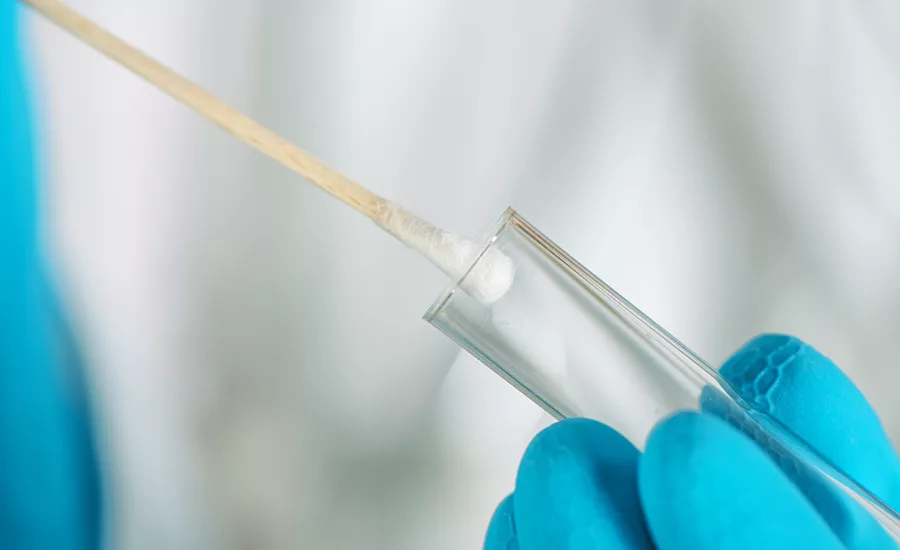
A recent study conducted by researchers at the Universitat Politècnica de València and published in MDPI’s Foods has demonstrated the critical importance of swab choice for environmental monitoring in food production facilities, with sponges (embedded in neutralizer broth) significantly outperforming cotton swabs in terms of Listeria monocytogenes recovery.
Sponges Outperform Swabs in Real-World Sampling
The researchers collected environmental samples using both sponges with neutralizer and cotton swabs at 46 sites across a ready-to-eat (RTE) food production facility. While cotton swabs yielded no positive detections for Listeria spp. or L. monocytogenes, sponge sampling identified Listeria spp. in 30 percent of samples and L. monocytogenes in 17 percent.
The authors attributed cotton swabs’ lack of recovery to their inability to detach microorganisms from surfaces.
Laboratory Results Confirm Field Findings
Controlled in vitro laboratory experiments supported the findings from the RTE facility. When tested against stainless steel, Teflon, and epoxy surfaces inoculated with L. monocytogenes, sponges achieved recovery rates of 76–93 percent. In contrast, the recovery rate of cotton swabs was consistently below 50 percent.
Additionally, the researchers reported that cotton swabs often produced non-quantifiable or false negative results, even at relatively high contamination levels (4 log10 colony forming units per square centimeter).
Implications for Environmental Monitoring Programs
The study highlighted that ineffective sampling methods could lead to under-detection of L. monocytogenes, potentially hindering timely corrective actions and increasing the risk of RTE product contamination.
The authors concluded that cotton swabs are not suitable for routine pathogen sampling in RTE environments, recommending their use only in hard-to-reach areas where alternative devices cannot be applied. Swabs with other material than cotton may improve recovery in those cases, but this hypothesis would need to be verified through another sampling exercise.
The study’s findings align with existing U.S. Department of Agriculture (USDA) and International Organization for Standardization (ISO) recommendations supporting the use of sponge-based sampling with neutralizers for environmental monitoring.
Looking for quick answers on food safety topics?
Try Ask FSM, our new smart AI search tool.
Ask FSM →