Monitoring and Recordkeeping: The Heart of HACCP


Recordkeeping is the seventh and last Hazards Analysis and Critical Control Points (HACCP) principle (Figure 1), as it should be. Each and every prerequisite program and HACCP principle must be documented—i.e., procedures must be developed, documented, and implemented for each element describing what is expected and how that element should be conducted and managed. So, everything flows toward that last principle: recordkeeping and documentation.
Figure 1. Steps Involved in HACCP Plan Development1
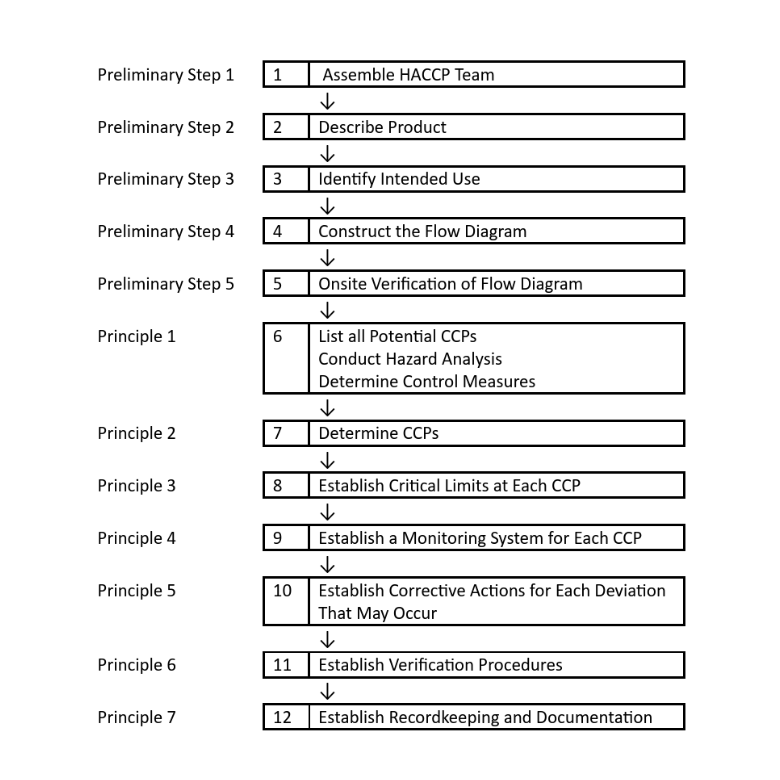 Image credit: R. Stier, derived from NACMCF
Procedures that are developed, especially those that address monitoring critical control points (preventive controls), must describe how the monitoring should be done, who is responsible for doing the work, and how and where the results of monitoring shall be recorded. Will the information be recorded manually or electronically? If the former, then forms need to be developed as part of the company's document management program. If the information is to be recorded electronically, then an electronic form needs to be created.
Records are essential to ensuring food safety. They demonstrate that the program is being properly managed and that the established critical limits are being met. Remember the old U.S. Food and Drug Administration (FDA) adage: "If it is not written down, then it never happened."
Records are necessary to ensure that the foods being produced are safe and wholesome.
Recordkeeping Best Practices
Several essential elements make up recordkeeping:
- Developing procedures that describe how preventive controls should be monitored and recorded
- Developing forms (hard copy or electronic) to record results
- Determining who will be responsible for monitoring and recordkeeping
- Training the staff responsible for monitoring and recordkeeping
- Documenting that the responsible staff have been properly trained
- Verifying that monitoring and recordkeeping have been properly conducted, which also requires a record.
The procedures that are developed for monitoring and recordkeeping depend on the critical factors established for the critical limits and control points in the process. Critical factors might include product pH, time and temperature, belt speed, Brix, water activity, or any other element established by the HACCP team as being essential for ensuring food safety.
Protocols must also be developed and documented for information that is automatically recorded such as a recorder chart to document temperature or pressure. The operator must ensure that the recorder has ink and is functioning properly. For this reason, most operations mandate that the operator make notes on the chart at set intervals.
Looking for quick answers on food safety topics?
Try Ask FSM, our new smart AI search tool.
Ask FSM →
The protocol should specify how often monitoring should be conducted, what is to be measured or recorded, the time the measurement is taken, how the measurement should be recorded (e.g., black or blue pen, if it is a hard copy record), and what comments should be noted. It should also include language describing what should be done if there is a deviation to the critical limit. Actions could include notifying management, stopping the line, doing additional testing, or diverting product.
The procedure should also emphasize how to make a correction if an improper entry is made. Struck entries must be initialed and dated (including time), the proper entry must be inserted, and a note must be made in the comments section describing the error.
Lastly, protocols need to address any data that is entered electronically. The electronic forms are password-protected, so only authorized persons can enter data. Care must be taken not to make errors when entering the data because once entered, it may not be possible to make a correction. A note will need to be made, and another test conducted.
Developing Forms for Monitoring and Recordkeeping
Development of forms for monitoring and recordkeeping falls under the document management group. Hard copy records should provide a place to record the data, the date and time the measurement was made, who made the measurement, and a space for comments or notes. It is also a good idea to include the sampling guidelines on the form and the critical limits at the preventive control being monitored.
The processor must determine who will be responsible for monitoring. Will it be production staff or the quality group? How many persons from each shift will be assigned to monitoring and recordkeeping? Backups will need to be assigned for breaks and vacation time. Many operations favor using production staff for monitoring since they are on the floor and close to the site(s) where monitoring is conducted.
Once monitors are selected, they must be properly trained on the documented procedures. Audits focus on whether procedures are followed, so the monitors must adhere to what has been documented. Auditors will often interview the persons doing the monitoring and recordkeeping, so training must ensure that the person not only understands how to do the task, but also why it is important. All education sessions must be documented and preferably included in the personnel file of the person receiving the education.
If the protocol is altered for any reason, then the production staff must be informed of the update. For this reason, it is not a good idea to make changes to procedures immediately preceding a scheduled audit. The operation must ensure that production staff have been properly trained on the updated procedure.
Processors must emphasize to those responsible for monitoring that measurements must be recorded immediately. Jotting down data on scrap paper or the back of one's hand and recording it at a later time could be considered falsification of records.
Finally, records must be reviewed and verified. When developing forms for monitoring, many companies include a box for verification where the auditor can enter their name, the date the record was reviewed, and any comments. Other companies may prepare a stamp with that information. Records should be reviewed within one working day and definitely before any product is shipped. These records may also be reviewed as part of an internal audit or a third-party audit.
Takeaway
Monitoring and recordkeeping are the heart of HACCP. Records provide supporting data to show that the processor is producing safe foods. The HACCP team must determine where the monitoring should be conducted and what limits will ensure safety, and it is imperative that all monitors are properly trained and adhere to the procedures outlined in their training.
Reference
- U.S. Food and Drug Administration (FDA). "HACCP Principles & Application Guidelines." National Advisory Committee for Microbiological Criteria for Food (NACMCF). Adopted August 14, 1997. https://www.fda.gov/food/hazard-analysis-critical-control-point-haccp/haccp-principles-application-guidelines.






