Study: Blue Light Plus Plant Chemicals Reduce Listeria on Salmon, Prevent Biofilm
New research has demonstrated that certain plant-based compounds can enhance the antimicrobial effect of blue light treatment against Listeria monocytogenes on food and disrupt its biofilm-forming abilities.
Photodynamic inactivation, which involves the application of blue light at 405–470 nanometers (nm), is an emerging strategy for foodborne pathogen control. Although investigations of the potential of exogenous photosensitizers (i.e., external substances that can transfer light to catalyze photochemical reactions) for enhancing antimicrobial blue light have begun, such research is limited. When exposed to blue light, many phytochemicals produce reactive oxygen species (ROS) that damage cells and lead to cell death.
In this context, researchers from the University of Warmia and Mazury in Poland compared the effects of four plant-based chemicals—curcumin, berberine, quercetin, and capsaicin—used in conjunction with high-irradiance (332 megawatts per square centimeter) blue light (460 nm) against L. monocytogenes on smoked salmon. The researchers studied the phytochemicals’ antimicrobial activity, gene expression regulation, anti-biofilm efficacy, and potential for real-world application.
Overall, the researchers observed antimicrobial synergy between high-irradiance blue light and natural photosynthesizers, with pathogen viability reduction achieved even at the lowest doses: 25 joules per square centimeter (J/cm²) blue light (corresponding to 75 seconds) using one-fourth of the minimum inhibitory concentration (MIC) for each photosensitizer.
Results varied depending on the specific photosensitizer used. At the lowest doses, berberine, curcumin, quercetin, and capsaicin achieved 3-log, 2.3-log, 2.2-log, and 1.8-log reductions in L. monocytogenes viability, respectively.
Berberine also demonstrated promising anti-biofilm efficacy, with 2-log and greater than 4-log reductions at 25 J/cm2 and 50 J/cm2, respectively.
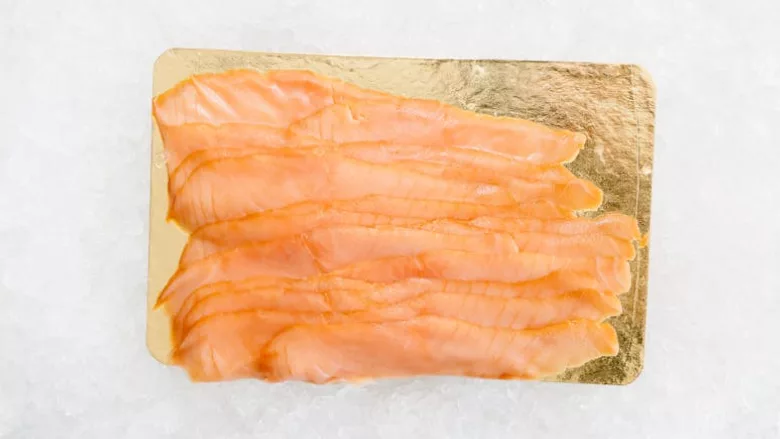
On smoked salmon, high-irradiance blue light achieved L. monocytogenes reductions of 0.5 log colony forming units per gram (CFU/g) at 50 J/cm2 and 1.3 log CFU/g at 100 J/cm2. Curcumin (at one-fourth MIC) performed the best with blue light on smoked salmon, enhancing L. monocytogenes reduction by an additional 0.7 logs and suppressing inherent microbiota by 2 logs. However, further optimization may be necessary to control for any physicochemical changes or to better reflect real food systems.
The study also provided evidence that high-irradiance blue light with natural photosensitizers induces distinct cellular biofilm and stress pathways. While berberine acted quickly to permeate the cell membrane and induce stress, increasing the expression of several biofilm-associated genes, quercetin may inhibit biofilm growth by regulating the expression of specific genes.
Looking for quick answers on food safety topics?
Try Ask FSM, our new smart AI search tool.
Ask FSM →