Food Safety
search
Ask Food Safety AI
cart
facebook twitter linkedin
  • Sign In
  • Create Account
  • Sign Out
  • My Account
Food Safety
  • NEWS
    • Latest News
    • White Papers
  • PRODUCTS
  • TOPICS
    • Contamination Control
    • Food Types
    • Management
    • Process Control
    • Regulatory
    • Sanitation
    • Supply Chain
    • Testing and Analysis
  • PODCAST
  • EXCLUSIVES
    • Food Safety Five Newsreel
    • eBooks
    • FSM Distinguished Service Award
    • Interactive Product Spotlights
    • Videos
  • BUYER'S GUIDE
  • MORE
    • ENEWSLETTER >
      • Archive Issues
      • Subscribe to eNews
    • Store
    • Sponsor Insights
    • ASK FSM AI
  • WEBINARS
  • FOOD SAFETY SUMMIT
  • EMAG
    • eMagazine
    • Archive Issues
    • Editorial Advisory Board
    • Contact
    • Advertise
  • SIGN UP!
NewsContamination ControlFood TypeManagementRisk AssessmentMicrobiologicalProduceReady-to-eat

QMRA for Listeria on Cantaloupe Identifies Importance of Post-Packing Time, Temperature
By Bailee Henderson
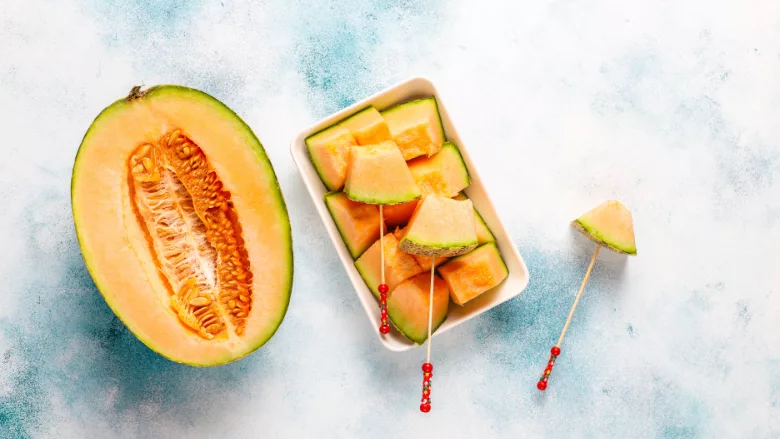
cantaloupe
Image credit: azerbaijan_stockers via Freepik
November 12, 2025

Researchers have developed a new, farm-to-fork quantitative microbial risk assessment (QMRA) model to evaluate the risk of Listeria monocytogenes contamination in fresh-cut cantaloupe, and ran simulations using the model in a new study. Published in the Journal of Food Protection, the study was led by researchers at Cornell University and funded by the U.S. Department of Agriculture National Institute of Food and Agriculture (USDA-NIFA).

Overall, the QMRA’s estimates underscore the importance of a multi-pronged approach to L. monocytogenes risk reduction in fresh-cut cantaloupe. Temperature control post-packing, effective washing practices, and improved data collection, especially at the field level, are crucial.

Model Development and Simulations

The model considers conditions across the cantaloupe supply chain, including field-level harvest, intermediate handling (i.e., in cooling facilities or packinghouses), fresh-cut processing, distribution, retail, and home storage. The researchers ran simulations to provide estimates of L. monocytogenes concentration in a single serving of cantaloupe (134 grams) and to estimate annual illnesses and deaths in the U.S. attributed to L. monocytogenes-contaminated fresh-cut cantaloupe. 

Importantly, the absence of data on L. monocytogenes prevalence and concentration at the field level restricted the model’s scope and prevented assessment of pre-harvest interventions. Moreover, due to data constraints, cross-contamination between facility surfaces and produce was modeled simplistically. While this had minimal impact on illness estimates, it influenced contamination prevalence.

Although the model is not ready for immediate use by industry as it does not allow for operation-specific data inputs, it provides a framework for identifying and evaluating interventions. The model, as well as data and code from the study, can be accessed via GitHub.

Findings and Implications for Industry

The QMRA estimated a median probability of illness per serving of 1.4 × 10⁻¹² for the general population and 6.4 × 10⁻¹¹ for susceptible populations. While the median predicted annual illnesses and deaths were zero, the 95th percentile estimates reached up to 1,070 illnesses and 264 deaths, indicating the potential for significantly adverse public health outcomes in the worst-case scenarios.

The initial concentration of L. monocytogenes on cantaloupe at harvest, as well as post-packaging time–temperature conditions, were identified as the most influential factors affecting the presence of L. monocytogenes per serving and the risk of illness. The researchers suggest that targeting time and/or temperature conditions post-packaging may be an effective strategy for reducing the risk of listeriosis due to L. monocytogenes on cantaloupe.

Looking for quick answers on food safety topics?
Try Ask FSM, our new smart AI search tool.
Ask FSM →

Additionally, the initial L. monocytogenes levels at harvest and cross-contamination at the fresh-cut facility had the greatest impact on the prevalence of contaminated servings. 

QMRA Analysis, Validation, and Limitations

Scenario analysis revealed that increased clustering of L. monocytogenes contamination—where contamination is concentrated in fewer units—generally led to better public health outcomes than homogeneous contamination.

The QMRA model was validated against data from a major 2011 U.S. listeriosis outbreak, which resulted in 33 deaths and 147 hospitalizations, and retail-level L. monocytogenes concentration data. Observed contamination levels fell within the predicted range, supporting the model’s reliability. However, high-end percentile estimates (95th and 99th) showed wider uncertainty bounds, a common issue in rare-event modeling. Therefore, these estimates should be interpreted with caution.

Future research should focus on expanding field-level data, refining cross-contamination modeling, and improving simulation granularity to better capture serving-level risk variability.


KEYWORDS: Cornell University listeria study

Share This Story

Baileehendersonmay23

Bailee Henderson is the Digital Editor of Food Safety Magazine. She can be reached at hendersonb@bnpmedia.com.

Recommended Content

JOIN TODAY
to unlock your recommendations.

Already have an account? Sign In

  • people holding baby chicks

    Serovar Differences Matter: Utility of Deep Serotyping in Broiler Production and Processing

    This article discusses the significance of Salmonella in...
    Testing & Analysis
    By: Nikki Shariat Ph.D.
  • woman washing hands

    Building a Culture of Hygiene in the Food Processing Plant

    Everyone entering a food processing facility needs to...
    Personal Hygiene/Handwashing
    By: Richard F. Stier, M.S.
  • graphical representation of earth over dirt

    Climate Change and Emerging Risks to Food Safety: Building Climate Resilience

    This article examines the multifaceted threats to food...
    Management
    By: Maria Cristina Tirado Ph.D., D.V.M. and Shamini Albert Raj M.A.
Manage My Account
  • eMagazine Subscription
  • Subscribe to eNewsletter
  • Manage My Preferences
  • Website Registration
  • Subscription Customer Service

More Videos

Sponsored Content

Sponsored Content is a special paid section where industry companies provide high quality, objective, non-commercial content around topics of interest to the Food Safety Magazine audience. All Sponsored Content is supplied by the advertising company and any opinions expressed in this article are those of the author and not necessarily reflect the views of Food Safety Magazine or its parent company, BNP Media. Interested in participating in our Sponsored Content section? Contact your local rep!

close
  • Salmonella bacteria
    Sponsored byThermoFisher

    Food Microbiology Testing Methods: Salmonella species

  • a diagram explaining indicator organisms
    Sponsored byHygiena

    How Proactive Listeria Testing Helps Prevent Six- and Seven-Figure Recalls

  • woman grocery shopping
    Sponsored byCorbion

    Designing Safety Into Every Bite: Proactive Risk Mitigation for Refrigerated Foods

Popular Stories

NRTE breaded stuffed chicken

USDA Indefinitely Delays Enforcement of Salmonella as Adulterant in Raw Breaded, Stuffed Chicken

non-conforming product

How to Handle Non-Conforming Product

spoonfuls of food ingredients

FDA’s Developing Rule to Tighten GRAS Oversight Moves to White House

Events

December 11, 2025

How to Develop and Implement an Effective Food Defense Strategy

Live: December 11, 2025 at 2:00 pm EDT: From this webinar, attendees will learn common areas where companies encounter challenges in their food defense strategies and how to address them.

May 11, 2026

The Food Safety Summit

Stay informed on the latest food safety trends, innovations, emerging challenges, and expert analysis. Leave the Summit with actionable insights ready to drive measurable improvements in your organization. Do not miss this opportunity to learn from experts about contamination control, food safety culture, regulations, sanitation, supply chain traceability, and so much more.

View All

Products

Global Food Safety Microbial Interventions and Molecular Advancements

Global Food Safety Microbial Interventions and Molecular Advancements

See More Products

Related Articles

  • greek salad

    Review Identifies Gaps in Existing Quantitative Risk Assessment Models for Listeria on Produce

    See More
  • meat cut on a board

    Case Studies Reveal Importance of EMPs for Listeria at Food Production Facilities

    See More
  • temperature monitoring

    The Basics of Temperature Monitoring and Importance of Ensuring Accuracy

    See More

Related Products

See More Products
  • 1118396308.jpg

    High Throughput Analysis for Food Safety

  • 1119160553.jpg

    Food Safety: Innovative Analytical Tools for Safety Assessment

  • 1119053595.jpg

    Food Safety for the 21st Century: Managing HACCP and Food Safety throughout the Global Supply Chain, 2E

See More Products

Related Directories

  • On Target Packaging

    On Target Packaging is a production/maintenance servicer for combination and check weighers. We do not sell or process food, but provide service/repairs, and equipment for the food industry
×

Never miss the latest news and trends driving the food safety industry

eNewsletter | Website | eMagazine

JOIN TODAY!
  • RESOURCES
    • Advertise
    • Contact Us
    • Directories
    • Store
    • Want More
  • SIGN UP TODAY
    • Create Account
    • eMagazine
    • eNewsletter
    • Customer Service
    • Manage Preferences
  • SERVICES
    • Marketing Services
    • Reprints
    • Market Research
    • List Rental
    • Survey/Respondent Access
  • STAY CONNECTED
    • LinkedIn
    • Facebook
    • Instagram
    • X (Twitter)
  • PRIVACY
    • PRIVACY POLICY
    • TERMS & CONDITIONS
    • DO NOT SELL MY PERSONAL INFORMATION
    • PRIVACY REQUEST
    • ACCESSIBILITY

Copyright ©2025. All Rights Reserved BNP Media.

Design, CMS, Hosting & Web Development :: ePublishing