The U.S. Food and Drug Administration (FDA) has posted answers to frequently asked questions (FAQs) and additional tools to provide industry with more information about the FDA Food Safety Modernization Act (FSMA) Food Traceability Final Rule, also known as FSMA 204.
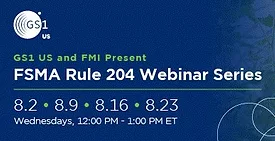
In this episode of Food Safety Matters, we are joined by Angela Fernandez of GS1 U.S. to discuss the new requirements and opportunities for companies to improve product traceability and supply chain visibility in light of FDA’s FSMA Rule 204 and the New Era of Smarter Food Safety, and how the use of GS1 Standards can help achieve these goals.
The U.S. Food and Drug Administration (FDA) has published a Small Entity Compliance Guide for the Food Traceability Final Rule fulfilling Food Safety Modernization Act (FSMA) Section 204.
The Institute of Food Technologists (IFT) has released a report commissioned by the U.S. Food and Drug Administration (FDA) that evaluates food traceability trends based on 90 submissions from teams participating in FDA’s 2021 Low- or No-Cost Tech-Enabled Traceability Challenge. IFT determined that the knowledge, means, and technology have been developed to make end-to-end tech-enabled traceability a reality, but it will not be realized without collective action and continued innovation among the diverse food industry community.
The Institute of Food Technologists’ Global Food Traceability Center (IFT’s GFTC) has released eleven new commodity-specific educational videos covering key sections of the U.S. Food and Drug Administration’s (FDA’s) Food Traceability Final Rule.
Of all the key features of FDA's Traceability Final Rule, the Traceability Lot Code (TLC) stands out for its criticality and understated complexity. This crucial code serves as a breadcrumb trail, highlighting every step a product takes through the supply chain.To meet the TLC requirements, industry actors will need to make significant modifications to current lot coding practices.
This article examines and unpacks the evolving demands for traceability across various dimensions, such as supply chain visibility, transparency, trust, and sustainability. It investigates the growing importance of services related to the traceability of food production, harvesting, processing, and distribution, as well as verifiable credentials for product and process claims.
In November 2022, the U.S. Food and Drug Administration (FDA) released its Final Food Traceability Rule—a new rule that will have wide-reaching impact on food companies. This issue features Part 2 of the results of our survey of food processors' thoughts on this new rule and their plans for compliance.
The European Food Safety Authority (EFSA) recently published a report detailing the activities of its Advisory Group on Data during 2022. The aim of the EFSA Advisory Group on Data is to demonstrate the ways in which digitalization of food systems can improve food safety in Europe.