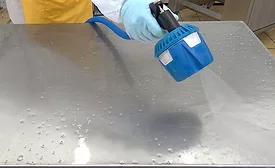
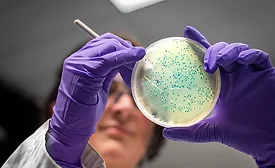
A recent study reviewed the efficacy of environmentally friendly pathogen inactivation methods against Listeria monocytogenes biofilms in food production environments, specifically, electrolyzed water, plasma-activated water, ozone, and enzymes.
A recent study has demonstrated the extent to which defects on food contact surfaces in tree fruit packinghouses lowers the efficacy of sanitizers against Listeria monocytogenes biofilms.
With each passing year, new and emerging technologies and techniques that have promise for advancing food safety are developed and validated. This article summarizes the top food safety innovations of 2023, based on audience interest.
Ongoing research funded by the Center for Produce Safety aims to fill knowledge gaps about the efficacy of sanitizers and wash techniques used on peaches.
Madison Chemical has introduced its new ProClean® DEGREASER, a liquid, moderately alkaline, multi-purpose detergent for general purpose cleaning and degreasing in food and beverage plants.
Researchers from Kao Corporation have developed a long-lasting skin coating agent that kills pathogens on the hands, paving the way for new hand hygiene solutions that could potentially help food handlers prevent cross-contamination.
A project funded by the Center for Produce Safety has collected information about, validated, and evaluated the efficacy of the cleaning and sanitation practices for harvest equipment among blueberry harvesters and packers.
PurOne Cleaner and Disinfectant from EvaClean Infection Prevention Solutions has received EPA approval of its updated master label, adding Candida auris to its existing biofilm claim, and making the product one of the few to be registered as effective against both hazards.
Ongoing research funded by the Center for Produce Safety aims to evaluate the efficacy of commercially available sanitizers against common foodborne pathogens and biofilms encountered during tree fruit harvesting, and then conduct a validation study of the best-performing treatments at commercial facilities.
Researchers are exploring the use of superheated, dry steam to clean food manufacturing facilities where the use of traditional wet sanitation is limited, such as in produce packing facilities and low-moisture food processing plants.