Antimicrobial Violet-Blue Light Shows Promise for Reducing Drug-Resistant Campylobacter on Poultry
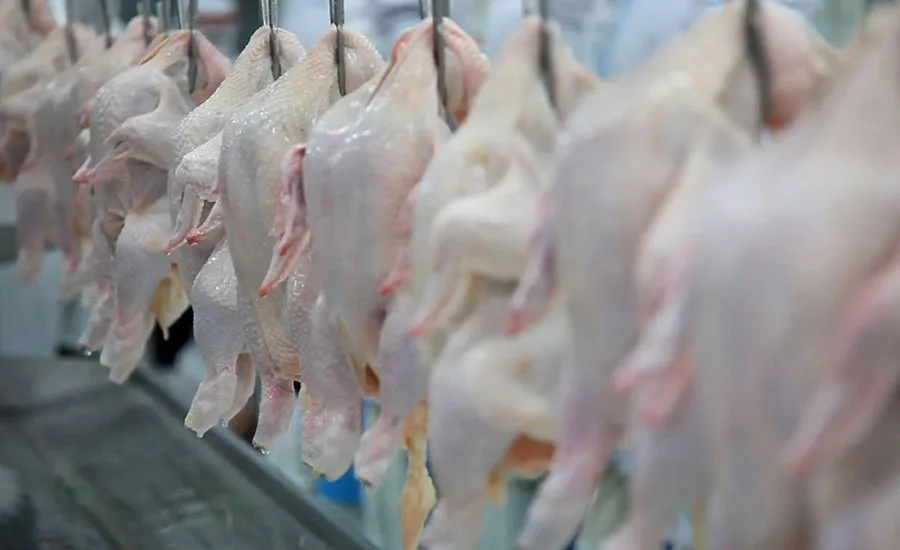
In a new study, low-power, violet-blue light treatment was shown to be effective against diverse poultry-associated Campylobacter isolates, including antimicrobial-resistant (AMR) strains. The study was led by University of Reading researchers in collaboration with the UK Animal and Plant Health Agency (APHA).
Published in Microbiology, the study evaluated violet-blue photodynamic inactivation (VB-PDI), which uses 405-nanometer (nm) visible light to activate naturally occurring photosensitizers within bacterial cells. This process generates intracellular reactive oxygen species (ROS) at levels that are lethal to Campylobacter. The researchers are investigating VB-PDI as a possible non-chemical intervention for reducing surface contamination of poultry products.
Campylobacter is the leading cause of bacterial gastroenteritis worldwide. In the UK, approximately 70,000 laboratory-confirmed cases were reported in both 2024 and 2025. The annual economic burden associated with Campylobacter infection in the UK has been estimated at £0.7 billion. Additionally, Campylobacter is present on approximately two-thirds of raw chicken sold by UK retailers.
VB-PDI Effective Across Campylobacter Species and AMR Profiles
To determine whether VB-PDI technology would be effective against the diversity of Campylobacter found in poultry production, the researchers tested 64 isolates collected through UK national surveillance programs between 2008 and 2024. The collection comprised 43 C. jejuni, 14 C. coli, and seven C. lari isolates originating from broilers, broiler farms, and turkeys.
All 64 isolates showed dose-dependent susceptibility to VB-PDI. At the highest tested dose of 36 joules per square centimeter (J/cm²), every isolate underwent at least a 2-log reduction in viable cells, and 44 percent experienced reductions exceeding 4 log. The researchers found no significant differences in susceptibility among the three Campylobacter species. A separate bioinformatic analysis of 6,658 genomes representing 53 Campylobacter species also found that genes associated with the mechanism underlying VB-PDI susceptibility were ubiquitous across the genus.
In additional experiments, bacterial reductions increased linearly with exposure time. No viable cells were detected after 15 minutes under a higher-power, 50-milliwatt treatment or after 80 minutes under a lower-power, 10-milliwatt treatment, representing reductions greater than 5 log, or 99.999 percent. The researchers also did not detect persister cells under the experimental conditions.
Importantly, existing AMR did not diminish VB-PDI's efficacy. Among the isolates, 61.5 percent were resistant to ciprofloxacin, 55.4 percent to tetracycline, and 16.9 percent to ertapenem. Additionally, 18.5 percent were multidrug-resistant. No significant association was observed between these resistance phenotypes and susceptibility to VB-PDI. Aerotolerance, which can contribute to the persistence of Campylobacter in poultry production environments, also did not significantly affect treatment susceptibility.
Looking for quick answers on food safety topics?
Try Ask FSM, our new smart AI search tool.
Ask FSM →
Researchers Found No Evidence of Evolved VB-PDI Resistance
The researchers also investigated whether repeated VB-PDI exposure could select for resistant Campylobacter. Three lineages of a C. jejuni field isolate were subjected to 15 consecutive treatments, each producing an approximately 3-log reduction and leaving roughly 0.1 percent of the population surviving each exposure.
No significant increase in VB-PDI tolerance was observed after the repeated treatments. The researchers attributed the apparently low potential for resistance in part to VB-PDI's mechanism, which causes ROS-mediated damage across multiple cellular targets rather than acting on a single target, as many antibiotics do. However, they acknowledged that further research would be necessary to more conclusively characterize the potential for resistance development.
2-log Reduction Could Decrease Public Health Risk by 90 Percent
The researchers highlighted poultry processing as a potential application for VB-PDI. Based on historical UK contamination data, they estimated that achieving a 2-log reduction on broiler carcasses could decrease the proportion of highly contaminated carcasses leaving slaughterhouses from 26 percent to 7 percent. Applying the same reduction to 2023 retail survey data would decrease the proportion of highly contaminated whole chickens from 10 percent to approximately 2 percent. Previous risk modeling cited by the researchers suggested that a 2-log reduction could decrease the downstream public health risk of infection by as much as 90 percent.
Because the approach uses low-power LEDs with long operating lifespans and minimal maintenance requirements, the researchers suggested that VB-PDI could potentially provide an economically accessible intervention, including for producers in low- and middle-income countries.
Poultry Processing Applications Require Further Study
However, the findings were based on controlled laboratory experiments using bacterial suspensions, rather than treatment of poultry carcasses. The researchers cautioned that poultry skin, organic material, and biofilms in processing environments could affect light penetration and bacterial susceptibility. Trials using naturally contaminated carcasses under industry-relevant processing conditions are therefore needed to determine whether the reductions demonstrated in vitro can be replicated in commercial settings.