Building a HACCP Program: More Than the Seven Principles

Hazard Analysis and Critical Control Points (HACCP) celebrated its 66th anniversary in 2025. What began in 1959 as a means of ensuring the safety of food for the U.S. National Aeronautics and Space Administration (NASA) space program, HACCP was jointly developed by NASA, Natick Laboratories, and Pillsbury. Since the 1960s, HACCP has evolved into a globally accepted food safety system that is widely required by regulators, customers, certification schemes, or company programs, depending on the operation and jurisdiction. HACCP has expanded from three principles to seven, and modern HACCP-based food safety systems incorporate prerequisite programs and other elements that were not part of the original incarnation.
Evolution has taken place in many other food safety systems, standards, and regulations over recent decades. Consider how the regulatory framework established under the U.S. Food Safety Modernization Act (FSMA) has continued to develop over the past 15 years, or how the ISO 22000 standard, "Food safety management systems—Requirements for any organization in the food chain," has been updated since its introduction in 2005. These two, especially the latter, have significant influence on global food safety. Certification of food safety systems is extremely important, which is why many companies not only require their suppliers to maintain a HACCP program and Food Safety Management System (FSMS), but also to adhere to one of the Global Food Safety Initiative's (GFSI's) recognized certification programs.
A HACCP plan encompasses the elements required by the seven HACCP principles, but effective implementation depends on a broader system of prerequisite programs, supporting procedures, document controls, training, and management oversight. These supporting programs compel companies to develop, document, implement, and maintain a large number of procedures in many different areas. Most processors will already have some elements of a formal program in place before initiating development of a HACCP-based system. This article focuses on the fundamentals of building such a system from the ground up.
Essential HACCP Elements
The first necessary element is management commitment. Management must support the effort to build the program and provide the resources (e.g., money, labor, and time) needed to develop, document, and implement it. The latter element, time, is extremely important. Building a program will not happen overnight. When starting from scratch, complete development and implementation may take 1–2 years. Management support should be reflected in the company's mission statement and/or quality policy.
The second required element is a document management program, which will include a standard format for all documents and procedures to be created. The following describes how such a protocol might look:
- Each company must develop a standard format for documents, including a standard numbering system to track revisions.
- All documents must be drafted by persons approved by the company to prepare documents.
- Documents must be reviewed and approved for use by a designated person or persons (e.g., quality assurance personnel, document control officer, etc.).
- A system for tracking changes to current documents must be maintained.
- It is recommended that a system for tracking non-controlled documents be developed. Options include using a stamp or ensuring that any uncontrolled document that is printed includes a watermark.
- A designated person must maintain a master log of all documents.
- All forms used for quality, production, and other operations must also be approved. The same document control guidelines apply.
The document management program must also include the following elements:
- Master log of documents and forms
- Distribution of new documents
- Recovery of old protocols
- Document retention
- Destruction of documents
- Use of document control software.
Requirements for HACCP Development
Many procedures will be required to support the HACCP program. These are summarized by element and discussed below. The order in which they are developed will depend on the processor. The company will need to clearly establish responsibilities for developing the necessary procedures in different program areas. The management team is tasked with defining the areas for which protocols will be developed and identifying the persons responsible for them. As responsibilities are determined and assigned to different individuals or operating groups, job descriptions will need to be modified to reflect these changes, so Human Resources will need to be involved as well.
The company should also establish protocols for internal and external communication, since many procedures will require working with or involving persons outside the company. These outside parties may include suppliers, regulators, local police, hospitals, emergency services, contractors, pest control operators, cleaning companies, and others. When developing a list of persons to contact, make sure the protocols include routine checks, at a minimum quarterly, to confirm that contact information is current. In an emergency, outdated contact information could delay a timely response.
With these overarching administrative responsibilities established, many food safety experts recommend tackling prerequisite programs before developing the HACCP plan itself. For purposes of developing the HACCP system, prerequisite programs can be organized into six general areas:
- Sanitation Standard Operating Procedures (SSOPs)
- Good Manufacturing Practices (GMPs)
- Product identification
- Traceability and recalls
- Preventive maintenance
- Employee education/training.
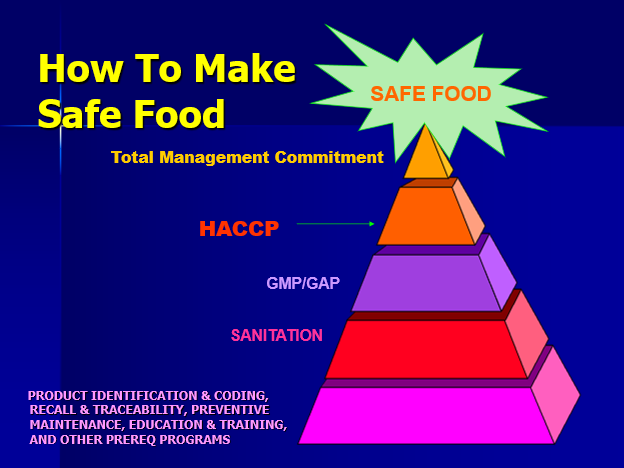
The prerequisite programs provide a solid base upon which to build the HACCP plan, as illustrated in Figure 1.
Looking for quick answers on food safety topics?
Try Ask FSM, our new smart AI search tool.
Ask FSM →
Figure 1. Prerequisite programs provide the foundation for safe food production
SSOPs
Sanitation, especially cleaning and sanitizing, is absolutely essential for ensuring the production of safe food. First, establish a master cleaning schedule that clearly defines everything that must be cleaned and how often it must be done. Protocols for cleaning and sanitizing must be developed for all unit operations and the equipment that facilitates those operations, as well as floors, walls, drains, overheads, warehouses, refrigerators, and utensils. Cleaning procedures should also be validated to ensure they are effective, especially if the products being manufactured contain allergens.
SSOPs should also address applicable employee hygiene and protective-equipment requirements associated with sanitation activities. Cleaning procedures for equipment and the plant itself should include verification activities to determine whether the procedure was followed correctly and was effective. Where warranted by the products and operation, an environmental monitoring program should also be established as part of the facility's broader sanitation and food safety system.
Preparing cleaning procedures for everything that requires cleaning is a challenge. It is not a "one-size-fits-all" activity.
GMPs
GMPs encompass a number of items, some of which will involve contractors. When contractors are involved, procedures will need to be established to outline what is expected from the contractor, how the contractor reports, and what is done internally to verify compliance. For example, most companies contract out pest management services.
Other GMP procedures that will need to be developed and implemented include, but are not limited to:
- Managing utilities such as water, air, and steam
- Equipment evaluation, approval, and purchasing
- Rework guidelines
- Allergen management
- Foreign material control
- Chemical handling and storage
- Shipping, receiving, warehousing, and purchasing
- Food defense.
Procedures for each of the above elements need to be developed, documented, implemented, and maintained. Procedures should be developed as thoroughly as possible before implementation, but they should also be reviewed after implementation and updated when experience indicates that improvements are needed. A well-developed system that incorporates continuous improvement is easier to maintain than one that requires continual firefighting and troubleshooting.
Product Identification and Traceability
Product identification and traceability are two sides of the same coin. It is not possible to track products if they are not properly identified (coded) and if production quantities are not known. Production must establish protocols for clearly tracking the amount of product in each lot and properly segregating individual lots. If a lot number changes by the hour, then the company must ensure that each lot remains uniform. Cases and pallets should not be mixed between lots.
Procedures for tracking products and conducting recalls are required under various GFSI-recognized certification programs, ISO 22000, and applicable government regulations. The recall program must include procedures for conducting mock recalls and evaluating performance. The ultimate goal with these procedures and others is continuous improvement.
Preventive Maintenance
Maintenance procedures must be developed for all pieces of equipment and the physical plant. Different frequencies of maintenance are usually required for different equipment, e.g., daily, weekly, monthly, and yearly.
Emergency maintenance protocols must also be developed. These are especially important for pieces of equipment that are necessary for optimum production and any units deemed essential for ensuring food safety.
Employee Education
The final prerequisite area is education and training. Processors and handlers must establish protocols for ensuring that their workforce and management have been properly educated and trained in all areas of sanitation, GMPs, and food safety that relate to their jobs. The education or training required for each position must be outlined in each job description. Records of training must be maintained and may be reviewed by regulators and auditors.
Constructing a HACCP Plan
With the supporting programs in place, the HACCP plan itself must be developed in accordance with the seven HACCP principles, beginning with a hazard analysis. The hazard analysis must include a risk assessment of all raw materials, ingredients, and packaging, as well as each step identified in the process flow diagram for each product. Once potential hazards have been identified, the company must determine critical control points, establish critical limits, and develop procedures for monitoring those limits. The HACCP plan must also include corrective actions, verification activities to ensure the plan is being followed as designed, and records documenting compliance.
Personnel responsible for monitoring critical limits, as well as others involved in implementing and maintaining the HACCP program, must be properly educated and trained, and that training must be documented, as discussed earlier. Verification activities should also include procedures for reviewing critical control point monitoring records and conducting appropriate internal reviews or audits. Critical limits must be validated to demonstrate that the control measures, when properly implemented, are capable of controlling the identified hazards.
Finally, protocols must be established for regularly reassessing the HACCP plan and its supporting food safety programs. Reassessment should be conducted at least annually, as well as whenever the HACCP plan is modified or issues arise that could affect the plan or broader food safety system.
This article presents an abbreviated overview of what is required to develop, document, implement, and maintain a HACCP plan and the programs that support it. A processor or handler may need to develop and implement dozens of procedures, including the education and training of all personnel involved in their implementation and maintenance. For companies building a HACCP system from the ground up, the process requires a significant commitment of time and resources, along with strong management support and a demonstrated commitment to food safety. These characteristics are hallmarks of well-managed food processors and companies that set a high standard for the industry.