Improving the Safety of Hydroponic Crops: Evaluation of Strategies to Mitigate Human Pathogens in Hydroponic Production
Several key opportunities exist to strengthen research and develop system-specific and effective food safety strategies for hydroponics
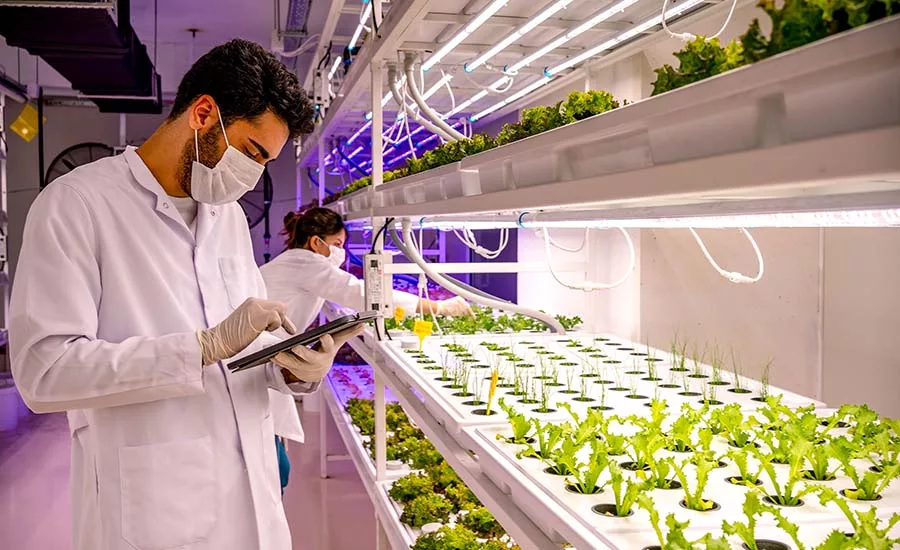
Growing vegetables using hydroponics in controlled environments enables continuous, year-round, local production of nutrient-dense crops, which are essential to addressing the increasing prevalence of chronic diseases and micronutrient deficiencies in the U.S. Since hydroponic systems do not require fertile soil or large outdoor areas, they can be established in both urban and rural settings, improving access to affordable, fresh, and nutritious foods across the country.
Hydroponic cultivation is experiencing rapid global expansion, driven by demand for nutrient-dense, year-round fresh produce. Currently, the U.S. hydroponic market is valued at approximately $961.8 million USD and is projected to grow annually at a rate of 10.7 percent. However, this intensive form of production presents unique food safety challenges, particularly the potential for contamination with human pathogens. Recently, several foodborne illness outbreaks and hydroponic crop recalls have been reported, highlighting the critical need for effective mitigation strategies to ensure both food security and food safety in these complex systems.
The Unique Microbial Challenge in Hydroponic Systems
Hydroponic systems inherently pose specific food safety challenges distinct from traditional field production. Since crops are constantly exposed to the circulating nutrient solution, if pathogens enter the system through contaminated water, workers, or surfaces, then the solution can serve as a transmission route, cross-contaminating the edible parts of the plants. Furthermore, organic compounds secreted by roots (e.g., sugars) leach into the nutrient solution, creating a unique environment that encourages bacterial growth and biofilm formation on system surfaces.
Multiple bacterial human pathogens such as Listeria monocytogenes, Shiga toxin-producing Escherichia coli (STEC), and Salmonella have been isolated from hydroponic environments, shown to survive in nutrient solution and production systems, and readily contaminate edible parts of hydroponic crops. Since hydroponic operations often run continuously, they generally lack the necessary "clean breaks" required for thorough sanitation, allowing pathogen biofilms to become established and pose a severe, long-term food safety threat. While the Food Safety Modernization Act (FSMA) Produce Safety Rule provides guidelines, they were developed for soil-based systems and do not adequately address the specific needs of hydroponic production.
Mapping the Evidence: Interventions and Research Gaps
There is currently limited scientific evidence on how to best prevent and mitigate contamination with foodborne pathogens in hydroponics. This is partly due to diverse systems and management practices in the industry requiring system-specific food safety solutions. Despite the diversity of hydroponic systems utilized and the potential differences in food safety risks associated with each system, nearly half of all intervention studies failed to specify the type of hydroponic system used. In those studies that reported the system type, scaled validation was lacking, making it difficult to translate the findings into practical recommendations for commercial settings.
Research has focused primarily on leafy greens, with lettuce receiving the most attention, while crops with longer growing cycles or more complex production requirements—such as tomatoes, cucumbers, and strawberries—have been largely overlooked. This limits our understanding of food safety mitigation strategies for these high-value crops. Not surprisingly, the usual suspects (Salmonella, Shiga toxin-producing E. coli [STEC], and Listeria monocytogenes) were most often investigated. Salmonella spp. was studied in almost half of all available studies, while over a third of the studies investigated only human pathogen indicators or surrogates, rather than virulent pathogenic strains. Information on all other human pathogens remains limited.
Among the interventions studied for preharvest stages, chemical approaches were most frequently evaluated. Chemical sanitizers, particularly chlorine-based products and peroxyacetic acid (PAA), are the most frequently tested interventions because they are often available and affordable for commercial operations. However, the efficacy of chemical treatments varies significantly depending on the compound and the surface material. For example, studies evaluating chlorine-based sanitizers at concentrations below 200 ppm demonstrated low reductions of Salmonella Typhimurium on nutrient film technique (NFT) surfaces. In contrast, several peracetic acid (PAA) and quaternary ammonium compound (QAC)-based sanitizers demonstrated high efficacy on most surfaces, but when applied to nutrient solution, they adversely affected plant health.While these treatments can achieve pathogen reduction, the cost-benefit balance of their use may not be favorable for the industry due to their negative impact on crop yield and nutritional quality. Physical, biological, and multi-hurdle interventions have been rarely evaluated. Based on the published evidence, no single intervention—whether chemical, physical, or biological—was able to eliminate pathogens from seeds, sprouts, or edible parts of crops.
Looking for quick answers on food safety topics?
Try Ask FSM, our new smart AI search tool.
Ask FSM →
Advancing Hydroponic Food Safety: A Call for Future Research
The current body of evidence does not emulate the production conditions and risks specific to hydroponic crop production systems. Moreover, the systems, crops, interventions, and stage (pre- or postharvest) in which interventions were implemented varied considerably between studies, precluding any generalization of findings or pooled analysis. Due to these factors, it is difficult to use the available evidence to develop food safety recommendations for the industry.
Several key opportunities exist to strengthen research and develop system-specific and effective food safety strategies for hydroponics:
- Scale and scope: There is a valuable opportunity to expand research through commercial-scale or near-commercial-scale intervention studies that more accurately reflect industry conditions. In addition, broadening the focus beyond lettuce to include hydroponically grown crops with longer cycles—such as tomatoes, peppers, and cucumbers—would allow the development of validated approaches for a wider range of systems, supporting safer and more diverse crop production.
- Reporting quality: Future research can have a greater impact by improving transparency and methodological detail. Clearly describing the type of hydroponic system and production conditions, as well as providing complete datasets, will allow results to be reliably reproduced and built on and applied in commercial settings.
- Alternative intervention strategies: Given the challenges associated with chemical treatments, there is a significant opportunity to explore a broader range of alternative mitigation strategies—including biological, physical, and multi-hurdle methods—tailored to the unique conditions of hydroponic production systems.
- Strengthening resources: Advancing food safety research in hydroponics requires research greenhouses and growth rooms with appropriate Biosecurity Level 2 (BSL-2) clearance. Establishing a proactive food safety culture and relying on validated, data-driven practices are essential for building consumer confidence in hydroponic produce.
Hydroponic production offers significant potential to improve human nutrition, support health, promote sustainable agriculture, and help combat food insecurity, making food safety a critical focus for both research and practice. The current available evidence, along with the notable gaps identified, highlights the challenges of conducting scalable and reproducible experiments that can generate data-driven, practical food safety recommendations for a variety of hydroponic cropping systems.
Current research shows that the field is in its infancy and that the body of evidence does not exist to establish practical, commercially scaled guidelines. Advancing hydroponic food safety will require substantially more resources beyond standard laboratory facilities, including indoor growing spaces equipped with appropriate biosafety clearance. By fostering a strong food safety culture and implementing validated interventions, the hydroponic industry can ensure the production of safe, high-quality crops while supporting its long-term growth and sustainability.
Back to Basics: Prevention Over Mitigation
Given the limited evidence for mitigation of human pathogens in hydroponic systems, prevention remains the most reliable strategy. Prevention relies on the implementation of Good Agricultural Practices (GAPs), based on comprehensive risk assessments of all food safety hazards with specific focus on the primary vectors of microbial contamination: water/nutrient solution, workers, environmental surfaces, and pests.
Water and Nutrient Solution Quality Management. Water and nutrient solution are the most significant vehicles for human pathogens in hydroponic operations; consequently, experts consistently prioritize water management as a critical control point (CCP). The risk profile begins at the source: city water is generally considered the safest, while surface water poses the highest risk. If sources are mixed, then the system's water is defined by the highest-risk component. Since there are currently no effective interventions to eliminate human bacterial pathogens once they are introduced into the nutrient solution in hydroponic systems during production, preventing pathogen entry into both the source and recirculated water is of the utmost importance.
Worker Hygiene. People, including workers and visitors, are important sources of contamination in hydroponics. Personal hygiene is ranked among the highest-priority management practices, with proper handwashing standing as the single most important strategy for risk reduction. This must be supported by an enforceable worker health policy that strictly prohibits sick or injured individuals from handling produce, equipment, or packaging.
Environmental Surfaces. Since pathogens can establish themselves on dirty equipment, surfaces, and floors, experts have identified sanitation and the cleanliness of surfaces as critical priorities for preventing foodborne pathogen contamination in hydroponics. Appropriate zoning should be implemented to categorize surfaces within the hydroponic operation based on the risk they pose to produce contamination, thereby prioritizing cleaning and sanitation.
Hydroponic GAPs prioritize sanitation efforts using a four-zone categorization. Zone 1 includes food contact surfaces that directly touch produce (like harvest bins and workers' hands), making them the highest priority for cleaning and sanitation. Other zones address surfaces near produce (Zone 2), environmental surfaces inside the packing shed (Zone 3), and surrounding areas like toilet facilities (Zone 4). Cleaning and sanitation protocols should include sanitizers that are labeled for use in food production environments.
Pests. Simultaneously, the physical environment must be secured against rodents, birds, and domestic animals, which are known vectors for pathogens like Salmonella and E. coli. Best practices involve physical exclusion via screening and rubber sweeps, alongside meticulous sanitation to remove debris or cull piles that offer harborage. In the event of an intrusion, producers must implement a risk assessment to exclude any produce suspected of pest contamination, ensuring that compromised crops never enter the supply chain.
To ensure these GAP protocols are actionable, they must be documented in a food safety plan containing policies, Standard Operating Procedures (SOPs), and logs. This documentation is vital not only for verification but also for traceability; the ability to trace a crop "one step forward and one step back" is essential for rapidly isolating products during a potential recall.
References
- Lewis Ivey, M.L., A.A. Mensah, F. Diekmann, and S. Ilic. "Food Safety in Hydroponic Food Crop Production: A Review of Intervention Studies to Control Human Pathogens." Foods 14, no. 13 (June 2025): 2308. https://doi.org/10.3390/foods14132308.