A Roadmap to Deliver Food Safety Excellence in Retail Foodservice
Food safety management of foodborne disease risk must go beyond regulatory compliance
During the course of my career in public health, I have always worked to understand the root cause of various infectious diseases that are transmitted to humans by environmental exposure—for example, infection from microbial pathogens from drinking water, fruit and vegetable misting machines in grocery stores, or in food prepared in a restaurant. This career path has been challenging, but the mission of helping to prevent illness and save lives has always been my reward.
With foodborne illness, where the root causes (i.e., hazards) are well known, the controls of each these hazards are proven effective, and there is robust research and development from the federal government and academia to continually improve our knowledge. The challenge comes from gaps in prevention—i.e., the interpretation, implementation, and execution of this knowledge by the retail foodservice industry. It is this gap that drives myself, along with many of our food safety management solution providers, to help the retail foodservice industry prevent foodborne illnesses with innovative products and services, and also collaborate to ensure effective preventive controls.
If you have read any of my books or previous articles, you will know that I always describe the state of public health in the retail foodservice industry by showing the numbers of foodborne disease outbreaks associated with this industry. This is proof that more work needs to be done by everyone to assure food safety. The number of foodborne illnesses caused by the retail foodservice industry has not declined over the past 15-plus years, and has averaged about 60 percent of total foodborne disease outbreaks year to year.
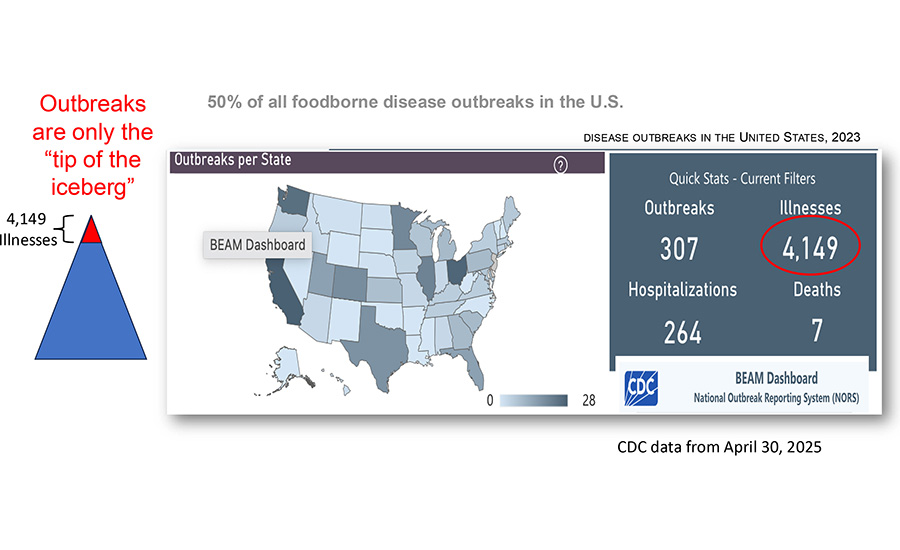
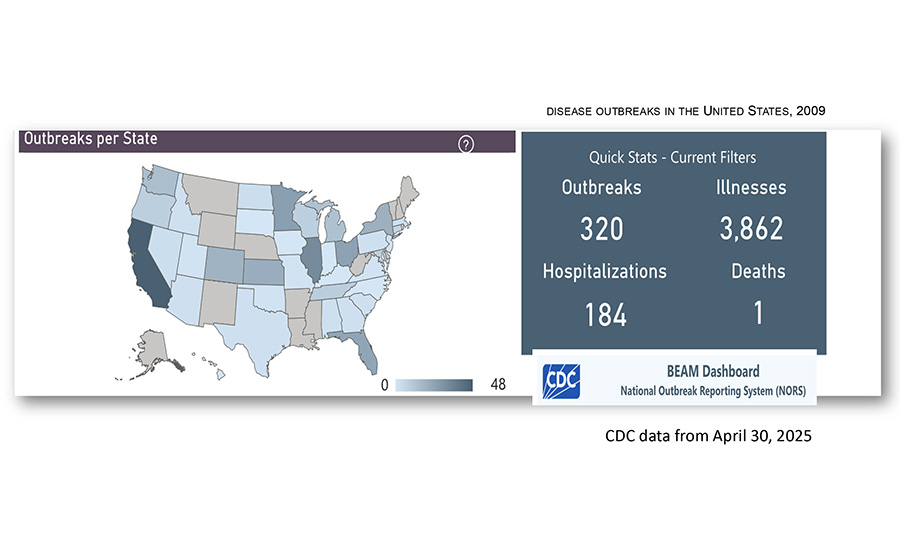
The most current U.S. data from the Centers for Disease Control and Prevention (CDC) via the Beam Dashboard,1 which uses National Outbreak Reporting System (NORS) data, shows 307 outbreaks, 4,429 illnesses, and 7 deaths (a preventable tragedy) caused by retail foodservice establishments in 2023. The outbreak statistic represents 50 percent of total number of 593 foodborne disease outbreaks from all settings in the U.S. (Figure 1). When these data are compared with the data from 2009 (the first year that CDC began reporting outbreaks via NORS), one can see that no real change has occurred in the total number of foodborne disease outbreaks caused by the retail foodservice industry in the U.S. (Figure 2).
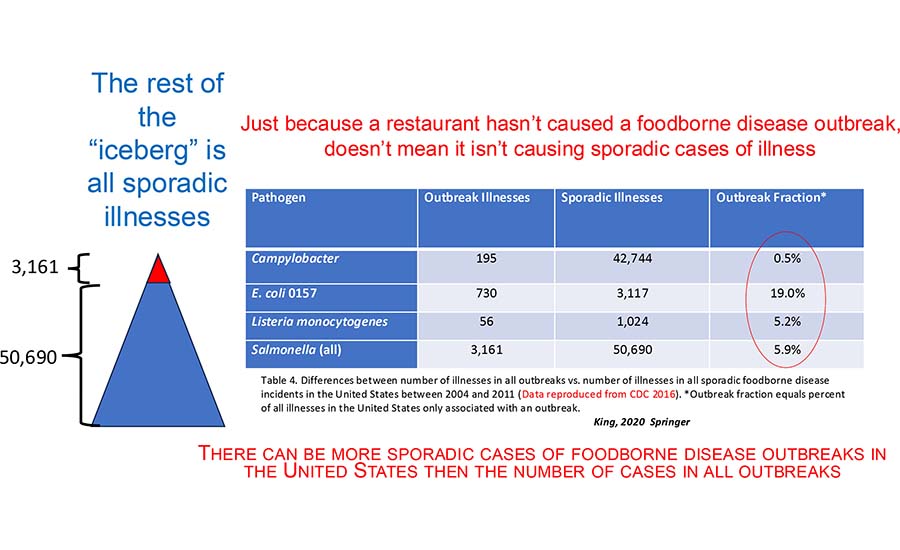
I often hear from people in the foodservice industry that they have never had a foodborne disease outbreak in their organization, so they must be managing food safety well. However, when I visit their food facilities or their suppliers and observe their operations, some are clearly not. A joint study2 by CDC, the Department of Agriculture (USDA), and the Food and Drug Administration (FDA), reported in 2016 that there can be more sporadic cases of foodborne illnesses caused by microbial pathogens like Campylobacter, Escherichia coli O157, Listeria, and Salmonella in the U.S. than there are total cases of each pathogen reported in outbreaks (Figure 3). This means that even though a retail foodservice establishment may not have "caused" a foodborne disease outbreak, it could be contributing to sporadic cases of illness if it does not ensure food safety in its facility operations and by its suppliers.
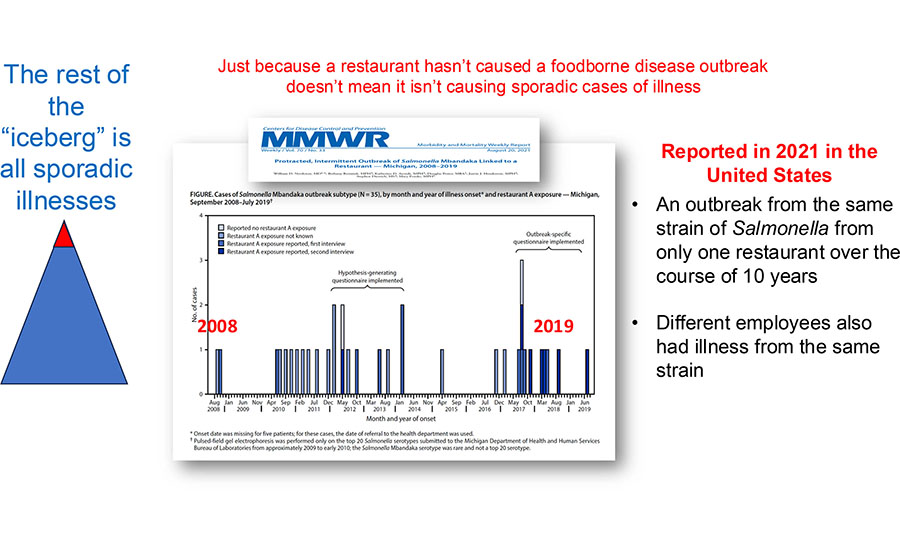
This scenario was further demonstrated by a single restaurant that was found to be causing sporadic cases of foodborne illnesses from the same strain of Salmonella over the course of 10 years (Figure 4). The pathogen was found throughout the restaurant on high-touch surfaces like mop handles, drains/floors, and in dishwashing sinks, where it became a persistent pathogen in the restaurant environment.
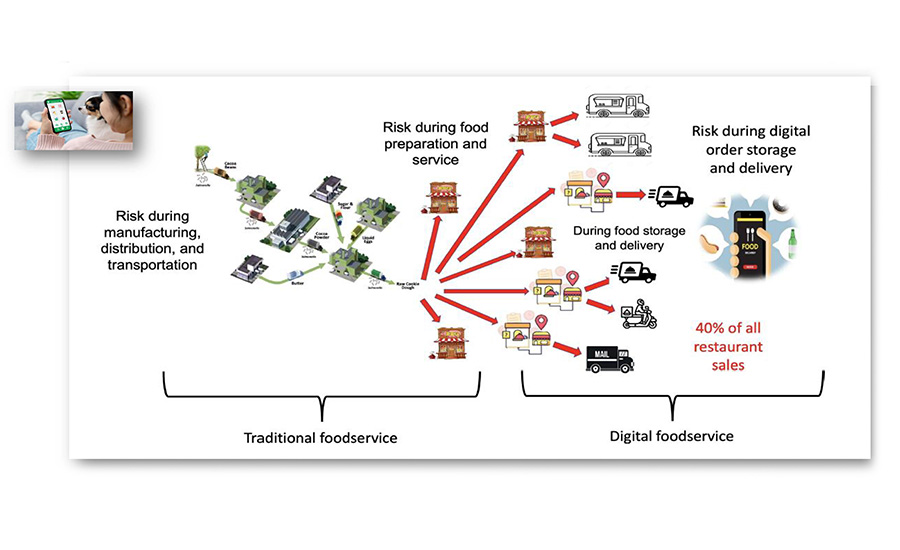
Now, post-pandemic, these risks continue to grow due to the digitalization of the retail foodservice industry,3 (Figure 5) where the volume of food orders to each foodservice kitchen is growing exponentially. Risks include contamination of food from undeclared allergens,4 where the challenges in prevention are high.
Looking for quick answers on food safety topics?
Try Ask FSM, our new smart AI search tool.
Ask FSM →
The good news is that the retail foodservice industry can work to continuously improve how food safety risks are managed by:
- Ensuring that businesses employ a food safety business leader5 who works with each of the corporate business functional leaders to implement and execute a food safety management program that drives a food safety culture.
- Ensuring that food ingredients and product suppliers meet FDA's Food Safety Modernization Act (FSMA) requirements6 for the manufacturing of foods by demonstration of a food safety plan. This plan should describe the hazard analysis and preventive controls that will be used to prevent contamination of ingredients and products, including how these hazards and controls are monitored during each production cycle.
- Implementing and executing a food safety management system7 (FSMS) in all foodservice establishments. The FSMS should include a robust cleaning and sanitation prerequisite control program8 to address persistent pathogens and reduce risk from sick employees, before it is required in each state. The 2024 Supplement to the FDA Food Code now describes the need for an FSMS to ensure active managerial control9 of food safety risks in foodservice establishments.
- Going beyond compliance in the way foodservice establishments clean and sanitize their facilities, to prevent cross-contamination.10
- Performing gap assessments11 of the food safety management program via third parties and benchmarking with industry food safety business leaders for continuous improvement.
A hallmark of the retail foodservice industry is the sharing of food safety management best practices among food safety business leaders, because ensuring food safety is viewed as a non-competitive business function. Retail foodservice businesses and their solution providers must work together to ensure food safety for their industry sector and, ultimately, for the health of consumers.
References
- U.S. Centers for Disease Control and Prevention (CDC). National Center for Emerging and Zoonotic Infectious Diseases (NCEZID). "BEAM Dashboard." Last reviewed April 18, 2025. https://www.cdc.gov/ncezid/dfwed/BEAM-dashboard.html.
- Ebel, E.D., M.S. Williams, D. Cole, et al. "Comparing Characteristics of Sporadic and Outbreak-Associated Foodborne Illnesses, United States, 2004–2011." Emerging Infectious Diseases 22, no. 7 (July 2016): 1193–1200. https://pmc.ncbi.nlm.nih.gov/articles/PMC4918141/.
- King, H. "Digital Transformation of Foodservice: Potential Contributing Factors for Foodborne Illness Outbreaks." Food Safety Magazine April/May 2024. https://www.food-safety.com/articles/9401-digital-transformation-of-foodservice-potential-contributing-factors-for-foodborne-illness-outbreaks.
- King, H. and S. Lyon. "Proactive Allergen Prevention in the Foodservice Industry." Food Safety Magazine February/March 2024. https://www.food-safety.com/articles/10114-proactive-allergen-prevention-in-the-foodservice-industry.
- King, Hal, Ed. Food Safety Leadership in the Business of Food Safety. BNP Media. October 30, 2023. https://www.food-safety.com/ebook/food-safety-leadership.
- King, H. and W. Bedale. Hazard Analysis and Risk-Based Preventive Controls. Elsevier, Academic Press, October 2017. https://shop.elsevier.com/books/hazard-analysis-and-risk-based-preventive-controls/king/978-0-12-809475-4.
- King, H. Food Safety Management Systems. Springer, 2020. https://link.springer.com/book/10.1007/978-3-030-44735-9.
- King, H. "Sanitation Prerequisite Programs as a Necessary Component of FSMS for Foodservice Establishments." Food Safety Magazine October/November 2022. https://www.food-safety.com/articles/8055-sanitation-prerequisite-programs-as-a-necessary-component-of-fsms-for-foodservice-establishments.
- King, H. "Implementing Active Managerial Control Principles in a Retail Food Business." Food Safety Magazine. February 1, 2016. https://www.food-safety.com/articles/6212-implementing-active-managerial-control-principles-in-a-retail-food-business.
- King, H. "Is It Time to Change How We Clean and Sanitize Food Contact Surfaces with Reusable Wiping Towels?" Food Safety Magazine. August 13, 2018. https://www.food-safety.com/articles/6660-is-it-time-to-change-how-we-clean-and-sanitize-food-contact-surfaces-with-reusable-wiping-towels.
- King, H. "The Importance of Third-Party Gap Assessment for a Food Safety Management Program." Food Safety Magazine April/May 2023. https://www.food-safety.com/articles/8498-the-importance-of-third-party-gap-assessment-for-a-food-safety-management-program.
Hal King, Ph.D. is Managing Partner of Active Food Safety LLC and a member of the Editorial Advisory Board of Food Safety Magazine. He is a public health professional who has worked in the investigation of respiratory, foodborne, and other disease outbreaks at the CDC, performed federally funded research on the causation and prevention of infectious diseases at Emory University School of Medicine's Division of Infectious Diseases, and worked in the prevention of intentional adulteration of foods and food defense with the U.S. Army Reserves Consequence Management Unit. Dr. King was formerly the Director of Food and Product Safety at Chick-fil-A Inc., and is the author of several frequently cited books on food safety management and food safety business leadership. Dr. King is also the recipient of the 2018 NSF International Food Safety Leadership and Innovation Award.