Investing in Innovation as a Necessity for Safer Food

The poorest communities are hit the hardest, and children are particularly vulnerable, with unsafe food contributing to stunted growth, weakened immune systems, and other impairments. Recent data shows that these effects of poor nutrition are again on the rise, affecting more than 150 million children worldwide in 2024. Agriculture represents only 1.85 percent of total government expenditures worldwide, just over $700 billion USD in 2024.3 This is simply not enough, because a world without hunger and with safe food for all is indeed possible.
In many low- and middle-income countries (LIMCs), the inspection systems which are needed to ensure food safety are weak and underfunded. Many small producers lack the basic infrastructure required such as clean water or cold storage as well as the necessary safeguarding practices which determine access to markets. Globally, unsafe food costs LIMCs over $110 billion USD annually in productivity losses and medical expenses.4 The cost of doing nothing is far higher than the cost of effective action.
Investment Now, Security Tomorrow
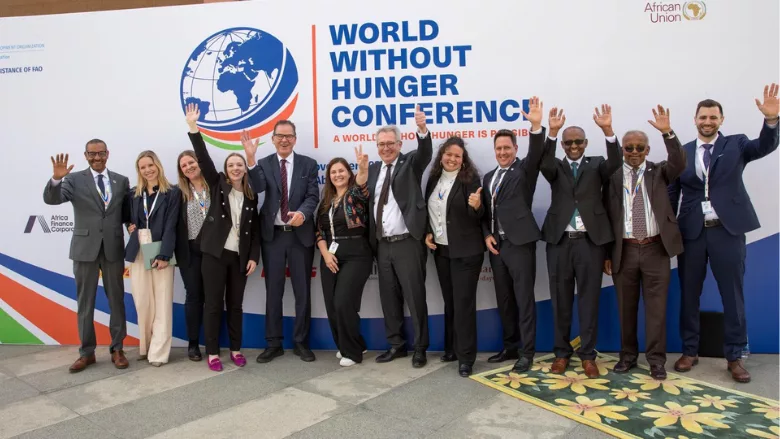
Together with FAO, UNIDO recently conducted a detailed analysis of the actions necessary in order to build the strong, safe, and resilient food systems of the future. We presented these results at the World Without Hunger conference in Addis Ababa in November 2024. The conclusions were clear: over the next decade, the world must invest approximately $50 billion USD per year across six key areas of the agri-food system: processing, distribution, retail, food loss prevention, infrastructure and crucially, food safety. Think of the over $2 trillion dollars spent on armaments and war worldwide each year, and how with a small fraction of that we could create a world with food safety and food security for all.
As global food demand increases and changes due to population growth, urbanization, and a rising middle class, the systems upon which we rely must be modernized. Working to end hunger is not charity, it is both a moral imperative and a smart investment. Safe food improves health, boosts productivity, empowers people to realize opportunities, and opens the door to regional and international markets for more shared prosperity.
UNIDO's Mission: Safer Food and Stronger Food Systems
For decades, we have supported governments and industries in building food safety systems which work for consumers, producers, and the planet. UNIDO helps set up trusted trade regimes based on international standards. We support countries in building their institutional capacities and robust policy and regulatory frameworks. For example, UNIDO contributed to the Africa Food Regulatory Authorities Forum together with representatives from the African Union in October 20235 and to regional conformity assessment bodies, such as the West African Accreditation System (SOAC). We also work with thousands of small and medium-sized enterprises globally, providing tailored support for compliance with international food safety standards.
Recently, we launched the UNIDO Food Safety Approach 2.0, a new strategy centered around three pillars:
- First: Supporting resilient and improved food safety practices in businesses through effective capacity building
- Second: Enabling robust food safety systems by supporting competent authorities and conformity assessment bodies
- Third: Fostering advocacy for food safety and new partnerships, especially by engaging with the private sector and advancing multi-stakeholder dialogue and interventions.
We see food safety as a complex ecosystem, including national regulators, agribusiness, food safety service providers, and academia, as well as technology providers who offer innovative solutions. This is what UNIDO offers at the national, regional, and global level.
Innovation: The Future of Food Safety
We are living in the age of data. Digitalization, artificial intelligence (AI), machine learning and traceability are already transforming how food is produced and risks along the supply chains are being managed. These technologies are improving inspection outcomes, surveillance and tracking food from farm to fork.
Looking for quick answers on food safety topics?
Try Ask FSM, our new smart AI search tool.
Ask FSM →
The AI and big data market in the food industry, valued at nearly $7 billion USD in 2022 alone, is expected to grow exponentially with a projected increase of $270 billion USD by 2032.6 Local innovation through access to support services underlines the importance of sustainable industrialization in LIMCs. UNIDO works together with UN partners as well as industry, which ultimately can improve access to innovation and food systems transformation.
The Vienna Food Safety Forum 2025 was a call for smarter food safety systems through digitalization.7 We must work together to unlock the opportunities of digitalization and AI and provide support for everyone to adopt these tools for a future in which no one is left behind.
A Call to All: Join the Movement for Food Safety
Food safety is a shared responsibility. Governments set the rules. Consumers drive demand. However, it is the food industry which must play a leading role. This is why we call upon them to step up and join our Addis Ababa Call to Action. Investing in food safety systems is crucial to achieving the Sustainable Development Goals.
In a world of rising inequality, conflict and climate pressure, food safety must not fall off the agenda. A world without hunger is possible and food safety is part of the solution.
References
- Food and Agriculture Organization of the United Nations (FAO). "The State of Food Security and Nutrition in the World." Rome, Italy. 2025. https://doi.org/10.4060/cd6008en.
- World Health Organization (WHO). "Estimating the Burden of Foodborne Diseases." https://www.who.int/activities/estimating-the-burden-of-foodborne-diseases#:~:text=Each%20year%20worldwide%2C%20unsafe%20food,number%20is%20likely%20an%20underestimation.
- United Nations Department of Economic and Social Affairs. "Goal 2: End Hunger, Achieve Food Security and Improved Nutrition, and Promote Sustainable Agriculture, Progress and Info." 2025. https://sdgs.un.org/goals/goal2#progress_and_info.
- World Bank Group. "Food-borne Illnesses Cost US$ 110 Billion Per Year in Low- and Middle-Income Countries." October 23, 2018. https://www.worldbank.org/en/news/press-release/2018/10/23/food-borne-illnesses-cost-us-110-billion-per-year-in-low-and-middle-income-countries.
- African Union. "AU Food Safety Agenda for Africa to be Boosted by the African Food Regulatory Authorities Forum (AFRAF)." October 11, 2023. https://au.int/en/pressreleases/20231011/au-food-safety-agenda-africa-be-boosted-african-food-regulatory-authorities.
- Emergent Research. "Artificial Intelligence (AI) and Big Data in Food Industry Market Size Worth USD 269.92 Billion in 2032." 2023. https://www.emergenresearch.com/press-release/global-artificial-intelligence-and-big-data-in-food-industry-market.
- Food Safety Magazine Editorial Team. "Vienna Food Safety Forum 2025: A Call for Smarter Food Safety Systems through Digitalization." Food Safety Magazine. June 13, 2025. https://www.food-safety.com/articles/10435-vienna-food-safety-forum-2025-a-call-for-smarter-food-safety-systems-through-digitalization.