Food Safety
search
Ask Food Safety AI
cart
facebook twitter linkedin instagram youtube
  • Sign In
  • Create Account
  • Sign Out
  • My Account
Food Safety
  • NEWS
    • Latest News
    • White Papers
  • PRODUCTS
  • TOPICS
    • Contamination Control
    • Food Types
    • Management
    • Process Control
    • Regulatory
    • Sanitation
    • Supply Chain
    • Testing and Analysis
  • PODCAST
  • EXCLUSIVES
    • Food Safety Five Newsreel
    • eBooks
    • FSM Distinguished Service Award
    • Interactive Product Spotlights
    • Videos
  • BUYER'S GUIDE
  • MORE
    • NEWSLETTERS >
      • Archive Issues
      • Subscribe to eNews
    • Store
    • Sponsor Insights
    • ASK FSM AI
  • WEBINARS
  • FOOD SAFETY SUMMIT
  • EMAG
    • eMagazine
    • Archive Issues
    • Editorial Advisory Board
    • Contact
    • Advertise
  • SIGN UP!
Home » Publications » Food Safety Magazine

Our Publications

Please select a publication below.

Food Safety Magazine

OctNov22_MainCover.jpg

October/November 2022

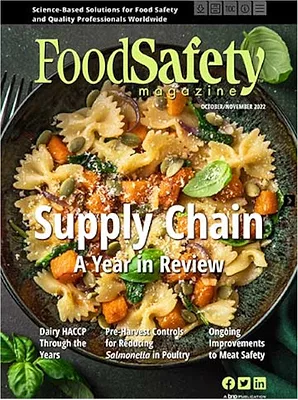
The October–November edition of Food Safety Magazine features an investigation of ongoing supply chain issues precipitated by the COVID-19 pandemic; a discussion of regulatory changes in the dairy industry throughout the years, including PMO, HACCP, and FSMA preventive controls; a critical look at reducing the risk of Salmonella from poultry through pre-harvest controls during grow-out; an exploration of ongoing improvements to meat and poultry safety, from increased interest in Listeria and Salmonella to considerations for lab-cultivated meat; and other explorations of various industry topics!

  • Features
  • Columns

Features

Back to Top
Supply Chain Management

Supply Chain Management: A Year in Review

To understand supply chain disruptions in a more systematic way, broader scenario planning and more rigorous work processes are needed
John W. Spink Ph.D.
October 9, 2022

The COVID-19 pandemic has begun to ease, but supply chain challenges have not. This article examines these ongoing supply chain challenges, what we can expect of the supply chain in the future, and guidance for how to respond to these disruptions.


Read More
Dairy HACCP

Dairy HACCP Through the Years

The dairy industry has seen many regulatory changes, including the incorporation of the FSMA Preventive Controls Rule within the Pasteurized Milk Ordinance
Jason Crafts
October 11, 2022

Many of the techniques used in creating a HACCP plan are shared with other types of plans, such as food quality and food defense plans. This article discusses regulatory changes in the dairy industry through the years, including the Grade "A" Pasteurized Milk Ordinance (PMO), the National Conference on Interstate Milk Shippers Dairy HACCP Pilot Program, and the incorporation of the Food Safety Modernization Act Preventive Controls Rule within the PMO.


Read More
chickens

Spotlight: A Critical Look at Reducing the Risk of Salmonella from Poultry—Part 2

Harshavardhan Thippareddi Ph.D. Manpreet Singh Ph.D. Todd Applegate Ph.D. Sudhir Yadav Ph.D.
October 4, 2022

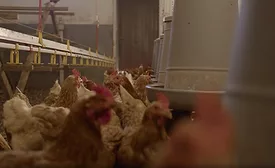
To understand and eventually reduce the risk of salmonellosis from poultry meat, it is necessary to understand the poultry production system, the introduction of the microorganism into the poultry ecosystem (as well as its gastrointestinal tract), the sources of Salmonella during production, and, subsequently, strategies to control or reduce the risk from this microorganism at both the pre-and post-harvest stages. Part 2 of this article series examines pre-harvest controls during grow-out.


Read More
meat safety

Ongoing Improvements to Meat and Poultry Safety

The author examines five current topics in meat and poultry and their implications to protein food
Eric Wilhelmsen
Eric Wilhelmsen Ph.D., CFS
October 11, 2022
The meat and poultry industries are an interesting mix of conservative practices and innovation. This article examines five topics and their implications to protein food, including meat safety as a model for the produce industry; increased interest in Salmonella and Listeria; USDA proposed rulemaking for meat and poultry; the move toward aggregated sampling; and developing safety needs for tissue-cultivated products.


Read More

Columns

Back to Top
lab workers

The Incident Command System and Foodborne Illness Outbreak Investigations

The Coordinated Outbreak Response and Evaluation (CORE) Network is the coordination focal point for all FDA resources during outbreak investigations
Stelios Viazis Ph.D. Sharon Seelman M.S., M.B.A. Kari Irvin M.S. Julia Mangia M.P.H.
October 11, 2022

During foodborne illness outbreak investigations, public health and regulatory authorities collect three types of data to determine a common food consumed by ill people: epidemiologic, traceback, and laboratory. State and local partners work with FDA to conduct traceback investigations and examine the food supply chain to determine the origin of the foods identified by the epidemiologic investigations. This article looks at the benefits of using incident command system (ICS) principles during emergency response coordination activities for foodborne illness outbreaks, with input from members of the FDA's CORE Network.


Read More
chinese takeout

Navigating U.S. Federal and State Regulation of PFAS in Applications Involving Food

PFAS restrictions and bans are not consistent, and determining compliance presents numerous challenges
George Misko
George G. Misko J.D.
October 11, 2022

As the focus on per- and polyfluoroalkyl substances (PFAS) intensifies, multiple states and some U.S. federal agencies are implementing or considering implementation of restrictions or bans on the products use in food contact articles. This article focuses on the restrictions and bans in the U.S. that impact the use of PFAS in food packaging, and includes a discussion of the challenges manufacturers face due to inconsistent science and policy decision related to the use of these chemicals in food packaging.


Read More
foodservice

Sanitation Prerequisite Programs as a Necessary Component of FSMS for Foodservice Establishments

It is imperative that a paradigm shift happens now in how risk is managed in foodservice establishments
Hal King
Hal King Ph.D.
October 11, 2022

It is imperative that we have an immediate paradigm shift in how we manage risk in foodservice establishments to significantly decrease the health and economic burden of foodborne illnesses. This article discusses how to develop a prerequisite program that can be used to train and be monitored via a Food Safety Management System (FSMS) in a foodservice establishment.


Read More
Food Processors

Evolving Relationships Between Food Processors and Regulatory Agencies

Processors speak out about how they are coping with regulatory demands now that FDA has resumed in-person inspections
Bob Ferguson
Bob Ferguson
October 11, 2022

We have been monitoring the relationships between food processors and regulators for a number of years. Our attention to this topic started with the implementation of FSMA to watch the evolution of the FDA's enforcement posture, as well as inspection and sampling procedures related to the new requirements. Now that the FDA has resumed its regular in-person inspections, we asked processors: (1) whether they have had an inspection so far in 2022 and, if so, did FDA collect any samples; (2) now that processors are seeing inspectors again, do they still agree that FDA "educates before it regulates"; and (3) with their experiences from recent and previous inspections, what do processors wish that regulators understood better? This column presents answers from more than 300 food processors in every category on these and related regulatory questions. 


Read More
Pesticide residues

Demystifying Pesticide Residues

To determine acceptable pesticide residue risk levels, we rely on a risk assessment framework to make science-based decisions
Dave Stone Ph.D. Jason Sandahl Ph.D.
October 11, 2022

This article covers U.S. regulatory oversight in establishing pesticide residue tolerances, testing for residues in domestic goods and imports, and the importance of science-based standards for global trade and food safety.


Read More
food safety culture

Global Food Safety Culture: Latin America

Latin America leans toward indirect, high-context communication and relationship-based culture
Lone Jespersen
Lone Jespersen Ph.D.
John David Sophie Tongyu Wu Ph.D.
October 11, 2022

Panelists Michele Fontanot (Professional Service Manager, 3M Latin America), Paola Lopez (QA Manager, Sigma), and Lone Jespersen, Ph.D. (Cultivate, Switzerland), identified three prominent features around food safety culture in Latin America region: a culture of caring, empowerment, and authentic food safety culture being a competitive advantage. 


Read More
Food Safety Plan/HACCP Plan

Reanalysis—A Critical Component of Verification

The Food Safety Plan/HACCP Plan is a living document that requires ongoing maintenance, including reanalysis at appropriate time intervals
Martin Bucknavage M.B.A., M.S. Kathy Gombas
October 11, 2022

A Hazard Analysis and Critical Control Points (HACCP)-based program is not a document that is simply written and forgotten. Changes occur over time, and a company's food safety and HACCP plans must adapt to reflect these ongoing changes and any new information. This is where reanalysis comes in. Reanalysis is a critical component of the verification principle, where the plan is reviewed to ensure that it is accurate and applicable and that it reflects change and improved understanding.


Read More
food preparation

How Restaurant Operators can Handle Food Poisoning Allegations

Restaurants must handle foodborne illness claims professionally, and a framework for investigating consumer food poisoning allegations must be in place
Bole
Dhruv Kishore Bole, M.B.A, PCQI, LSSGB
October 11, 2022

Every restaurant owner wants to avoid foodborne illness incidents and accusations, since a single lawsuit stemming from a food poisoning incident can have serious consequences for the restaurant's business, including poor brand image, high legal costs, and reduced customer loyalty. This article examines how restaurant operators can handle food poisoning accusations from customers.


Read More
Manage My Account
  • eMagazine Subscription
  • Subscribe to Newsletters
  • Manage My Preferences
  • Website Registration
  • Subscription Customer Service

More Videos

Sponsored Content

Sponsored Content is a special paid section where industry companies provide high quality, objective, non-commercial content around topics of interest to the Food Safety Magazine audience. All Sponsored Content is supplied by the advertising company and any opinions expressed in this article are those of the author and not necessarily reflect the views of Food Safety Magazine or its parent company, BNP Media. Interested in participating in our Sponsored Content section? Contact your local rep!

close
  • Salmonella bacteria
    Sponsored byThermoFisher

    Food Microbiology Testing Methods: Salmonella species

  • a diagram explaining indicator organisms
    Sponsored byHygiena

    How Proactive Listeria Testing Helps Prevent Six- and Seven-Figure Recalls

  • woman grocery shopping
    Sponsored byCorbion

    Designing Safety Into Every Bite: Proactive Risk Mitigation for Refrigerated Foods

Popular Stories

smoked salmon

Experts Share Lessons from a Successful Listeria ‘Seek and Destroy’ Process

dog kibble arranged in shape of bone next to bowl and spoon full of kibble

From Crackers to Kibble: Why Pet Food Belongs in the Low-Moisture Food Safety Conversation

cute baby in high chair feeding himself a bottle

‘Operation Stork Speed’ Expert Panel Highlights Infant Formula Safety Vulnerabilities

Events

January 27, 2026

Strategies for Reinforcing Food Safety Culture Among Temporary and Seasonal Staff

Live: January 27, 2026 at 2:00 pm EST: From this webinar, attendees will learn common areas where companies encounter challenges in their food defense strategies and how to address them.

May 11, 2026

The Food Safety Summit

Stay informed on the latest food safety trends, innovations, emerging challenges, and expert analysis. Leave the Summit with actionable insights ready to drive measurable improvements in your organization. Do not miss this opportunity to learn from experts about contamination control, food safety culture, regulations, sanitation, supply chain traceability, and so much more.

View All

Products

Global Food Safety Microbial Interventions and Molecular Advancements

Global Food Safety Microbial Interventions and Molecular Advancements

See More Products

Never miss the latest news and trends driving the food safety industry

Newsletters | Website | eMagazine

JOIN TODAY!
  • RESOURCES
    • Advertise
    • Contact Us
    • Directories
    • Store
    • Want More
  • SIGN UP TODAY
    • Create Account
    • eMagazine
    • Newsletters
    • Customer Service
    • Manage Preferences
  • SERVICES
    • Marketing Services
    • Reprints
    • Market Research
    • List Rental
    • Survey/Respondent Access
  • STAY CONNECTED
    • LinkedIn
    • Facebook
    • Instagram
    • X (Twitter)
  • PRIVACY
    • PRIVACY POLICY
    • TERMS & CONDITIONS
    • DO NOT SELL MY PERSONAL INFORMATION
    • PRIVACY REQUEST
    • ACCESSIBILITY

Copyright ©2026. All Rights Reserved BNP Media.

Design, CMS, Hosting & Web Development :: ePublishing