Evolving Relationships Between Food Processors and Regulatory Agencies
Processors speak out about how they are coping with regulatory demands now that FDA has resumed in-person inspections
This issue's Food Safety Insights column is a continuation of the survey that we first reported in our August/September issue. That survey included over 450 food processors and food safety professionals in every category in the U.S., Canada, and from around the world. In the August/September column, we discussed the pent-up demand for projects and new initiatives that processors are hoping to return to, with some of the urgency and disruptions from the COVID-19 pandemic becoming less acute. In this column, we continue to report on our results, but these questions are related to how processors are coping with regulatory demands now that the U.S. Food and Drug Administration (FDA) and other agencies have resumed their in-person inspections. We report on industry's relationships with various agencies, but we give extra focus to the companies' relationship with FDA. Of the 450 respondents in our survey, approximately 200 reported that they are FDA-regulated facilities.
We have been monitoring the relationship that food processors have with regulators—particularly with FDA—for a number of years now. Our attention to this topic started with the implementation of FDA's Food Safety Modernization Act (FSMA)—arguably the most impactful food safety regulatory change in recent memory—to watch the evolution of FDA's enforcement posture, as well as inspection and sampling procedures related to this new regulation. This evolution was somewhat disrupted by the COVID-19 pandemic over the past few years, but now that FDA has resumed its regular, in-person inspections, we wanted to hear from processors whether they have had an inspection in 2022a and, if so, whether FDA collected any samples. We also asked if processors still agree that FDA "educates before it regulates."
FDA Resumes In-Person Inspections
Let's first add some background to this second issue regarding FDA's position that it will strive to "educate before it regulates." From the beginning of the implementation of FSMA, FDA has indicated its plan to "educate before and while it regulates." FDA has said that it was, and is, its intent to conduct interactive inspections working closely with food processors that will emphasize education to help industry comply with FSMA and focus enforcement actions on the food safety problems that pose the greatest threats to public health.
In 2017, ahead of the first FDA FSMA inspections, we asked processors if they accepted FDA's claim that the agency will "educate before it regulates." At that time, it was safe to say that industry was skeptical, with our survey showing that only 40 percent of the respondents agreed that this was likely. In 2019, after several years of FSMA inspections, we asked this question again and found that the industry's attitude had changed, with 72 percent of processors in our survey agreeing at that time that FDA was indeed educating first.
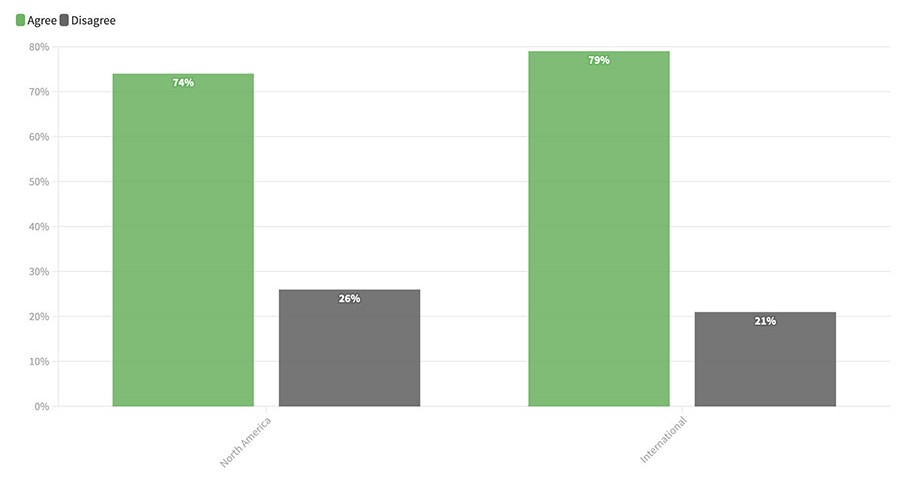
Now, in 2022, following FDA's post-COVID-19 resumption of in-person inspections, this acceptance of FDA's position continues to be accepted by food processors (Figure 1), with 74 percent of processors in North America and 79 percent of international companies in this survey still agreeing.
FIGURE 1. Do You Believe that FDA Educates Before it Regulates?
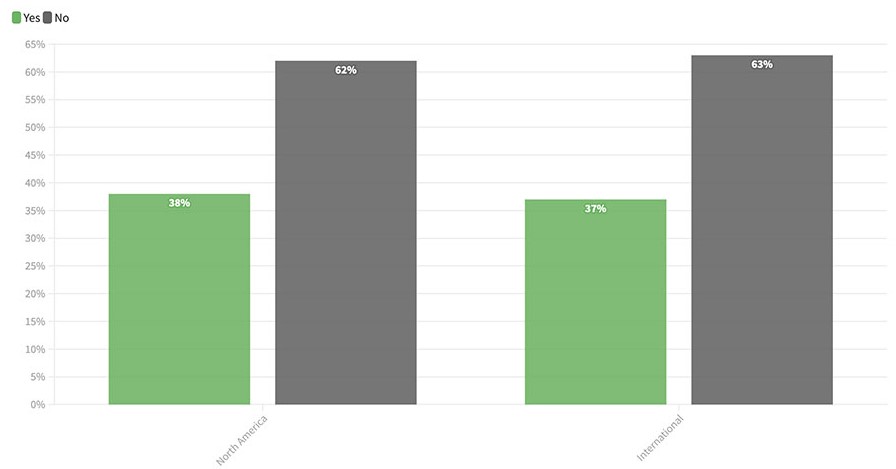
With FDA resuming its in-person inspections, we also wanted to know how these inspections were progressing. Approximately one-third (Figure 2) of FDA-registered facilities in our survey reported that they have had an FDA inspection so far in 2022.a Interestingly, the rates reported by the processors in both North America and internationally were similar.
FIGURE 2. Have You Had an FDA Inspection in 2022?
Sample Collection
An issue of importance to many processors is the collection of environmental samples by FDA during inspections. Not only can this regulatory sampling be an anxiety-producing test for the regulated company and its food safety professionals, but any samples collected that are found to be positive for food pathogens also likely will be analyzed using Whole Genome Sequencing (WGS). Those sequences will be added to the Agency's GenomeTrackr database and may be found or referenced in future investigations of foodborne illnesses or outbreaks. For these reasons, FDA sampling events always get the attention of in-plant food professionals.
Looking for quick answers on food safety topics?
Try Ask FSM, our new smart AI search tool.
Ask FSM →
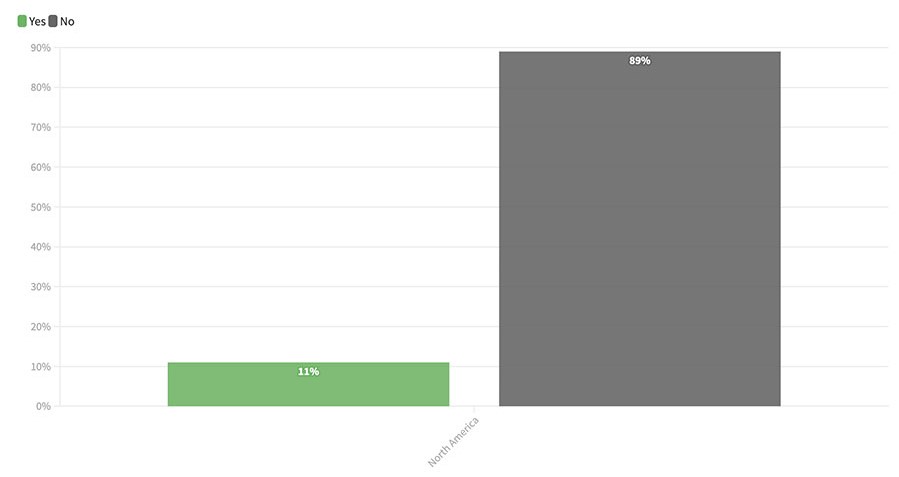
As an indicator of what has been happening in 2022, only 11 percent (Figure 3) of those FDA-regulated facilities in North Americab that have had an inspection in the first half of 2022 reported that FDA collected environmental samples from their facility. For comparison, in previous surveys, closer to 30 percent of processors reported that FDA had collected samples during its onsite inspection. It is reasonable to expect that this 11 percent figure is low, and likely represents a post-COVID-19 "gearing up" of the agency's work in the first half of this year. We should expect to see a higher frequency of sampling going forward.
FIGURE 3. If You Have Had an FDA Inspection in 2022, Did FDA Collect Environmental Samples?
FSMA Implementation Challenges
We also revisited another question that we have asked in previous surveys: "What are your biggest concerns with the implementation of FSMA?" For the North American companies, the issue reported most frequently (Figure 4) involved understanding the specific requirements needed to comply with FSMA, especially those requirements that would be raised during a regulatory inspection. This is a similar result to what we have seen in previous surveys.
Several respondents reported that it is difficult to keep up with changes. One commented, "We are still waiting for the final version of FDA's Intentional Adulteration guidance documents; yet, during our inspection, we were expected to be in compliance." Another indicated, "It seems that there has been very limited updates on any changes, and even if you are on the FDA listserve, you are never quite sure if you have all the most current information."
Other respondents reported that they are doing what they can to keep up, with one commenting, "Training is available, but it is costly, and different FDA inspectors interpret rules differently, making for extra work and causing confusion." Another mentioned that they have been turning to other resources for help, saying, "We have a good working relationship with our state inspectors, who are helping us prepare for our next FDA inspection."
FIGURE 4. What Have Been your Biggest Concerns with the Implementation of FSMA or Your Efforts to Comply with FSMA?
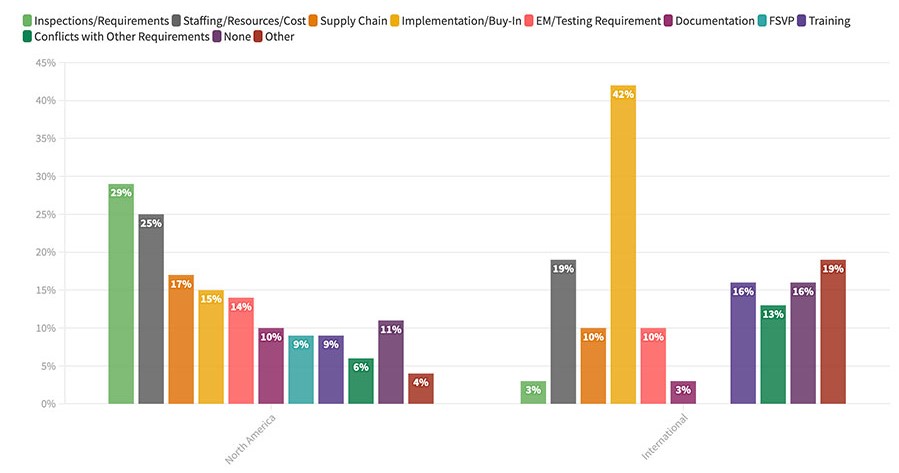
The second most-reported issue was finding the staffing and resources, especially money, to get it all done. These comments ranged from difficulties in securing enough qualified food safety specialists to work in their program to having the resources to keep them trained on current requirements. To summarize the numerous comments on this topic, many respondents indicated that they are trying to deal with far too many issues while working with insufficient staff, they are stretched for time, and they have too few resources to procure the tools they need to accomplish everything.
Interestingly, the most-reported issue for international companies was getting buy-in for the implementation of changes needed for FSMA compliance. Many respondents mentioned having to motivate their company to make the needed changes from their current program to one that is compliant with FSMA. Some indicated that they are encountering general resistance to commit the resources needed for compliance. Others, however, mentioned more technical compliance issues such as changing their Hazard Analysis and Critical Control Points (HAACP) program to include Preventative Controls, or overcoming the thinking that Good Manufacturing Practices (GMP) or Food Safety System Certification (FSSC) compliance can substitute for FSMA compliance.
Companies outside of the U.S. are more likely to need to comply with regional and national regulations other than FSMA, and it seems that some management teams are rationalizing that compliance with those regulations or certifications should be sufficient justification for the quality of their program. This creates a conflict with management and roadblocks in the implementation of FSMA requirements, yet the food safety people understand that as long as they will be exporting to the U.S., FSMA compliance is necessary.
An Ever-Evolving Relationship
It seems that the relationship between processors and regulators has improved, although there is still work to be done. While there will always be limitations on resources and pressure to "do more with less," it is clear that food safety departments are working hard to maintain their staffing and appropriate resources to address their day-to-day responsibilities and also respond to new regulatory requirements—or, as the saying goes, "trying to change the tires on the car while going 60 miles per hour." As these are important and relevant questions for anyone in food safety, we will continue to ask these questions, monitor the progress, and report on what we find here in Food Safety Insights.
Notes
- As of the date of our survey in early June 2022.
- A larger percentage of international facilities reported that FDA had collected samples during their inspection, but the sample size was small, and too few of the overall number facilities responded to the question, further reducing the sample size and making it too small for the data to be relevant; therefore, we are not reporting the figures here.
Bob Ferguson is President of Strategic Consulting Inc. and can be reached at bobferguson9806@gmail.com or on Twitter at @SCI_Ferguson.