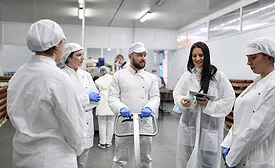
Sampling is part of a process that has two functions. It can be used to sample a process during operations or to sample the output of a process, such as a product lot. During sampling, the measurand (the object being measured) must be properly selected, properly transported to a location where the object or objects will be analyzed, and the results must be reported to the appropriate individuals. This article covers the systematic development of a sampling plan.
This article examines the multifaceted threats to food safety posed by climate change, focusing on cross-sectoral solutions to adapt to multiple emerging food safety risks.
A question that often arises is, "Does a food production establishment require both a HACCP plan and a Food Safety Plan?" The answer to this question depends on country- or region-specific legal requirements, among other factors.
The advent of artificial technologies like electronic noses, electronic eyes, and electronic tongues has fundamentally reshaped our approach to evaluating food samples, as underscored by their ability to capture intricate sensory attributes. The symbiotic relationship between artificial instruments and machine learning underscores their potential to reshape the food industry, ensuring that the food we relish is not only delectable but also safe and of the highest quality.
PFAS concentrations, which do not break down easily in the body, tend to increase rather than diminish over time. In light of these concerns and the prevalence of PFAS in consumer products like food packaging, many state and local governments, as well as public interest organizations, have begun enacting or promoting legislation that would regulate the implementation of PFAS in consumer products.
FDA has been adjusting its industry guidance for Food Contact Notifications and Food Contact Substances for infant formula since the passage of the Infant Formula Act of 1980
Starting in 2010, the U.S. Food and Drug Administration (FDA) began to include new restrictions in new Food Contact Notifications on the use of food contact substances for infant applications. Recently, FDA has hosted webinars to present information on regulatory requirements and considerations for infant formula ingredients and packaging. This article will discuss the history and current efforts by FDA to ensure the safety of infant formula, especially pertaining to food contact substances used in packaging.
Do engaged, informed, and empowered sanitation teams act as a predictor of success for an integrated pest management (IPM) program? With excellent food safety risk management behaviors, a frontline sanitation team can help manage existing risks and identify new ones, dramatically reducing the potential of product contamination due to pest activity in a facility. This article describes an action plan to help achieve these goals.
In defending food safety procedures and practices to an inspector who is challenging them, it is best to have multiple sequential "rings of defense." This means that the easiest changes are suggested first, with more costly and difficult changes suggested later. Doing this strategically has the advantage of minimizing changes to the procedures and practices, and potentially avoiding a costly recall or market withdrawal.
In the ever-evolving world of the food industry, ethics play a pivotal role in safeguarding consumers and upholding the integrity of businesses. This article aims to provide readers with a profound understanding of ethics in the food industry and how they intertwine with food safety culture. Thought-provoking stories highlight the importance of formal food ethics and their role in decision-making. As consumers, employees, or stakeholders, we all play a part in shaping a more ethically responsible food industry, where safety and trust are paramount.
The most important role of a Food and Agriculture Information Sharing and Analysis Center (FA-ISAC) is to facilitate the flow of information between industry and government entities
Information sharing is an important function for a Food and Agriculture Information Sharing and Analysis Center (FA-ISAC), which links business and government through "active collaboration," thereby strengthening the ability of the food and agriculture industries to withstand challenges and threats.
 RSS
RSS


.webp?height=168&t=1699369261&width=275 "creative visualization of a digital eye (a human eye with digital graphics overlaid).png")