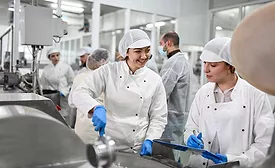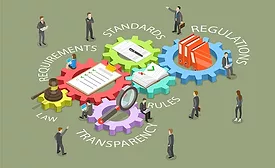
This article explores the intricate relationship between food safety culture and EU regulation while shedding light on its enforcement, the legislative framework, and implementation within the industry. It also explores how technology and data-driven approaches can play a vital role in promoting a positive food safety culture, and how industry best practices complement EU regulation.
It is up to each and every food processor, handler, and warehouser to develop, document, and implement a policy regarding photography of their operations. This is a much greater challenge today compared to 20 years ago because nearly every cellphone has a high-quality camera with the ability to capture both pictures and video. Operations that are regulated by FDA must also factor the agency into their camera policy.
How would work be different if, instead of focusing on the challenges of working in silos, we built stronger leaders to effectively navigate crowd-sourcing opportunities?
Food safety culture is about people. Food companies that do this well empower all employees across the entire business to take appropriate action to ensure that the final product is safe. The ultimate goal is to ensure that all employees do the right things all the time—even when no one is looking.
For the third year in a row, IAFNS is hosting a Science Innovation Showcase, where everyone is invited to participate in an exchange of science related to innovative ingredients, products, and processes.
The scientific program at the 2023 IFT FIRST featured several food safety discussions around new challenges and key topics like chemical contaminants, consumer trust, standardization, FDA's traceability rule, and the co-management of food safety and sustainability. The theme of the event was "Innovation in a Time of Crisis: Can We Future-Proof the Food System?"
The August/September Food Safety Insights column continues with our survey asking food processors about their top issues and priorities. In this issue, we explore processors' "to-do" lists of projects for the next 1–2 years and the regulations or requirements that will have the biggest impacts on their programs in the near future.
While ransomware is the most common cyberattack vector for businesses, other cyber threats can be far more dangerous to the food supply system, as discussed in this article.
Salmonella spp. have long been associated with low-moisture foods such as nuts and nut-derived products, with varying prevalence observed in tree nuts, including cashews, at retail. Virtually all cashews are imported to the U.S. Some nuts, including cashews, are imported as a "raw" product (i.e., one that has not been subjected to a process to adequately reduce pathogens, such as a kill step). Salmonella contamination of such products has resulted in several notable outbreaks in the U.S. in the past ten years, including those in which cashew-containing products have been implicated as a vehicle. This article presents a brief overview of outbreak investigations of Salmonella infections linked to the consumption of cashews and cashew-containing food products. It also presents challenges encountered, lessons learned, and relevant regulatory requirements for importers and manufacturers of cashews and cashew-containing products.
This article discusses the consumer and regulatory drivers of the current focus on heavy metals in foods for babies and young children, and also explores the congressional investigation and FDA's subsequent Closer to Zero effort. It also discusses the latest developments and what moves can be expected next from FDA.