

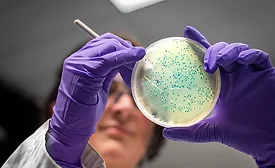




In 2026, Penn State University will host a series of three-day, in-person short courses designed for food safety and quality assurance professionals, food inspectors, plant managers, sanitarians, and food engineers, overing food microbiology, food science fundamentals, sanitation, and FSMA compliance.
A new USDA study suggests that the “green,” biodegradable enzyme ficin can improve the efficacy of conventional sanitizers when used as a pre-treatment in egg processing environments, reducing the contact time and sanitizer concentration required to achieve Salmonella biofilm inactivation.
This article discusses how an operation should develop, document, implement, and maintain a program to properly manage the many chemicals that are used in food processing.
In processing operations for dairy and low-moisture foods, specialized sanitation and environmental monitoring programs are paramount to securing food safety and hygienic operation of facilities.
Glove manufacturer Eagle Protect PBC has submitted a petition to FDA urging the agency to prohibit the use of polyvinyl chloride (PVC or vinyl) disposable gloves for food handling in the U.S., citing compliance gaps, poor durability, and chemical risks.
In bakery environments, maintaining hygiene and safety is a constant challenge, especially when production scales up for the festive season. Preventing these hazards is essential not only to protect consumers but also to maintain product quality and brand trust.
A laboratory study has provided new insights into the efficacy of peroxyacetic acid (PAA) and chlorine dioxide against Escherichia coli, Listeria monocytogenes, and norovirus in wash water during potato processing, and investigated cross-contamination risks in batch washing and water reuse scenarios.
This episode of Food Safety Five discusses research on Listeria biofilms, including sanitizer efficacy and evolutionary insights, and on a persisting Escherichia coli strain in leafy greens. It also covers regulatory developments in the UK, Canada, and the UAE, as well as a potential U.S. ultra-processed foods (UPFs) definition.
A new report from PMMI, the Association for Packaging and Processing Technologies reveals trends driving food safety and sanitation decisions among food and beverage manufacturers, and what these trends mean for original equipment manufacturers and suppliers.