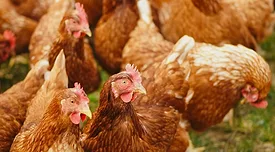
Scientists from USDA’s Agricultural Research Service are exploring how “transgenerational protection”—which is the ability of layer hens to pass along their resistance to Salmonella to their broiler chicks—can be encouraged, to ultimately reduce early colonization that introduces microbial contamination at the processing plant and poses a food safety risk to consumers.
To encourage the use of Salmonella vaccines for poultry flocks, the U.S. Department of Agriculture’s Food Safety and Inspection Service (USDA’s FSIS) intends to exclude current commercial vaccine subtypes of Salmonella confirmed in FSIS raw poultry samples from the calculation used to categorize establishments under the raw poultry Salmonella performance standards.
Researchers at USDA have developed a thermal pasteurization method based on Radio Frequency technology that effectively reduces the presence of Salmonella in intact eggs, in a fraction of the time required for traditional pasteurization.
In this episode of Food Safety Matters, we are joined by Brian Ronholm, Director of Food Policy for Consumer Reports, who lends his insight as a consumer advocate and former regulator to a discussion around food regulatory policy and food safety legislation. We dissect a variety of current events in food safety, such as toxic heavy metals in baby foods and food additives legislation, from multiple perspectives, including industry, consumer, regulatory, and consumer advocate.
As part of the agency’s Leafy Greens STEC Action Plan, the U.S. Food and Drug Administration (FDA) has published a report detailing the results of targeted inspections and microbiological testing of leafy greens grown in Salinas Valley, California during the region’s 2022 harvest season.
With a $5 million grant from the U.S. National Science Foundation (NSF), a multidisciplinary research team is developing sensor-based rapid detection technology, backed by an artificial intelligence (AI) –powered decision support system, to control Salmonella and other foodborne pathogens throughout the poultry supply chain.
In light of USDA-FSIS’s proposed regulatory framework to reduce Salmonella illnesses attributable to poultry, a recently published report by the National Advisory Committee on Microbiological Criteria for Foods (NACMCF) provides guidance on microbiological criteria that might be used to identify and incentivize effective intervention strategies.
The U.S. Department of Agriculture’s Food Safety and Inspection Service (USDA’s FSIS) recently highlighted its key achievements in 2023 that helped strengthen food safety and the supply chain, including efforts on a new regulatory framework to crack down on Salmonella in poultry.
A study demonstrated that fresh-ground tomato juice can inactivate both typhoidal and non-typhoidal strains of Salmonella, as well as uropathogenic E. coli strains.
A 2021 multinational foodborne illness outbreak investigation involving imported melons contaminated by Salmonella Braenderup exemplifies effective collaboration across countries, rapid information sharing, and harmonized data collection, and the lessons learned could form the basis of standard practices in multinational outbreak investigations.