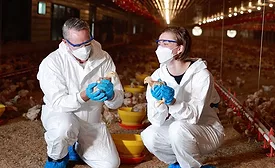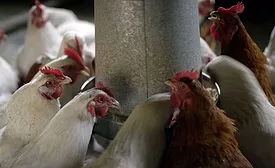
A new software platform by Ancera offers a “BioBarrier” against Salmonella through surveillance systems and big data analytics for improved poultry productivity, enabling compliance with tightening U.S. Department of Agriculture (USDA) regulations.
The European Food Safety Authority (EFSA) has put out an alert regarding an international outbreak of Salmonella Enteritidis in chicken, involving 335 cases across 14 European countries plus the UK, as well as the U.S.
According to recent research from the U.S. Centers for Disease Control and Prevention (CDC), infections caused by Salmonella with antimicrobial resistance (AMR) only to clinically important antibiotics were not associated with poorer outcomes, suggesting that factors other than treatment failure may be important.
The U.S. Department of Agriculture’s Food Safety and Inspection Service (USDA’s FSIS) has released a notice informing agency inspection program personnel about the continuation of and changes to the Raw Pork Products Sampling Program.
The U.S. Food and Drug Administration (FDA) has updated its infant formula compliance program, which outlines the agency’s approach to inspections, sample collection, sample analysis, and compliance activities for FDA personnel, with a focus on Cronobacter and Salmonella contamination.
Regardless of the proposed Salmonella performance standards, the pork industry has consistently taken proactive measures to address and mitigate Salmonella contamination risks for years
Data have allowed the pork industry to understand risk points in slaughter and processing, as well as the highest-risk products and how Salmonella changes throughout the process. The collective goal is to promote universal food safety knowledge, improve human health, and, thus, contribute to USDA's ambitious target of achieving a 25 percent reduction in salmonellosis cases by 2030.
A recent study aiming to investigate the usefulness of publicly available whole genome sequencing (WGS) data for Salmonella surveillance has provided an overview of antimicrobial resistance (AMR) among different serovars and defined the most common antibiotic resistance genes.
In this episode of Food Safety Matters, we are joined by Kris de Smet, D.V.M., Head of the Food Hygiene Team under the Directorate-General for Health and Food Safety at the European Commission. Dr. de Smet discusses his work with the European Commission and Codex Alimentarius in areas such as Salmonella mitigation, foodborne illness outbreak preparedness and management, and food safety culture improvement and measurement.
A survey of non-typhoidal Salmonella (NTS)found on retail foods sold in the UK has shown the overall prevalence of Salmonella to be low, although there is great genetic diversity among the Salmonella that was present, which may hinder outbreak investigations and source attribution in the case of foodborne illness outbreaks.
A recent literature review has provided an overview of the impacts of climate change on significant foodborne pathogens, parasites, and toxins; specifically, Salmonella, Campylobacter, Vibrio, Cryptosporidium, Giardia, and marine biotoxins.