The review also identifies six health effect categories for further evaluation as part of efforts to support the development of health-based values for the “forever chemicals.”
The European Food Safety Authority (EFSA) lowered the acceptable daily intake for trifluoroacetic acid (TFA) to a quarter of the previously established level, and also set an acute reference dose for the chemical for the first time.
The Memorandum of Understanding expands interagency collaboration on food contaminant monitoring, including for toxic heavy metals and per- and polyfluoroalkyl substances (PFAS), under the National Residue Program.
SGS INSTITUT FRESENIUS adapts to evolving standards for PFAS testing with investments in Waters Instrumentation, Software, and Consumables, particularly the Waters Xevo TQ Absolute Mass Spectrometer and waters_connect for Quantitation Software.
July 14, 2026
As the world’s leading testing, inspection and certification company, SGS prides itself on establishing the global benchmark for sustainability, quality, and integrity.
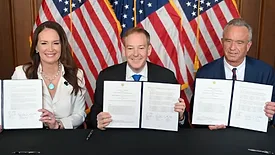
The Keep Food Containers Safe from PFAS Act (H.R. 9593) would amend the Federal Food, Drug, and Cosmetic Act to prohibit food packaging containing intentionally added per- and polyfluoroalkyl (PFAS) substances, a.k.a. “forever chemicals.”
According to the researchers, treating PFAS as a single class of contaminants may overlook important differences in how individual compounds move through water systems and respond to remediation. Treatment strategies should be designed based on molecular structure, especially chain length.
With two proposed rules issued on May 18, the Trump EPA followed through on its stated intent to rescind or extend the compliance date for Biden-era drinking water limits for several “forever chemicals” of concern.
New Mexico has published a final rule enforcing the New Mexico PFAS Protection Act, outlining a staggered prohibition on the sale of products containing intentionally added PFAS, and describing a PFAS warning label for products still containing the chemicals.
Samples were tested for arsenic, cadmium, lead, mercury, PFAS, pesticides, and phthalates/plasticizers. When toxic heavy metals were detected in some samples, it was at levels far below EPA drinking water limits.