Practical Guidelines for Choosing Between Dry and Wet Sanitation
Need to Know
- Dry cleaning should generally be the default in low-moisture food processing environments, with wet cleaning reserved for situations where it provides a meaningful food safety benefit
- Sanitation decisions should consider cleaning efficacy, residue characteristics, equipment design, moisture control, and the facility's ability to achieve and verify complete dry-out
- When wet sanitation is necessary, facilities should minimize water use, prevent moisture migration, apply appropriate sanitizing treatments, and verify dryness before resuming production
In low-moisture food facilities, the choice between dry and wet cleaning has important food safety implications. Dry cleaning is preferred; however, many dry facilities still use wet sanitation intermittently for specific needs. However, the decision to execute wet sanitation, even only intermittently, in a dry environment should not be taken lightly and requires an evaluation of the added benefit versus the additional microbial risk.
In this article, "cleaning" refers to the removal of product residues, soils, allergens, and microorganisms from surfaces, whereas "sanitizing" refers to application of an antimicrobial treatment, usually heat or chemistry, to reduce microorganisms that remain on surfaces after cleaning. "Dry cleaning" refers to the physical removal of residues and microbial cells without intentionally introducing water; "dry sanitation" may include dry cleaning followed by a non-aqueous or low-moisture sanitizing step; and "wet sanitation" includes water-based cleaning, rinsing, and sanitizing.1
Water can be an effective cleaning tool, but introducing it into a dry processing environment creates conditions that allow pathogens to grow, spread, and establish harborage. Conversely, avoiding water under all circumstances can unnecessarily limit the sanitation toolbox when wet cleaning might provide a meaningful improvement in cleaning efficacy. A practical starting point is therefore "dry by default, wet by exception." Dry cleaning should generally be preferred in areas intended to remain dry, with escalation to controlled wet cleaning when the expected food safety benefit outweighs the microbial risk associated with introducing water. The central question is not whether dry or wet cleaning is inherently better, but rather, which cleaning approach results in the lowest overall food safety risk?
Why Facilities Choose Dry Cleaning
Advantages of dry cleaning include:
- Avoids introducing water that could support microbial growth.
- Reduces the potential for water to transport contamination into difficult-to-dry locations.2
- Helps maintain the low-humidity conditions that limit growth of organisms such as Salmonella.3
- May reduce downtime associated with washing, rinsing, sanitizing, and drying equipment.
- Reduces water use and wastewater generation.
- Particularly advantageous for equipment or environments that were not designed for routine wet sanitation.
Conversely, limitations of dry cleaning include:
- Dry methods may be less effective against some residues that are harder to physically remove.
- Dry cleaning has not always been accepted as a method for allergen changeover and lot segregation. Risk assessments evaluating dry allergen changeovers may consider the allergen, product matrix, equipment design, and residue characteristics in validation data. Wet cleaning should not be assumed necessary for allergen control, but may be required where dry methods cannot sufficiently remove allergenic residue.
- Vacuuming, scraping, brushing, wiping, compressed air, or other dry techniques may redistribute contamination if not controlled.
- Some equipment may be difficult to access sufficiently using dry cleaning tools.
Why Facilities Choose Wet Cleaning
Advantages of wet cleaning include:
- Water, detergents, mechanical action, and rinsing can better remove certain soils than dry cleaning alone.
- Policies may use wet cleaning for allergen changeover, lot segregation, a product contamination event, or a positive environmental finding.
- Allows application of different aqueous sanitizers after cleaning that provide a modest microbial reduction.
Conversely, limitations of wet cleaning include:
- Hydrating dry product residues supports microbial growth.
- Water can mobilize contamination and spread it throughout the facility.
- Standing water or trapped moisture may persist in niches long after visible surfaces appear dry.4
- Poorly designed equipment or facilities may make complete dry-out difficult.
- The benefit of aqueous sanitizers in commercial use may not outweigh the increased risk.
A Risk-Based Decision Framework
From a food safety perspective, the choice between dry and wet cleaning requires balancing two primary considerations: the risk that the selected method will not be effective enough and the risk introduced by adding water to a dry processing environment (Figure 1). Sanitation decisions may also be influenced by broader business considerations, including customer requirements, operational efficiency, and mitigation of business risk. Rather than relying on arbitrary schedules (e.g., wet cleaning once per month), facilities should evaluate whether wet cleaning provides a meaningful improvement in control that is sufficient to justify the additional risk introduced by water.
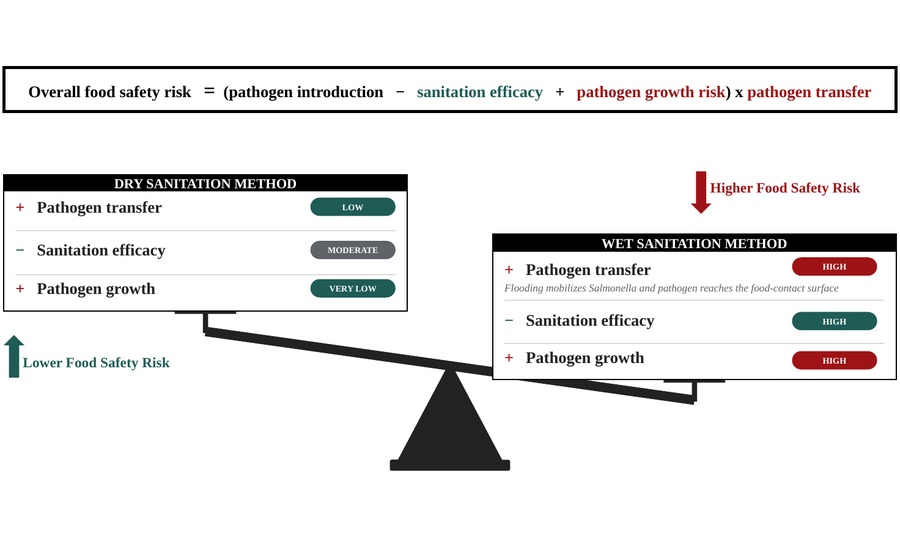
Many factors in this trade-off are variable, so they require site-specific evaluation (Table 1).
| Consideration | Keep it dry | Consider controlled wet |
|---|---|---|
| Dry sanitation efficacy | Dry cleaning consistently meets the sanitation endpoint | Dry cleaning does not reliably meet the required endpoint |
| Benefit of wet sanitation | Wet sanitation provides little added benefit beyond dry cleaning | Wet sanitation provides a clear, measurable improvement |
| Nature of the residue | Residues can be effectively removed through physical action | Residues are greasy, sticky, or otherwise difficult to remove dry |
| Hydrated residue supports growth | Residue nutrients support bacterial growth with sufficient moisture | Residues do not readily support bacterial growth when hydrated |
| Confidence in dry-out | Dry-out is slow or difficult to verify | Equipment and environment dries rapidly and can be verified |
| Relative humidity control | Relative humidity (RH) control is weak or variable; moisture persists in the environment | RH and ambient moisture are well controlled, supporting rapid drying |
| Type of wet sanitation | Flood sanitation introduces large amounts of water | Water can be applied in a controlled, localized manner |
| Hygienic status | Equipment has niches where water may collect, and environment does not drain well | Equipment and environment easily drains and is suitable for wet cleaning |
| Sanitation efficiency | Wet sanitation creates excessive downtime due to treatment of environmental surfaces and dry-out | Dry sanitation creates excessive downtime due to manual labor |
| Product type/process | All product is either ready-to-eat (RTE) or non-RTE | Both RTE and non-RTE product are processed on the same line |
| Sanitizer use | Sanitizer may be applied locally, or may not be applied at all | Sanitizer must be applied at scale |
How Effective is Dry Cleaning?
A first consideration is whether dry cleaning alone can consistently achieve the required sanitation endpoint. Dry physical cleaning can provide meaningful microbial reduction when appropriately designed and executed.5,6,7 That endpoint should be defined and may include visible soil or buildup removal, allergen removal, microbial reduction, or fulfillment of a regulatory or customer requirement. Effectiveness should be evaluated at difficult-to-clean food contact surfaces.
The relevant comparison, therefore, is how much additional benefit is obtained from wet cleaning. Wet cleaning may improve removal of adherent residues or allergens, improve access to some surfaces, and permit application of an aqueous sanitizer, but cleaning efficacy alone against those targets should be considered. The actual benefit of wet sanitation should also be evaluated as rigorously. Aqueous sanitizer efficacy can also vary substantially in application, providing much less than the often-cited 5 log reduction.4,8 It is likely that a 5-log reduction may be the wrong benchmark for sanitizers in industrial application (i.e., outside the lab), and the benchmark should not be made more stringent for dry sanitation methods than for wet. If dry cleaning reliably achieves the required endpoint and wet cleaning provides only a marginal additional benefit, then introducing water may increase overall food safety risk without providing a commensurate improvement in food safety.
Looking for quick answers on food safety topics?
Try Ask FSM, our new smart AI search tool.
Ask FSM →
What Happens When the Product Residue Gets Wet?
Dry product residues may inhibit bacterial growth; however, once hydrated, some residues can become highly supportive of bacterial growth. The potential impact of introducing water depends in part on the characteristics of the material present in the environment, including its composition, nutrient availability, pH, and presence of any antimicrobial properties, as well as evidence from published literature or in-house studies.
Importantly, not all residues present the same risk when hydrated. For example, unlike salt, nutrient-rich materials such as infant formula can support bacterial growth when hydrated. The greater the potential for a hydrated residue to support microbial growth, the stronger the justification should be for introducing water into that environment.
Can the Equipment and Environment be Dried Rapidly and Completely?
Wet cleaning should be considered in light of the facility's ability to rapidly and completely dry out. Facilities should evaluate how quickly equipment and the environment can return to a dry condition. This should be based on whether all affected product-contact and environmental surfaces can be adequately inspected or otherwise verified as dry. Particular attention should be given to locations where moisture may persist, including hollow tubing and framework, gasket interfaces, bearings, conveyors, electrical enclosures, cracks, floor interfaces, and overhead structures.
The assessment should also consider whether dry and wet areas are effectively segregated, whether equipment can be sufficiently disassembled to facilitate drying, whether air movement is adequate, and whether heated or dehumidified air is available where appropriate. Importantly, facilities should not assume that equipment and the surrounding environment are dry after a predetermined period, as conditions affecting drying times can vary. Instead, sites should verify that water has been effectively removed from the environment before production resumes.
How Well Does the Facility Control Relative Humidity?
Facilities should also consider their ability to remove moisture during and after wet cleaning. Factors such as HVAC capacity, dehumidification, seasonal humidity, condensation potential, and air movement between wet and dry areas can substantially affect how quickly a processing environment returns to a dry condition. A dry-out procedure adequate during winter conditions may be insufficient during humid summer periods. High ambient relative humidity can extend drying time and increase the potential for moisture to persist in niches.
Facility-level moisture control should be incorporated into sanitation decisions, particularly because relative humidity can vary over time and by location within processing areas and may not be routinely monitored in many facilities.3 Dry-out should be treated as a key sanitation step that is monitored and verified, rather than as a fixed waiting period.9
Is the Method of Wet Cleaning Controlled or Flooding?
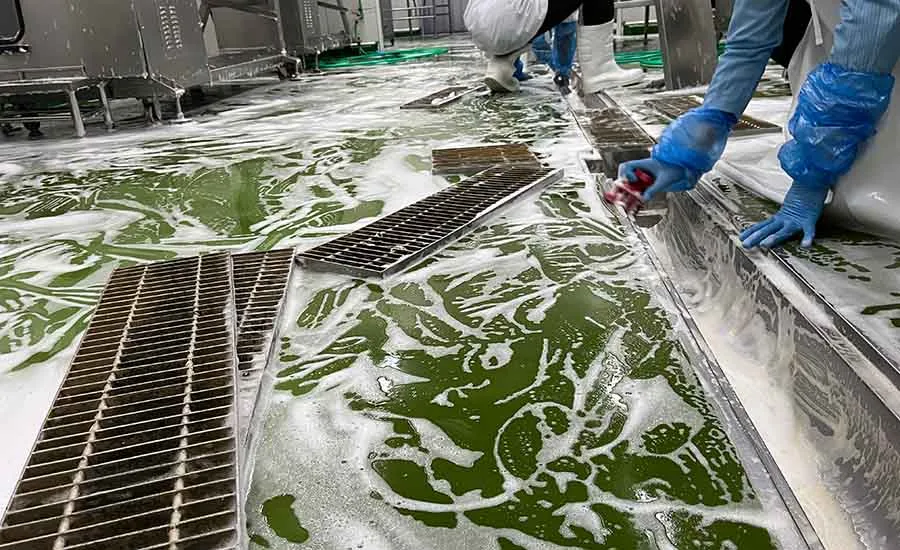
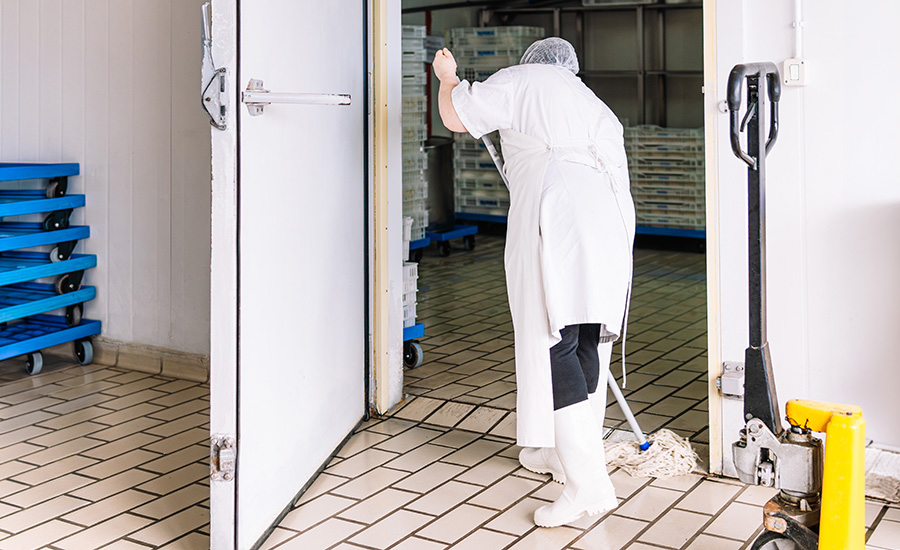
Not all wet sanitation creates the same level of food safety risk. Controlled wet cleaning targets specific equipment or surfaces using localized application and limited volumes of water. The water may also be contained, captured, or otherwise prevented from spreading throughout the surrounding environment. In contrast, flood sanitation uses substantially larger volumes of water, often requiring floor drainage. This increases the potential for water to spread across the intended cleaning area and makes complete dry-out more difficult to achieve. The method of water application should therefore be part of the sanitation decision. A facility may reasonably determine that targeted, controlled wet cleaning is justified for a specific need, while routine wet sanitation by flooding presents an unacceptable level of risk.
How Long and Resource-Intensive is Each Cleaning Method?
Microbial risk is not the only practical consideration when choosing between dry and wet cleaning. Facilities should also compare the labor required, extent of equipment disassembly, cleaning and drying times, water and chemical consumption, and waste handling associated with each approach.
Dry cleaning is not always faster. A difficult manual dry clean may take longer than a relatively efficient wet wash. Conversely, the apparent speed of wet cleaning can be misleading if the sanitation regimen is followed by several additional hours of drying before equipment can be safely returned to production. Sanitation efficiency should be evaluated across the entire process, from production shutdown through cleaning, verification, dry-out, and restart.
Is the Product RTE vs. Non-RTE?
Selection of sanitation methods in areas processing ready-to-eat (RTE) foods requires extra care. In non-RTE products, contamination may be eliminated with an effective downstream kill step; however, the consequences of cross-contamination of RTE product due to enhanced risk from wet sanitation requires additional consideration. This does not mean that flood sanitation will always be better for non-RTE products. Effective control of environmental cross-contamination is still needed.
The presence of a downstream lethality step should not be used to justify uncontrolled introduction of water into an otherwise dry environment. Additionally, where both RTE and non-RTE products are handled on the same equipment or in the same processing area, the effectiveness of the sanitation changeover between the two becomes an additional consideration.
If Water is Used, Then Sanitizing Should be Part of the Process
Wet cleaning creates hydrated surfaces and residues that can support bacterial growth, so any wet cleaning process should include an appropriate sanitizing step after effective cleaning. There are many aqueous sanitizer products available to support these activities.
As always, sanitizer selection should consider the target organism, surface compatibility, required concentration, contact time, temperature, application method, and any application considerations. It is important to note that sanitizing does not replace the need for adequate cleaning and rapid dry-out. Even in environments where wet sanitation is routinely used, controlling the amount and movement of water can improve food safety. If wet sanitation is adopted, particular attention should be given to what happens after sanitation. For example, an apparently successful wet sanitation event followed by increased environmental positives several days later may indicate that moisture migrated into difficult-to-dry areas.2
Conclusion: Choose the Lowest-Risk Option
The objective in selecting any approach to sanitation is to maximize risk reduction. In facilities designed to remain dry, dry cleaning should generally be the default because excluding water removes an opportunity for microbial growth. Yet, controlled wet cleaning can be a useful tool when dry cleaning cannot achieve the required outcome and wet cleaning has a measurable, meaningful improvement in control.
Ultimately, wet sanitation should be used only when the incremental control gained by introducing water is greater than the increase in microbial risk that water creates, and only when the facility can verify effective dry-out.
Acknowledgment
This work was supported in part by a grant from Dairy Management Inc. (Rosemont, Illinois) to Dr. Abby Snyder.
References
- Bogart, N. and A. Snyder. "The Real Microbial Reduction Step is Cleaning." Food Safety Magazine June/July 2026. https://www.food-safety.com/articles/11556-the-real-microbial-reduction-step-is-cleaning.
- Mirdamadi, N. and A. Snyder. "In Dry Environments, Wet Sanitation Isn't the Answer—It's the Issue." Food Safety Magazine February/March 2026. https://www.food-safety.com/articles/11162-in-dry-environments-wet-sanitation-isnt-the-answerits-the-issue.
- Slaughter, S., S. Chuang, D. Daeschel, L. McLandsborough, and A.B. Snyder. "Moisture matters: Unintended consequences of performing wet sanitation in dry environments." Applied and Environmental Microbiology 92, no. 5 (May 2026). https://journals.asm.org/doi/pdf/10.1128/aem.02365-25.
- Lou, Y. and A. Snyder. "The Limits of 'Dry' Sanitizers in Low-Moisture Environments." Food Safety Magazine August/September 2026. https://www.food-safety.com/articles/11760-the-limits-of-dry-sanitizers-in-low-moisture-environments.
- Daeschel, D., L. Chen, C. Zoellner, and A.B. Snyder. "A simulation model to quantify the efficacy of dry cleaning interventions on a contaminated milk powder line." Applied and Environmental Microbiology 91, no. 5 (May 2025). https://journals.asm.org/doi/pdf/10.1128/aem.02086-24.
- Suehr et al. "Effectiveness of dry purging for removing Salmonella from a contaminated lab scale auger conveyor system." International Association for Food Protection (IAFP) Annual Meeting, Salt Lake City, Utah, July 8–11, 2018.
- Liu et al. "Efficacy of removal using wheat flour and corn meal push-through in auger conveyor systems." IAFP Annual Meeting, New Orleans, Louisiana, July 26–29, 2026.
- Jiao, Y., J. Baker, C. Slaughter, D. Daeschel, and A.B. Snyder. "Variable fluid mechanics explain why static efficacy tests overestimate sanitizer performance against Listeria." Applied and Environmental Microbiology 92, no. 8 (July 2026). https://journals.asm.org/doi/10.1128/aem.00906-26.
- Thorson, K. and A. Snyder. "In Dry Processing Environments, Treat Water Like Glass." Food Safety Magazine April/May 2026. https://www.food-safety.com/articles/11604-in-dry-processing-environments-treat-water-like-glass.