The Real Microbial Reduction Step is Cleaning
In most cases, greater microbial reduction comes from cleaning than from sanitizing
Sanitizers are often positioned as the "hero" of sanitation because they are applied specifically to inactivate microorganisms on surfaces. This framing might suggest that sanitizing delivers the greatest food safety benefit. However, this is frequently not the case; the most significant microbial reduction is more often achieved during the cleaning step.
This distinction is more than semantic. Misconception around how sanitation activities ensure microbial control results in misdirected resources, ineffective training and validation efforts, and misguided regulatory or buyer requirements. In this article, we highlight the importance of cleaning activities within sanitation standard operating procedures (SSOPs).
Components of Sanitation Procedures
Sanitation activities, whether dry or wet, generally follow a structured sequence of procedures that are described in the "seven steps of sanitation" (Figure 1). Facility-specific procedures are documented in SSOPs. While variation exists across facilities, SSOPs typically include steps that address clearing the line, cleaning, inspection, and application of a sanitizer. These activities help achieve the multiple goals of sanitation: bulk food soil removal, prevention of allergen cross-contact, reduction in carryover of colors and flavors, reduction of microbial load, and prevention of pathogen cross-contamination.
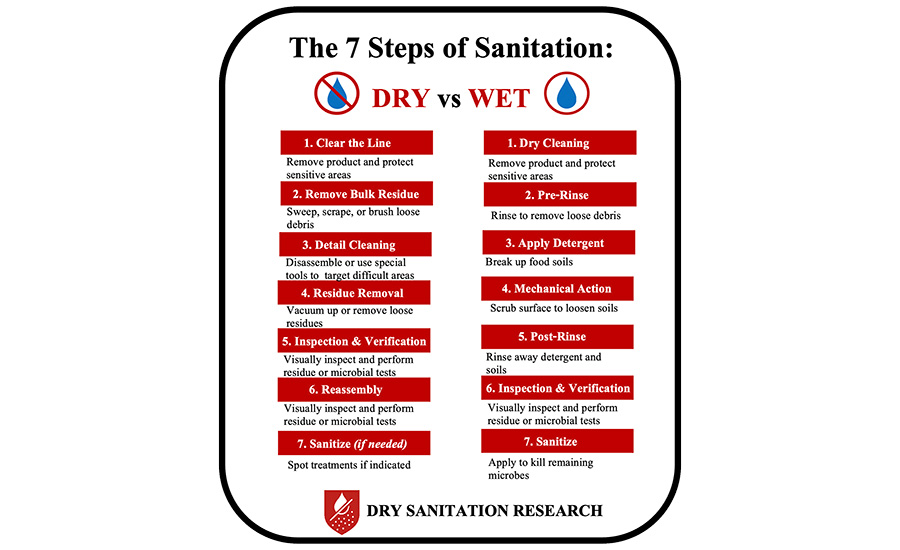
In conventional wet sanitation, the seven steps commonly include a pre-rinse, application of detergent, mechanical action (such as scrubbing), and a post-cleaning rinse before inspection and sanitizing. Water plays a central role by serving as a physical force to dislodge residues, a vector for detergents and sanitizers, and a transport medium to carry away residues.
The same general steps are used in dry sanitation, but execution differs significantly when water is excluded from the process (Figure 1). Dry physical cleaning is commonly accomplished with sweeping, scraping, and vacuuming. Many dry SSOPs do not include application of a sanitizer. However, some facilities will employ controlled application of sanitizers, typically as spot treatments. The sanitizers used are formulated to rapidly evaporate to avoid introducing water into low-moisture environments.
These procedures reference both cleaning and sanitizing activities. The U.S. Food and Drug Administration's (FDA's) 2025 Draft Guidance for Industry: Establishing Sanitation Programs for Low-Moisture Ready-to-Eat Human Foods and Taking Corrective Actions Following a Pathogen Contamination Event1 provides the following definitions:
- Cleaning techniques remove soil, including food residue, dirt, grease, or other objectionable matter, from the food-contact surface.
- Sanitizing treatments destroy (i.e., kill) microorganisms, such as pathogens, that contaminate that surface.
It is certainly true that the purpose of cleaning is to remove food residues, while sanitizing is intended to destroy microorganisms. However, these definitions do not fully capture what actually occurs during each step. Cleaning not only removes soil but also reduces the microbial load attached to that material. By focusing narrowly on soil removal, these standard definitions may have inadvertently contributed to the misconception that sanitizing is the primary (or only) microbial reduction step.
Looking for quick answers on food safety topics?
Try Ask FSM, our new smart AI search tool.
Ask FSM →
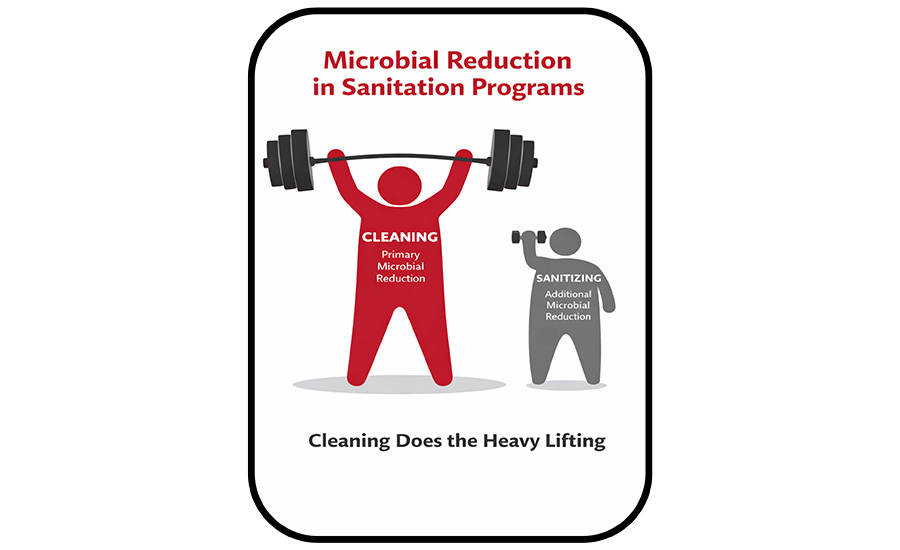
In most instances, a greater reduction in microbial load results from cleaning in either wet or dry sanitation regimens (steps 2–4). Consequently, the sanitizing step can inactivate some microbes that remain after effective cleaning. However, sanitizing is simply a secondary intervention on top of a well-executed cleaning step (Figure 2). Therefore, a slight modification of the above description of cleaning would be the addition of the parenthetical statement in bold: Cleaning techniques remove soil, including food residue, dirt, grease, or other objectionable matter (such as microorganisms), from the food-contact surface.
This description helps clarify the role of cleaning in in food safety, rather than positing cleaning as only impacting food soil removal.
Cleaning is the Primary Microbial Reduction Step
Cleaning activities can significantly reduce microbial counts on surfaces. Microbial reduction during physical cleaning occurs through mechanical action from scrubbing, brushing, or flow dynamics of fluids or powders. In wet sanitation, detergent chemistry that breaks up soils from surfaces also supports cleaning.
The limited research that has been conducted shows that cleaning can produce significant log reductions on surfaces. For example, research modeling dry cleaning interventions on contaminated milk powder lines demonstrated that physical removal steps confer significant microbial reduction.2 Empirical research on dry flushing also illustrated that significant Salmonella reduction (up to 5 log) occurred.3 Similar findings have been shown for wet sanitation including cleaning and sanitizing produce bins4 and harvesting equipment.5 Across these diverse systems, cleaning alone achieved a significant microbial reduction.
This makes intuitive sense. Do we really believe the microbial load on a surface is unchanged after cleaning? Of course not. In many sanitation programs, cleaning steps alone account for the majority of total microbial reduction in the process, with sanitizers providing an additional, incremental reduction once surfaces are already clean.
Mechanistically, this reduction occurs because microbes in food environments are rarely present as free, exposed cells. Instead, they are often associated with food residues that adhere to surfaces, which can anchor the microorganisms and limit their exposure to chemical agents. Cleaning disrupts these associations through physical forces. Brushing and scrubbing apply shear and abrasion that detach cells and break apart soil matrices. In wet sanitation, water and detergent sprays generate localized shear on surfaces. In dry systems, sweeping, vacuuming, blasting with salt or dry ice, and purging similarly dislodge and remove soils and microbes. Chemicals can further enhance this process by disrupting attachment and preventing re-deposition.
These physical mechanisms do more than prepare a surface for sanitizing. Physical cleaning can remove a substantial portion of the microbial load. By the time a sanitizer is applied, much of the microbial load has already been eliminated.
Sanitizers Have Real-World Limitations
Sanitizers can provide a benefit, but they are not magic. Expecting that a new chemical will solve the problem of environmental cross-contamination is unlikely to be a successful approach. The idea that a single spray or gaseous treatment can deliver significant microbial reduction across complex environmental niches distracts from more impactful strategies that focus on ensuring that cleaning is effective. In practice, the same features that make surfaces difficult to clean, such as crevices, rough welds, gaskets, and accumulated soils and residues, also limit the ability of sanitizers to reach and act on microbes.
Misconceptions about sanitizer performance are often reinforced by how they are studied. Laboratory-based sanitation studies provide useful information about whether a sanitizer can inactivate microorganisms under controlled conditions, but they do not reliably estimate how well those treatments will perform in production environments. Laboratory-scale coupon studies, in which flat, stainless steel surfaces are inoculated and uniformly treated, are highly favorable conditions for microbial inactivation. These test systems maximize contact between the sanitizer and cells, often resulting in large, consistent log reductions that do not extrapolate well to practical use.
When testing conditions become more representative of real-world environments, sanitizer performance is more variable and typically less efficacious.6 Pilot-scale studies introduce surface complexity, heterogeneous sanitizer distribution, and more realistic application methods, all of which reduce the contact between the sanitizer and target organisms. For example, recent work examining Listeria reduction demonstrated that application method alone significantly influenced sanitizer effectiveness, even when the same chemical was used.6 These findings highlight that sanitizer efficacy is not simply a property of the chemical itself, but of the physical environment in which it is applied. Overreliance on sanitizer efficacy data generated under idealized laboratory conditions can lead to misplaced confidence and suboptimal control strategies.
In practice, there are several constraints that limit a sanitizer's ability to achieve the levels of microbial reduction often observed under ideal, experimental conditions. Organic residues can neutralize active compounds, reducing their effectiveness before they reach target organisms (Figure 37). Equipment geometry frequently shields surfaces from adequate sanitizer contact. Exposure or dwell time can be relatively short, especially on well-drained or poorly exposed surfaces. Coverage can also be inconsistent because surface condition, including pitting, poor weld quality, and microcracks, can further limit efficacy.
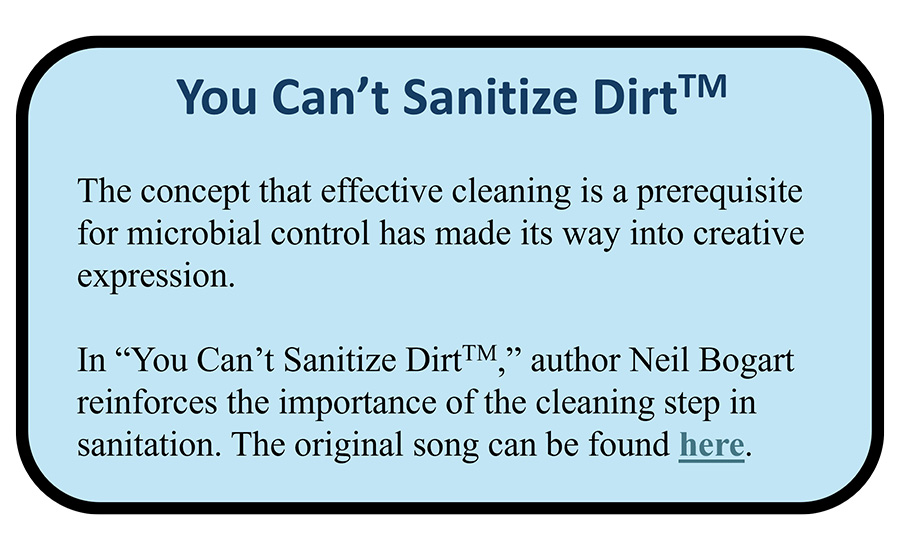
Chief among these constraints is complex equipment geometry. The areas that are most difficult to clean are also the most difficult to sanitize. If soil and microbial cells remain physically embedded within a niche, then applying a sanitizer over the surface will not compensate for inadequate cleaning. Mechanical intervention is typically required to remove contamination from these locations. This principle has been noted in a previous Food Safety Magazine article: locations that are hard to clean are inherently hard to sanitize.8 Said another way, if microorganisms cannot be physically removed during cleaning, then sanitizing is unlikely to provide more than a marginal additional benefit. Conversely, when cells are effectively removed through cleaning, the remaining microbial load is already low, and sanitizing again contributes only incrementally. In either instance, the efficacy of cleaning is the key determining factor in microbial control.
Recognizing the central role of cleaning is critical to ensuring that effort and resources are appropriately allocated within sanitation programs. When teams assume that sanitizers are responsible for most of the microbial reduction, they may over-rely on chemical interventions, become complacent in execution, and underinvest in training focused on effective cleaning techniques. This mindset can also lead to insufficient evaluation of cleaning performance and a failure to fully appreciate the importance of hygienic equipment design and the elimination of harborage sites.
A Shift in Mindset
If cleaning is so critical, then why does sanitizing often receive most of the attention? In part, this perception is rooted in how sanitation has historically been framed. Cleaning is typically described in terms of food soil removal, while sanitizing is explicitly defined as the step that reduces or destroys microorganisms. This framing implicitly assigns microbial control to sanitizing alone, overlooking the substantial microbial reduction that occurs during cleaning. As a result, cleaning is often viewed as preparatory, while sanitizing is positioned as the primary microbial control step.
This misconception is reinforced by how sanitation efficacy is studied. Sanitizers are routinely evaluated for their microbial lethality under controlled conditions, producing clear, quantifiable outcomes such as log reductions. In contrast, the effectiveness of physical cleaning is more difficult to characterize. It depends on factors such as equipment design, access, mechanical action, and operator technique, all of which introduce variability. Because it is harder to measure and standardize, cleaning has received comparatively less attention in both research and validation, despite being the step that often drives the majority of microbial reduction.
We should position cleaning as the foundation of microbial control. One practical approach to change mindsets is to more deliberately evaluate cleaning efficacy in real-world conditions. Many facilities already perform visual inspections and collect swab samples, such as ATP or microbial hygiene indicators, after cleaning and before sanitizing. This practice is valuable because it isolates the performance of the cleaning step, allowing teams to assess how effectively soils and associated microorganisms have been removed without the confounding influence of sanitizer application.
At a broader level, while considerable effort has been devoted to studying sanitizer efficacy, the physical removal of cells during cleaning remains comparatively understudied. This represents a critical gap. If cleaning is responsible for much of the microbial reduction in practice, it should be investigated and validated with the same rigor applied to sanitizer use. A useful question for sanitation leaders to consider is whether their cleaning processes are understood, measured, and validated to the same extent as their sanitizing steps.
Facilities should also invest in strengthening their physical cleaning programs. This includes training personnel to recognize visual indicators of inadequate cleaning, improving access to equipment through disassembly or hygienic design, and standardizing cleaning procedures to ensure consistency.
Where Do We Go from Here?
In retrospect, the role of cleaning in microbial reduction feels obvious, but this simple change in mindset can drive behavioral change. Many physical cleaning steps are manual; therefore, employee recognition that cleaning is a microbial control step and not just a "housekeeping task" is essential. Reducing harborage sites becomes a goal for cross-functional teams (e.g., engineering/maintenance, food safety and quality, sanitation). Sanitizers will be applied with realistic expectations.
This is not an argument against sanitizing, but rather for placing it in the appropriate context. Cleaning is the foundation of sanitation. Most microbial reduction in food manufacturing environments occurs during the cleaning step through physical removal of soils and the cells they harbor. Sanitizers provide an important but often incremental additional reduction once surfaces are cleaned.
Aligning professional development and sanitarian training, SSOP validation, equipment design, and research with this reality will strengthen sanitation outcomes. Our greatest gains in microbial control will not come from stronger chemicals, but from better cleaning.
Acknowledgment
This work was supported in part by a grant from Dairy Management Inc. to Dr. Abby Snyder.
References
- U.S. Food and Drug Administration (FDA). Draft Guidance for Industry: Establishing Sanitation Programs for Low-Moisture Ready-to-Eat Human Foods and Taking Corrective Action Following a Pathogen Contamination Event. January 2025. https://www.fda.gov/regulatory-information/search-fda-guidance-documents/draft-guidance-industry-establishing-sanitation-programs-low-moisture-ready-eat-human-foods-and.
- Daeschel, D., L. Chen, C. Zoellner, and A.B. Snyder. "A simulation model to quantify the efficacy of dry cleaning interventions on a contaminated milk powder line." Applied and Environmental Microbiology 91, no. 5 (April 2025): e02086-24. https://journals.asm.org/doi/10.1128/aem.02086-24.
- Suehr, Q., S. Keller, and N. Anderson. "Effectiveness of dry purging for removing Salmonella from a contaminated lab scale auger conveyor system." International Association for Food Protection Annual Meeting. Salt Lake City, Utah. July 8–11, 2018.
- Rock, C. and M. Danyluk. "CPS Tri-State Project on Harvest Equipment: A Data-Informed Consensus of 'Clean for the Intended Purpose.'" Center for Produce Safety. 2023. https://www.centerforproducesafety.org/research-database/cps-tri-state-special-project-on-harvest-equipment-a-data-informed-consensus-of-clean-for-the-intended-purpose.
- Ohman et al., 2023. "Before and After: Evaluation of Microbial and Organic Loads in Produce Handling and Packing Operations with Diverse Cleaning and Sanitizing Procedures." Journal of Food Protection 86, no. 12 (December 2023): 100185. https://www.sciencedirect.com/science/article/pii/S0362028X23068692.
- Jiao, Y., J. Baker, C. Slaughter, D. Daeschel, and A.B. Snyder. "Reduction of Listeria on stainless steel surfaces is impacted by sanitizer application method." Preprint via BioRxiv. 2026. https://www.biorxiv.org/content/10.1101/2025.04.09.647964v1.
- Bogart, N. "You Can't Sanitize Dirt™." Original song. https://song.do/play_music/e7b2ab4e9d45c819c586ecc99029405e?utm_source=share.
- Mirdamandi, N. and A. Snyder. "In Dry Environments, Wet Sanitation Isn't the Answer—It's the Issue. Food Safety Magazine February/March 2026. https://www.food-safety.com/articles/11162-in-dry-environments-wet-sanitation-isnt-the-answerits-the-issue