Food Safety
search
Ask Food Safety AI
cart
facebook twitter linkedin
  • Sign In
  • Create Account
  • Sign Out
  • My Account
Food Safety
  • NEWS
    • Latest News
    • White Papers
  • PRODUCTS
  • TOPICS
    • Contamination Control
    • Food Types
    • Management
    • Process Control
    • Regulatory
    • Sanitation
    • Supply Chain
    • Testing and Analysis
  • PODCAST
  • EXCLUSIVES
    • Food Safety Five Newsreel
    • eBooks
    • FSM Distinguished Service Award
    • Interactive Product Spotlights
    • Videos
  • BUYER'S GUIDE
  • MORE
    • ENEWSLETTER >
      • Archive Issues
      • Subscribe to eNews
    • Store
    • Sponsor Insights
    • ASK FSM AI
  • WEBINARS
  • FOOD SAFETY SUMMIT
  • EMAG
    • eMagazine
    • Archive Issues
    • Editorial Advisory Board
    • Contact
    • Advertise
  • SIGN UP!

Extending the applications of blockchain in the food manufacturing industry
By Wayne Labs
Blockchain

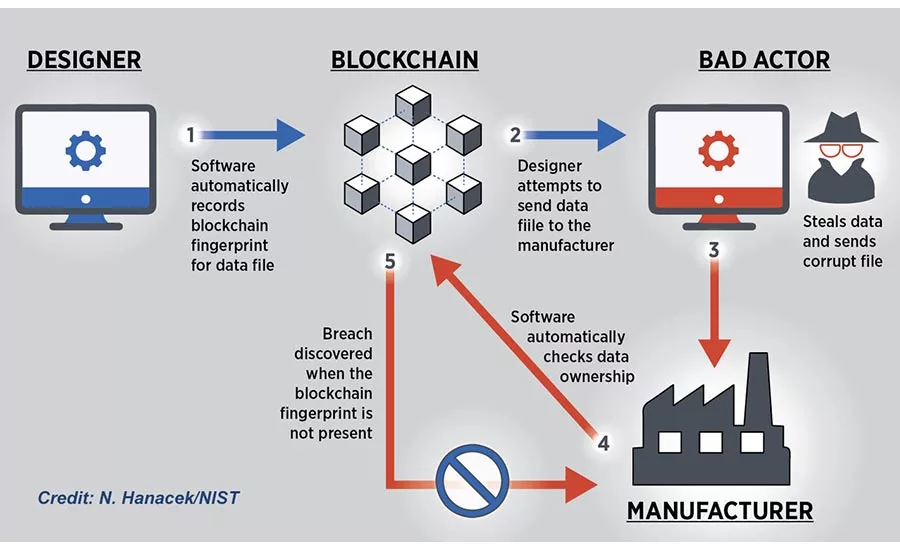
Engineers at NIST have designed a secure method for interchanging parts design data using blockchain technology. While in development for discrete manufacturing and pharmaceuticals, the technology could be applied in the food industry for product design and development.

Chart courtesy of N. Hanacek/NIST

May 16, 2019

According to a new NIST (National Institute of Standards and Technology) report, blockchain—the underlying security system used in bitcoin and other digital currencies—is being used to provide not only tamper-resistant transmission of manufacturing data for making machine parts, but also perfect traceability of that data to all participants in the production process.

Protecting the intellectual property of machine part design as it travels among participants in an additive manufacturing process could have extensibility into food and beverage in two ways beyond the tracking and tracing of food products from supplier to final point of sale.

First, in keeping the discussion at the machine parts level, blockchain technologies could be applied to parts design or machine modifications as food processor, OEMs and their parts suppliers design or make changes to a machine to handle new processes or packaging.

Second, blockchain technology could be applied to new food product design. For example, a processor’s master chef will collaborate with clients’ chefs about new product recipes, processing, packaging, etc. In addition, product design teams need to produce new graphics and packaging—all of which need to be protected from prying eyes while each team member gets accurate and timely information. How does it work?

Blockchain is an expandable list of records, or blocks, each containing data representing an individual transaction by members of a network. Each block consists of a data set, time stamp, a cryptographic hash (a cybersecurity fingerprint) and the hash of the previous block, mathematically linking them together. Information in any block cannot be altered without changing all subsequent blocks and alerting record-keepers in the network that possible foul play has occurred.

According to the NIST report (Series 300-6) entitled “Securing the Digital Threat for Smart Manufacturing: A Reference Model for Blockchain-Based Product Data Traceability,” smart manufacturing requires that product data be shared and exchanged among numerous engineering applications and information systems, but all the information generated and shared in a product’s lifecycle needs to be protected from tampering, corruption and theft. It must also be totally traceable and time-stamped—and always up to date.

“In other words, if I’m a manufacturer making a part for a product and I receive the specs for that part from the designer who’s upstream in the process, blockchain ensures that I can trust the data actually came from that person, is exactly what he or she sent, and was not interfered with during transmission,” says NIST research associate and computer scientist, Sylvere Krima, the report’s lead author. “Because the chain is tamper resistant and the blocks are time-stamped, a blockchain is a robust solution to authenticate data at any point during the product lifecycle.”

Looking for quick answers on food safety topics?
Try Ask FSM, our new smart AI search tool.
Ask FSM →


Why blockchain? 

“What we didn’t put in the report is the work we had done before that,” said Krima. The goal was to ensure that no one tampered with the data throughout the product lifecycle. The problem was that not all formats make protecting the data easy. “We looked at things such as digital certificates/signatures, but one issue we had with digital certificates/signatures is the fact that not all the data formats support digital signatures,” says Krima. “So we needed a way to have that kind of signature outside of the file itself.”

Another problem is that not all file formats consistently support digital signatures, so tracking and tracing data alternations is difficult. Blockchain became the solution because it supplies a central repository or registry that contains all the information about exchanges—what was exchanged, who was involved and when the transaction happened, says Krima.

Simply put, as a repository blockchain registers can support most any data, such as CAD files, Word documents, emails and plain text, according to Krima. Importantly, besides holding the data, blockchain keeps track of everything about movement of the information, keeping it up to date and secure.

So could this technology be applied to the food and beverage applications previously mentioned? “Absolutely,” says Krima. “What we’ve done is exactly that kind of use case; it enables exchange among partners.”

This application of blockchain technology for design teams is moving into other industries besides manufacturing, including pharmaceuticals and autonomous vehicles, says Krima. The good news is the technology is relatively simple to implement and not at all cost prohibitive. Siemens is working with blockchain technology in other product design areas, according to Krima.


This article was originally posted on www.foodengineeringmag.com.
KEYWORDS: blockchain technology food and beverage industry trends track and trace

Share This Story

Wayne labs 200px
Wayne Labs has more than 20 years of editorial experience in industrial automation. He served as senior technical editor for I&CS/Control Solutions magazine for 18 years where he covered software, control system hardware and sensors/transmitters. Labs ran his own consulting business and contributed feature articles to Electronic Design, Control, Control Design, Industrial Networking and Food Engineering magazines. Before joining Food Engineering, he served as a senior technical editor for Omega Engineering Inc. Labs also worked in wireless systems and served as a field engineer for GE’s Mobile Communications Division and as a systems engineer for Bucks County Emergency Services. In addition to writing technical feature articles, Wayne covers FE’s Engineering R&D section.

Recommended Content

JOIN TODAY
to unlock your recommendations.

Already have an account? Sign In

  • people holding baby chicks

    Serovar Differences Matter: Utility of Deep Serotyping in Broiler Production and Processing

    This article discusses the significance of Salmonella in...
    Meat/Poultry
    By: Nikki Shariat Ph.D.
  • woman washing hands

    Building a Culture of Hygiene in the Food Processing Plant

    Everyone entering a food processing facility needs to...
    Training
    By: Richard F. Stier, M.S.
  • graphical representation of earth over dirt

    Climate Change and Emerging Risks to Food Safety: Building Climate Resilience

    This article examines the multifaceted threats to food...
    Risk Assessment
    By: Maria Cristina Tirado Ph.D., D.V.M. and Shamini Albert Raj M.A.
Manage My Account
  • eMagazine Subscription
  • Subscribe to eNewsletter
  • Manage My Preferences
  • Website Registration
  • Subscription Customer Service

More Videos

Sponsored Content

Sponsored Content is a special paid section where industry companies provide high quality, objective, non-commercial content around topics of interest to the Food Safety Magazine audience. All Sponsored Content is supplied by the advertising company and any opinions expressed in this article are those of the author and not necessarily reflect the views of Food Safety Magazine or its parent company, BNP Media. Interested in participating in our Sponsored Content section? Contact your local rep!

close
  • Salmonella bacteria
    Sponsored byThermoFisher

    Food Microbiology Testing Methods: Salmonella species

  • a diagram explaining indicator organisms
    Sponsored byHygiena

    How Proactive Listeria Testing Helps Prevent Six- and Seven-Figure Recalls

  • woman grocery shopping
    Sponsored byCorbion

    Designing Safety Into Every Bite: Proactive Risk Mitigation for Refrigerated Foods

Popular Stories

NRTE breaded stuffed chicken

USDA Indefinitely Delays Enforcement of Salmonella as Adulterant in Raw Breaded, Stuffed Chicken

digital map of europe

EU Publishes Food Fraud Tool Mapping Thousands of Cases Since 2016

non-conforming product

How to Handle Non-Conforming Product

Events

December 11, 2025

How to Develop and Implement an Effective Food Defense Strategy

Live: December 11, 2025 at 2:00 pm EDT: From this webinar, attendees will learn common areas where companies encounter challenges in their food defense strategies and how to address them.

May 11, 2026

The Food Safety Summit

Stay informed on the latest food safety trends, innovations, emerging challenges, and expert analysis. Leave the Summit with actionable insights ready to drive measurable improvements in your organization. Do not miss this opportunity to learn from experts about contamination control, food safety culture, regulations, sanitation, supply chain traceability, and so much more.

View All

Products

Global Food Safety Microbial Interventions and Molecular Advancements

Global Food Safety Microbial Interventions and Molecular Advancements

See More Products

Related Articles

  • tracking produce

    Blockchain is the tracking method preferred by industry right now

    See More
  • food plant construction

    The ongoing impact of COVID-19 on the food industry and its supply chains

    See More
  • EU Food waste

    'Use by…,' 'Best before…,' confusion causes 10% of food waste in the EU

    See More

Related Products

See More Products
  • 9781498721776.jpg

    Handbook of Food Processing: Food Safety, Quality, and Manufacturing Processes

  • 1119053595.jpg

    Food Safety for the 21st Century: Managing HACCP and Food Safety throughout the Global Supply Chain, 2E

  • 9781138198463.jpg

    Food Safety Management Programs: Applications, Best Practices, and Compliance

See More Products

Related Directories

  • The Austin Co.

    The Austin Company is a consulting, design, engineering, and construction company offering a portfolio of services to a broad spectrum of industries nationwide. Austin offers clients flexibility in the way services are offered—our offerings are designed around your specific project requirements.
×

Never miss the latest news and trends driving the food safety industry

eNewsletter | Website | eMagazine

JOIN TODAY!
  • RESOURCES
    • Advertise
    • Contact Us
    • Directories
    • Store
    • Want More
  • SIGN UP TODAY
    • Create Account
    • eMagazine
    • eNewsletter
    • Customer Service
    • Manage Preferences
  • SERVICES
    • Marketing Services
    • Reprints
    • Market Research
    • List Rental
    • Survey/Respondent Access
  • STAY CONNECTED
    • LinkedIn
    • Facebook
    • Instagram
    • X (Twitter)
  • PRIVACY
    • PRIVACY POLICY
    • TERMS & CONDITIONS
    • DO NOT SELL MY PERSONAL INFORMATION
    • PRIVACY REQUEST
    • ACCESSIBILITY

Copyright ©2025. All Rights Reserved BNP Media.

Design, CMS, Hosting & Web Development :: ePublishing