Food Safety and Employee Safety: Two Sides of the Same Coin
The demand for accountability around food safety should be the same for employee safety

"CDC declares deadly Listeria outbreak associated with chicken…"
"Federal officials continue investigation into Salmonella outbreak as the number of reported new patients and hospitalizations increase across three states…"
These are the news stories that cause sleepless nights for food manufacturers, processors, and producers and drive the pursuit of better and more efficient microbial detection and prevention strategies for those working in food safety. In 2018, the U.S. Centers for Disease Control and Prevention estimated that unspecified agents cause 38.4 million episodes of foodborne illness in the U.S. each year. Determining the sources of foodborne illnesses is an important step in developing prevention measures. Consumer demand for safe, consistent quality in food products is at an all-time high, and brand reputation is constantly on the line.
For those working in occupational safety and health, other news headlines cause sleepless nights: "Food processing plant employee killed after chemical leak"; "Employee killed after being crushed by palletizer at bottling plant." A catastrophic facility event such as an employee fatality, injury, or unanticipated chemical release has far-reaching and heart-wrenching consequences well beyond the walls of the plant.
"Producing safe food" and "producing food safely" are ongoing challenges in almost every food and beverage manufacturing organization. Faster and more efficient production, technological changes, new equipment, sanitation/disinfection chemicals, personnel turnover, and aging facilities and systems all have significant, cross-cutting implications for both food safety and those working to process and produce the product.
Food Safety vs. Workplace Safety: At Odds?
Food safety and quality managers are tasked with controlling the risk and associated fallout of an error in the process that could negatively affect consumer safety—and therefore, the brand's reputation and profitability. This type of management requires critical and ongoing assessment of the food safety management system for gaps, breakdown in process, and potential for human error. The successful management of personal hygiene, thorough and validated sanitation procedures, vigilant environmental pathogen testing programs, and training are imperative to minimizing food product bacteriological, chemical, and physical contamination.
Looking for quick answers on food safety topics?
Try Ask FSM, our new smart AI search tool.
Ask FSM →
Conversely, occupational and environmental health and safety (OEHS) practitioners (including environmental health and safety personnel, or industrial hygienists) are tasked in work environments to anticipate, identify, evaluate, and control safety and health concerns that pose a threat to employees—and therefore, the business as a whole. Controlling exposures and risks to known occupational hazards is both the duty of the employer under the Occupational Safety and Health Act of 1970, which established the Occupational Safety and Health Administration (OSHA). This makes solid business sense since employee injuries and illnesses have substantial direct and indirect costs, as well as obvious ethical and moral stewardship implications.
The ramifications of skimping on either of these roles are substantial. "Pencil whipping"—or going through the motions of establishing programs and procedures, conducting mediocre inspections or training just to comply with regulations or eliminate an audit risk—misses the root cause of potentially deadly infractions.
The Control Conundrum: Peracetic Acid
One area of overlap that remains particularly challenging is the increasing use of peracetic acid (PAA) during food production and processing. The versatility of this chemical—which can be used as both a disinfectant and sanitizer depending on the application and concentration, and the innocuous simplicity of the post-use breakdown products (water, oxygen, and acetic acid)—make it an attractive replacement for other chemicals used as part of biological mitigation in food processing. A chemical product that leaves behind no residual affecting food quality and has demonstrated considerable ability to reduce foodborne pathogen prevalence during processing and handling seems like a win-win.
Although numerous benefits exist to using PAA as an antimicrobial intervention, concern regarding employee exposure to PAA, along with its subsequent health effects, is ongoing and increasing. Multiple reports have surfaced across all industry sectors where PAA is used, including healthcare, of employees suffering discomfort and illness, including acute nasal and eye irritation, shortness of breath, and upper respiratory symptoms1 when working in environments with PAA. These documented health concerns are significant and broad enough for various occupational health and safety organizations such as the American Conference of Governmental Industrial Hygienists (ACGIH) and even regulatory agencies (such as California OSHA) to issue personal exposure limits for airborne concentration of PAA at a workplace.
Hierarchy of Controls: The "Prevention Pyramid"
For those in OEHS, hazard control strategies are often ranked on a hierarchy to guide how to implement feasible and effective control solutions. This framework, which attempts to prevent a hazard before it reaches the individual and causes harm, is the same methodology utilized by food safety and quality professionals to eliminate or control biological contamination well before reaching the consumer. While the implementation might be different, the concept should feel familiar (Figure 1).
FIGURE 1. The Hierarchy of Controls; image courtesy NIOSH
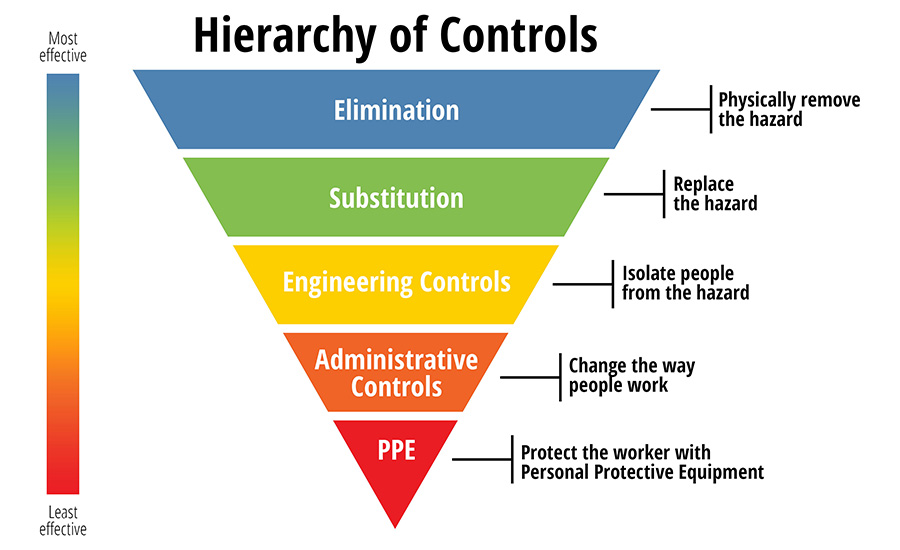
Elimination and substitution are considered the most effective strategies because successful implementation of these approaches removes the hazard before it is created. However, once a process is in place or a physical structure is built and in use, it can be difficult and expensive to remedy. In the case of environmental or microbial pathogens, until there is a magic wand that can eliminate endemic Campylobactor or Salmonella from poultry, for example, full elimination of this hazard—and the subsequent need to utilize chemicals for disinfection and sanitation—is not likely.
Engineering Controls
Engineering controls are the next most effective strategy because, ultimately, these approaches remove the human factor from the equation and are designed to remove the hazard at the source. For example, the concentrated form of PAA has a flashpoint of 105 °F (40.5 °C), and it also reacts violently with soft metals (e.g., copper, zinc, iron, or brass). These properties mean that PAA storage, handling, and transport at a processing facility are critical to ensuring plant and employee safety.
Typically, PAA is delivered in its concentrated form via tanker truck (and pumped into a containment silo) or in industrial totes and is eventually diluted into an aqueous solution and pumped throughout the plant. Providing an automatically climate-controlled, ventilated storage location for totes or barrels of concentrated PAA, for example, and automating the dispensing and dilution process would be an example of an engineering control within the hierarchy.
Administrative/Work Practices
This middle tier of control strategies can be the most complex, confounding, and costly; but in a food production environment reliant primarily on humans, this is also where the most significant impacts can be achieved. These control solutions are incumbent upon active and engaged management and supervision; consistent accountability; adequate resources; and meaningful, specific, and timely training. Pre-planning and a thorough understanding of the task and steps for completion are essential. If this sounds like a substantial amount of work—you are right! However, truly effective work practice and administrative controls will result in a more engaged and invested workforce and pay dividends for food and employee safety.
Revisiting the previous example of safe storage for PAA, equipping that location with sensors and a notification system to automatically alert employees of leaks or failures would be an administrative control; training employees on what actions to safely take next, appropriate supervision during the response, and how to report a malfunction would also fall into this control category. The system only works, however, if someone monitors the data and inspects for accuracy of the input/output—testing and calibrating the sensors according to the manufacturer's recommendations, for example.
Another illustration of administrative control is when chemicals such as PAA are made available in premixed, ready-to-use concentrations versus manual dilution. Sometimes, employees assume that "more is better" when it comes to chemical product application, which can have multiple unintended consequences downstream—too much PAA in the process water can kill the good microbes or alter the pH during wastewater treatment. This approach also reduces the potential for employee error in dilution measurement, which could affect both efficacies of the chemical in biological reduction and inadvertent employee overexposure from a safety perspective.
The method in which PAA is applied to a food product—whether via high-pressure spray nozzles in cabinets, steady stream/drip as the material moves along a conveyor, chiller baths with longer contact time (such as for poultry broilers), mist, dip, or fogging—can change the concentration of PAA in the air dramatically. The variability in application techniques leads to PAA existing as both a vapor and an aerosol in workplace air, and at varying concentrations. Depending on ventilation in the area, the proximity of employees to the point of application, and production line drain maintenance, employee exposure potential can be unpredictable.
Herein lies is a perfect opportunity for food safety managers and the OEHS manager to collaborate on administrative and work practice controls to improve quality outcomes and employee safety simultaneously. When conducting a walkthrough of the production floor to assess the appropriate application of PAA, consider adjusting your gaze to look through an alternative lens. As companies choose to increase the number of application sites of PAA or adjust the concentration of the chemical, the food safety team may see a quality improvement in the final product from a microbial contamination perspective; however, employees exposed to these changing amounts of PAA during production may notice new or more severe symptoms from exposure.
Look for inconsistencies and potential problem areas, and consider clues that could lead to preemptive action. For example, observing where employees are positioned relative to application points is an important first step. Are employees directly adjacent to a spray cabinet? Why are they in that location? Do they need to be located there? Have the spray nozzles been adjusted or blocked? Can employees voluntarily change the pressure or volume coming through the nozzles? Are the nozzles inspected regularly or included in a preventive maintenance plan? How long does an employee remain in that position? What are the activities in the surrounding area? Are pooling water or debris present on the floor under conveyors or in drip pans? How effective is drainage at the facility?
Spray nozzles are regularly inadvertently blocked by debris, causing erratic application and off-target overspray. This inconsistent application impacts food safety and potentially puts an employee directly into a "line of fire"; both problems lead to the inefficient use of expensive chemical solution and increased consumer and employee risk. Uneven flooring in older facilities leads to puddling with process water, debris, and drip collection pans located beneath a conveyor that is not angled correctly for drainage—these are likely observations that make a food safety manager cringe. Use that observation to look beyond the potential for microbial growth and contamination, to also see how pooling process water containing PAA can create an ongoing source of airborne exposure for employees as it volatilizes, evaporates into the environment, or mixes with other chemicals (such as chlorine) in the floor drains.
To actively address these issues, safety and health professionals should collaborate with the quality assurance personnel and clearly communicate the potential effects to employees, managers, maintenance staff, and employees working with wastewater control. Constant, clear communication must occur with all of these employees to prevent adverse impacts on employee health. Included in this tier of the control hierarchy is the need for understandable, relevant, and specific training on the why, how, what, and importance of the chemicals used at the plant during production and processing.
Training employees (in a manner and language they can understand) on the hazards of chemicals present and used in the workplace is an OSHA regulatory requirement.2 It is also important to ensure that employees understand the important role they play in maintaining food quality. Retraining is necessary when deficiencies in understanding are observed on the production floor, but it should not be the sole "go-to" corrective action implemented by management. A true root-cause investigation (also an administrative control) will glean more fruitful outcomes.
Personal Protective Equipment
Personal protective equipment (PPE), such as safety glasses, gloves, earplugs, and face shields, is considered the least effective control option on the hierarchy pyramid because it relies on the employee to correctly and consistently wear the appropriate gear every time it is donned. Before assigning or providing PPE to an employee, the employer must complete a hazard assessment of the work task that results in selecting the correct equipment for completing the job safely.
When there are conflicting interpretations with employee "personal protection," challenges can arise. For example, in most poultry processing facilities, employees are required to wear smocks or coats, aprons, hair and beard covers, and gloves—with the intent of protecting the food product from employee contamination, not the other way around. However, if the sleeves or cuffs of the jacket are too big, they can often become contaminated and wet, resulting in contact exposure for an employee on their forearms. Also, gloves that might be sufficient for handling food products on the line are inappropriate for extended chemical applications. Without appropriate training and management of a PPE program, including accountability mechanisms and employee input, this control strategy will lack teeth.
Sharing the Control Capabilities
In recent years, employee safety at food processing and beverage facilities has received heightened attention due to the incidence rates reported to OSHA. For example, Bureau of Labor Statistics (BLS) data indicate that "poultry workers suffer serious injuries at rates twice as high as workers in private industry and suffer work-related illness at rates more than six times" the national average.3 Those working in OEHS also know that, often, there is significant underreporting of injuries and illnesses by employees due to fear of retaliation or misunderstanding of their rights.
As a result of these issues, OSHA has instituted increased enforcement and outreach activities for this industry sector, including improved inspection and training. Concurrently, food safety inspections and compliance with the U.S. Food and Drug Administration's Food Safety Modernization Act are also under increasing regulatory scrutiny. Instead of separating the risk assessment process for food safety and quality from the risk assessment for employees performing the work, consider completing these assessments in tandem.
Wendy White, M.Sc. and food safety product manager, discussed challenges to developing a robust environmental management program (EMP). Her 2020 Food Safety Magazine article, "Getting Sanitation Out of the Reclean/Retest Rut,"4 discussed how improper sanitation contributes to environmental pathogen contamination and how many plants do not have adequate preventative actions—just an immediate corrective action "bandage" to quickly and impermanently fix a positive test result for the next retest swab. An equivalent response is when a line supervisor receives a complaint from an employee about burning eyes and throat while working near a spray cabinet dispensing PAA and moves the employee to another location on the line, rather than engaging in a more thorough investigation into a potential cause for the discomfort.
Heads or Tails: Why Not Both?
There is a demand for accountability around food safety from a regulatory, consumer, and company standpoint; it should be the same for employee safety. Working together to understand the needs and nuances of each program—and how the outcomes are intertwined—can lead to improved employee trust and participation in solving complex problems. Make heightened efforts to collaborate and communicate needs and priorities among personnel; training, retraining, supervisor responsibilities, and accountability are key.
Getting to the root cause of an employee safety and health concern should be just as critically important as determining the reason for a nagging contamination issue. Ignoring, blaming, downplaying, or considering a concern a "one-off" is a dangerous strategy. A positive swab test or a "near-miss incident" where an event almost led to a potentially devastating consequence should be treated by management as an opportunity to learn. Sharing these lessons among the stakeholders in a facility will improve outcomes for all.
References
- National Institute for Occupational Safety and Health. "Evaluation of Exposure to a Hydrogen Peroxide, Peracetic Acid, and Acetic Acid Containing Cleaning and Disinfection Product and Symptoms in Hospital Employees." September 2019.
- U.S. Department of Labor. Occupational Safety and Health Administration. "Hazard Communication." https://www.osha.gov/hazcom.
- U.S. Department of Labor. Occupational Safety and Health Administration. "OSHA Regional Instruction: Regional Emphasis Program (REP) for Poultry Processing Facilities." October 1, 2019. https://www.osha.gov/sites/default/files/enforcement/directives/CPL_20-09_CPL_04.pdf
- White, W. "Getting Sanitation out of the Reclean/Retest Rut." Food Safety Magazine (April/May 2020). https://www.food-safety.com/articles/6540-getting-sanitation-out-of-the-recleanretest-rut.
Hilarie Warren, M.P.H., C.I.H., currently manages the OSHA Training Institute (OTI) Education Center at Georgia Tech, one of the first OTI Education Centers in the national network of occupational safety and health training organizations authorized by OSHA. She enjoys helping companies translate regulatory requirements and move into implementation by providing opportunities for training attendees to share best practices and stories.
Jenny Houlroyd, M.S.P.H., C.I.H., has worked as an industrial hygienist with the OSHA Consultation Program for 16 years, providing onsite OSHA compliance assistance for businesses throughout the state of Georgia. She currently serves as the Manager of the Occupational Health Group for that program. This free program is designed for small- and medium-sized companies to assist employers with achieving regulatory compliance and ensuring that they provide safe and healthful working environments for employees.
Wendy White, M.Sc., is the Industry Manager for Food and Beverage at Georgia Tech's Manufacturing Extension Partnership (GaMEP). She is also a member of the Editorial Advisory Board of Food Safety Magazine.