Food Safety
search
Ask Food Safety AI
cart
facebook twitter linkedin instagram youtube
  • Sign In
  • Create Account
  • Sign Out
  • My Account
Food Safety
  • NEWS
    • Latest News
    • White Papers
  • PRODUCTS
  • TOPICS
    • Contamination Control
    • Food Types
    • Management
    • Process Control
    • Regulatory
    • Sanitation
    • Supply Chain
    • Testing and Analysis
  • PODCAST
  • EXCLUSIVES
    • Food Safety Five Newsreel
    • eBooks
    • FSM Distinguished Service Award
    • Interactive Product Spotlights
    • Videos
  • BUYER'S GUIDE
  • MORE
    • NEWSLETTERS >
      • Archive Issues
      • Subscribe to eNews
    • Store
    • Sponsor Insights
    • ASK FSM AI
  • WEBINARS
  • FOOD SAFETY SUMMIT
  • EMAG
    • eMagazine
    • Archive Issues
    • Editorial Advisory Board
    • Contact
    • Advertise
  • SIGN UP!
ManagementInternationalTraining

SecureFood School: Transforming Food System Risk Science into Real-World Education

By Maryna Nehrey Ph.D., Olena Hlazunova D.Sc., Ben Moore
outstretched hands holding plant in soil with connected dots overlaid representing data
Image credit: rawpixel via Magnific
May 5, 2026

Food systems are becoming increasingly vulnerable to climate change, economic shocks, and geopolitical disruptions. This makes it necessary to increase resilience to sustain productivity, environmental performance, and long-term economic viability. Recent crises, such as the war in Ukraine and the COVID-19 pandemic, have demonstrated how swiftly shocks can propagate through food production, processing, logistics, and consumption systems. Indeed, disruptions to supply chains resulting from the pandemic, energy price volatility, and clashes between regions have highlighted structural flaws in food systems and their impact on food availability, safety, and stability. Strengthening food system resilience therefore requires not only technological innovation, but also an improved societal understanding of food system dynamics and risks.

Over the past decade, a number of initiatives have emerged to develop analytical tools for monitoring and managing food system risks. Digital tools such as digital twins, early warning systems, and data-based modeling enable researchers and policymakers to identify vulnerabilities, simulate disturbances, and evaluate potential actions. However, the analytical outputs are usually confined to specific research environments. Translating scientific insights into formats that are legible and usable by wider stakeholder groups remains a challenge, but is essential for enhancing food system resilience. 

Education plays a central role in addressing this gap. Traditional educational approaches often focus on conveying knowledge rather than competencies in analyzing complex systems and responding to uncertainty. However, food systems are tightly knit socio-ecological systems where environmental factors, economic incentives, governance systems, and consumer behavior influence one another mutually. These interactions are important for anticipating risks and designing solutions. Therefore, educational approaches based on systems thinking and emphasizing collaborative learning and problem-focused experimentation might be beneficial in developing individuals' and communities' capacities to tackle problems related to the food system.

The SecureFood School was created to bring this concept to life. The initiative is a central tenet of the Horizon Europe project SecureFood, which is an integrated approach to enhance food systems resilience by advocating for food security and supporting an uninterrupted food supply. The SecureFood project develops analytical tools to support the identification of risks and the response to crises across food systems, including aspects such as digital twins of supply chains, early warning systems, data-driven risk assessment models, and a resilience governance framework. Though effective at offering useful insights to policymakers and actors, these aspects can be difficult for broader audiences to interpret. 

The SecureFood School addresses this challenge by developing project outputs into educational formats, inviting learners to explore the food system and how to cope with it. The SecureFood School is based on the Learning for Change (L4C) concept, an approach that views education not just as a tool for transferring information but also as a means of equipping learners with the ability to address real-world problems and contribute to systemic change. Regarding food systems, L4C encourages learners to consider how food production, processing, distribution, and consumption are interconnected and how disruption can affect these connections. Through collaborative learning and experimental coursework, participants develop the ability to critically assess risks and explore alternative responses.

A central objective of the SecureFood School is to foster systems thinking. The structure of food systems, the actors involved, and the processes at play are examined using simplified models for each case. Learners can identify such disruptions, ranging from extreme weather patterns and logistical breakdowns to market instability, as demonstrated in models showing how the supply chain is disrupted and food availability is impacted. By examining these interactions, students can understand how local experiences and choices can influence the responses of larger systems. 

The program operates through a hybrid learning model that combines classroom activities, digital learning environments, and community-based experimentation. A central, Moodle-based digital platform functions as the core knowledge hub for the SecureFood School (Figure 1). The platform hosts thematic modules on food system resilience, interactive materials explaining risk drivers, and practical exercises designed to stimulate critical reflection and collaborative problem-solving.

Looking for quick answers on food safety topics?
Try Ask FSM, our new smart AI search tool.
Ask FSM →

The selection of Moodle as the core learning platform followed a systematic evaluation of alternative digital learning architectures. Moodle provides an open-source, scalable, and modular environment that supports collaborative learning and stakeholder interaction. Tools such as forums, wikis, group workspaces, and interactive assignments allow participants to exchange ideas, document learning experiences, and provide feedback on educational materials. These features align closely with the participatory principles of the L4C approach.

Figure 1. A central, Moodle-based digital platform functions as the core knowledge hub for the SecureFood School (Image credit: SecureFood project)
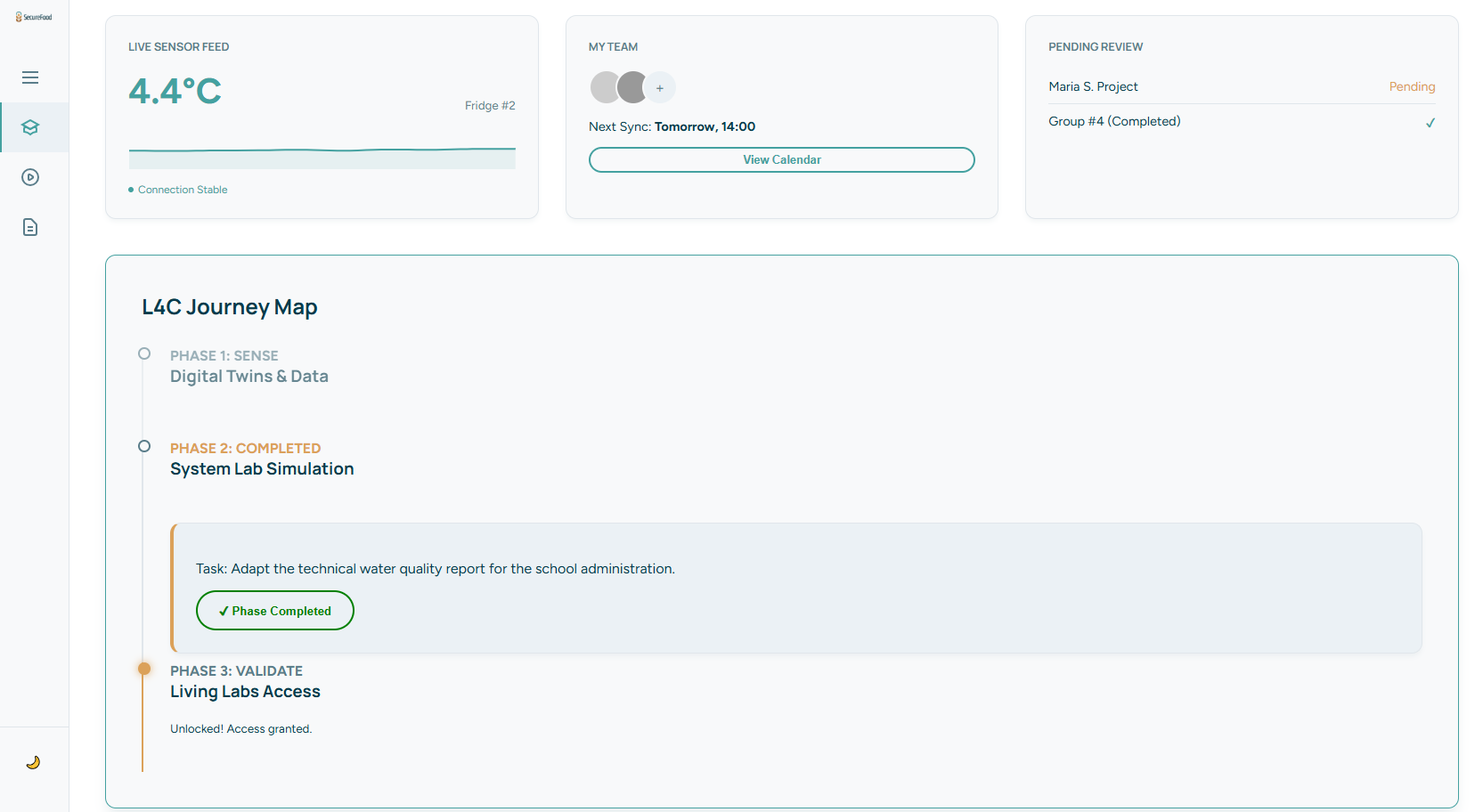
 A central, Moodle-based digital platform functions as the core knowledge hub for the SecureFood School Image courtesy of the SecureFood project

At the same time, Moodle is not used as a standalone system. The SecureFood School adopts a hybrid digital architecture in which Moodle serves as the central learning hub integrated with specialized external tools. Data visualization dashboards enable learners to explore simplified outputs from SecureFood modeling tools and examine key drivers of food system risk. Collaborative platforms such as digital whiteboards support co-creation and collective interpretation of data. This integration allows the program to combine structured educational pathways with interactive exploration of food system dynamics.

Another defining feature of the SecureFood School is its emphasis on experiential learning. Instead of focusing exclusively on theoretical knowledge, the program encourages participants to design and implement small-scale initiatives within their local environments. These initiatives translate analytical insights into practical action and enable learners to test resilience strategies in real-world settings. Examples of such initiatives include projects aimed at reducing food waste in school cafeterias, improving transparency in food sourcing, strengthening local procurement networks, or raising awareness of food system vulnerabilities within communities. Through these activities, participants collect data, evaluate outcomes, and reflect on the effectiveness of different strategies.

The educational resources used in the SecureFood School draw on a wide range of project outputs and communication materials. These include simplified visualizations of food system risks, educational modules based on modeling results, resilience governance guidelines, and toolkits supporting school-based innovation projects. The materials are designed to be adaptable to different age groups and stakeholder contexts, enabling the program to reach diverse audiences.

The SecureFood School has two main objectives. First, it aims to increase societal understanding of food system resilience by translating complex analytical results into accessible educational resources. In doing so, the initiative helps to bridge the gap between scientific knowledge and public awareness of the risks associated with the food system. Second, the program seeks to develop a generation of informed agents of change who can contribute to the creation of resilient and sustainable food systems. Through systems thinking, collaboration, and problem-solving activities, participants develop the skills needed to address food system challenges within their communities.

By embedding the Learning for Change approach within a scalable digital environment, the SecureFood School shows how the results of complex scientific projects can be turned into practical educational tools. The platform integrates technological innovation with participatory learning processes that encourage reflection, experimentation, and collaboration. Ultimately, the initiative strengthens societal adaptive capacity by enabling learners to anticipate, understand, and respond to disruptions affecting food systems more effectively.

In a context where food systems are becoming increasingly complex and exposed to multiple risks, initiatives such as the SecureFood School emphasize the importance of connecting scientific innovation with education and societal engagement. By translating risk intelligence into accessible learning experiences, the program supports the development of food systems that are more resilient, adaptive, and capable of maintaining food availability and safety in an increasingly uncertain environment.

KEYWORDS: EU resilience

Share This Story

Maryna Nehrey, Ph.D. is a researcher in the Department of Economic Cybernetics at the National University of Life and Environmental Sciences of Ukraine and the Department of Food Systems Sciences at the Research Institute of Organic Agriculture in Switzerland. She specialized in food system resilience, sustainability, and data-driven risk analysis. Dr. Nehrey translates complex scientific insights on food system risks into practical tools for education, policy, and stakeholder engagement.

She contributes to international research initiatives that address food security, crisis preparedness, and the resilience of agri-food systems. Within the Horizon Europe project SecureFood, she is involved in developing educational approaches that connect advanced analytical tools, such as modeling, early warning systems, and digital representations of supply chains, with real-world learning environments. Her research and teaching emphasise systems thinking, participatory learning and integrating science with societal engagement, strengthening the capacity of communities and future professionals to understand and respond to food system disruptions.

Olena Hlazunova, D.Sc. is a Vice-Rector for Scientific and Pedagogical Work and Digital Transformation at the National University of Life and Environmental Sciences of Ukraine. She specializes in digital transformation in higher education, innovative learning environments, and the development of technology-enhanced approaches to teaching, learning, and knowledge exchange. She has extensive experience in designing and implementing digital education systems, including hybrid and cloud-oriented learning environments, microlearning, and interactive educational platforms. She combines academic leadership, research, and practical implementation to strengthen universities' capacity for innovation, resilience, and high-quality digital learning.

She is actively involved in national and international projects, including Horizon Europe and DAAD initiatives, where she contributes to digitalization, research capacity-building, and the development of educational solutions for agriculture and food systems.

Ben Moore is Senior EU Project Manager at the SecureFood project, where he leads the communication and dissemination efforts among the project's 25-partner consortium from across Europe.

Recommended Content

JOIN TODAY
to unlock your recommendations.

Already have an account? Sign In

  • people holding baby chicks

    Serovar Differences Matter: Utility of Deep Serotyping in Broiler Production and Processing

    This article discusses the significance of Salmonella in...
    Meat/Poultry
    By: Nikki Shariat Ph.D.
  • woman washing hands

    Building a Culture of Hygiene in the Food Processing Plant

    Everyone entering a food processing facility needs to...
    Sanitation
    By: Richard F. Stier, M.S.
  • graphical representation of earth over dirt

    Climate Change and Emerging Risks to Food Safety: Building Climate Resilience

    This article examines the multifaceted threats to food...
    Management
    By: Maria Cristina Tirado Ph.D., D.V.M. and Shamini Albert Raj M.A.
Manage My Account
  • eMagazine Subscription
  • Subscribe to Newsletters
  • Manage My Preferences
  • Website Registration
  • Subscription Customer Service

More Videos

Sponsored Content

Sponsored Content is a special paid section where industry companies provide high quality, objective, non-commercial content around topics of interest to the Food Safety Magazine audience. All Sponsored Content is supplied by the advertising company and any opinions expressed in this article are those of the author and not necessarily reflect the views of Food Safety Magazine or its parent company, BNP Media. Interested in participating in our Sponsored Content section? Contact your local rep!

close
  • the use of dual-energy X-ray food inspection technology to identify foreign contaminants.
    Sponsored byEagle by METTLER TOLEDO

    Precision Inspection Starts with the Right X-ray Detector

  • This image depicts a worker cleaning stainless steel machinery in a food processing plant
    Sponsored byCintas

    Employee Uniforms: A Frontline Defense Against Food Contamination

  • This image depicts a healthcare professional managing a large volume of paperwork and transitioning to a digital workflow.
    Sponsored bySafetyChain

    The Invisible Plant Tax Starts with Your Records

Popular Stories

cheddar cheese sliced on wooden cutting board

Raw Farm E. coli Outbreak Ends; Congress Questions Why FDA Never Used Mandatory Recall Authority

FoodSafetyMattersFinal-900x550-(002).jpg

Ep. 216. Sandro Tarchini: Driving Global Food Traceability, Authenticity with Blockchain

gloved hands of a foodservice worker assembling a burger

Survey of U.S. Food Handlers Reveals Food Safety Knowledge Strengths, Opportunities to Improve Training


Events

May 6, 2026

Allergen Uncertainty: Risk Assessment, Reference Doses, and Codex Management Guidance

Live: May 6, 2026 at 2:00 pm EDT: Attendees will gain insight into the importance of preparing for the industry's shift from detection-based methods to risk-based allergen management.

May 11, 2026

The Food Safety Summit

Stay informed on the latest food safety trends, innovations, emerging challenges, and expert analysis. Leave the Summit with actionable insights ready to drive measurable improvements in your organization. Do not miss this opportunity to learn from experts about contamination control, food safety culture, regulations, sanitation, supply chain traceability, and so much more.

May 12, 2026

Leveraging AI for Food Safety: From Strategy to Impact

Live Streaming from Food Safety Summit: This dynamic workshop brings together leaders from industry, academia, and government to demonstrate how AI can be practically applied in food safety—from data strategy to daily execution.

View All

Products

Global Food Safety Microbial Interventions and Molecular Advancements

Global Food Safety Microbial Interventions and Molecular Advancements

See More Products

Related Articles

  • greenhouse terrace

    Enhancing Food Supply Chain Resilience through Digital Innovation: An In-Depth Look at the SecureFood Project

    See More
  • food line workers and safety managers collaborating

    Guiding Stars: Transforming Top Management into Food Safety Heroes

    See More
  • FoodSafetyMattersFinal-900x550-(002).jpg

    Ep. 195. Dr. Christopher Daubert: The Value of a Food Science Education

    See More

Related Products

See More Products
  • 1119237963.jpg

    Food Safety in China: Science, Technology, Management and Regulation

  • 1119071127.jpg

    Food Safety, Risk Intelligence and Benchmarking

  • food safety.jpg

    Food Safety Contaminants and Risk Assessment

See More Products

Related Directories

  • Computerway Food Systems

    Computerway Food Systems is a world leader in integrated plant floor and enterprise-level information systems designed specifically for food manufacturing and processing operations. Incorporated in 1986, Computerway modules include precise Recall and Traceability, real-time Production Control, accurate and aged Inventory of products and packaging, and scanned Shipping and Receiving operations.
  • Matrix Sciences

    In an increasingly complex environment, Matrix Sciences brings together the expertise, resources and support needed to partner with the agri-food supply chain – from Cultivation to Consumer®. The results: the information they require to make informed decisions with confidence in the cultivation, production, and research of food and agriculture products
×

Never miss the latest news and trends driving the food safety industry

Newsletters | Website | eMagazine

JOIN TODAY!
  • RESOURCES
    • Advertise
    • Contact Us
    • Directories
    • Store
    • Want More
  • SIGN UP TODAY
    • Create Account
    • eMagazine
    • Newsletters
    • Customer Service
    • Manage Preferences
  • SERVICES
    • Marketing Services
    • Reprints
    • Market Research
    • List Rental
    • Survey/Respondent Access
  • STAY CONNECTED
    • LinkedIn
    • Facebook
    • Instagram
    • X (Twitter)
  • PRIVACY
    • PRIVACY POLICY
    • TERMS & CONDITIONS
    • DO NOT SELL MY PERSONAL INFORMATION
    • PRIVACY REQUEST
    • ACCESSIBILITY

Copyright ©2026. All Rights Reserved BNP Media, Inc. and BNP Media II, LLC.

Design, CMS, Hosting & Web Development :: ePublishing