Mitigation Solutions for Surface Biofilms for Food Processors
If not effectively detected and eliminated, uncontrolled biofilms can become chronic sources of contamination
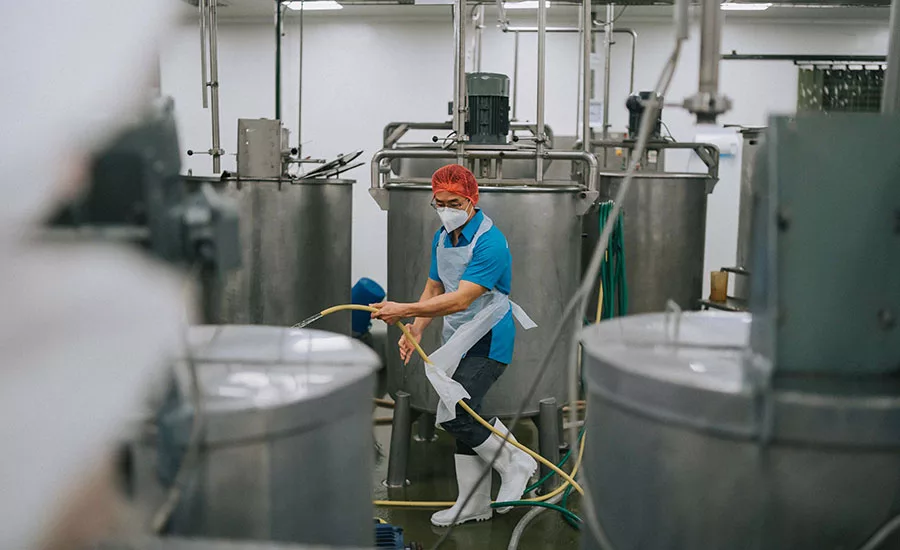
In food processing environments, biofilms remain a persistent and costly headache for manufacturers worldwide. A biofilm is a community of microorganisms, often including pathogenic species, which adhere to a surface and produce an often tight-knit matrix of extracellular polymeric substances (EPS). This matrix provides protection against cleaning agents, thereby facilitating nutrient retention and enabling bacterial communities to thrive in harsh conditions. Once established, biofilms are notoriously difficult to remove. They can develop on a wide range of food contact and non-food contact surfaces if routine sanitation measures are insufficient.
Within these microbial communities, communication among bacterial cells occurs through quorum sensing, a chemical signaling process that allows neighboring cells to coordinate their behavior and optimize survival strategies. In food manufacturing facilities, poorly maintained or inadequately cleaned surfaces create ideal niches for biofilms to form and persist. Common sites of colonization include cutting boards, slicers, handles, filters, drains, and even product surfaces themselves. These areas are often constructed from materials such as stainless-steel, polypropylene, plastic, glass, and rubber, all of which can support biofilm attachment if not properly maintained.
Environmental Factors That Support Biofilm Growth
The formation and persistence of biofilms in food environments are influenced by several key environmental conditions including temperature, nutrient availability, humidity, pH, etc.
- Temperature: Temperature plays a critical role in determining whether biofilms will form and how quickly they develop. Most foodborne bacteria responsible for biofilm formation thrive in the temperature range of 68–113 °F (20–45 °C), which coincides with ambient and processing temperatures in many food manufacturing facilities. While elevated temperatures can inhibit growth, some bacteria, such as Pseudomonas aeruginosa, can form biofilms even at refrigeration temperatures. This adaptability allows them to persist in cold storage rooms, chilled processing areas, and on equipment surfaces, frustrating sanitation efforts.
- Nutrient availability: The availability of nutrients directly influences biofilm development. When nutrients are abundant, such as when residues from raw materials accumulate on equipment, biofilms can grow rapidly and increase in density. Furthermore, nutrient-deficient conditions may slow growth but can also trigger stress responses, leading to the development of more resistant and persistent biofilm on surfaces. This resilience is a major reason why sporadic cleaning or incomplete sanitation often fails to eliminate biofilm entirely.
- Humidity: High humidity levels provide the moisture necessary for microbial attachment and EPS production, and moisture-rich environments support biofilm adhesion and survival, especially in areas such as drains, processing lines, and cooling units. While humidity is not the primary cause of biofilm formation, it creates favorable conditions that enhance bacterial colonization of surfaces.
- pH: The pH of the surrounding environment affects which microorganisms grow within a biofilm. Many bacterial strains prefer slightly alkaline conditions, but some, such as certain Staphylococcus species, can develop biofilms in more acidic environments. This species-dependent pH tolerance means that biofilms can form in diverse areas of a processing facility, from surfaces with acidic cleaning solution residue to neutral water lines.
Common Bacteria That Form Biofilms in Food Manufacturing Facilities
A number of pathogenic bacteria species can form biofilms and/or be protected by them, as detailed below.
Salmonella spp. are gram-negative, rod-shaped, facultative anaerobic bacteria capable of producing biofilms, although this ability varies by strain. Some, such as Salmonella Typhi, possess fimbriae and flagella that allow them to adhere to surfaces before generating EPS that protects the cells against disinfectants, making removal challenging. Treatment typically involves combining mechanical cleaning with multiple enzymes or organic chemicals to disrupt the matrix and kill the cells effectively.
Listeria monocytogenes is a gram-positive, facultative anaerobic bacteria known for its ability to survive and grow at low temperatures. Flagella play an important role during the initial stages of attachment, especially at temperatures below 86 °F (30 °C), which regulate cell motility. L. monocytogenes biofilms can establish themselves on a variety of industrial materials including stainless-steel, polystyrene, rubber gaskets, and polytetrafluoroethylene (PTFE) conveyor belts. This organism can enter facilities through raw ingredients, contaminated equipment, or the surrounding environment. Enzymatic treatments, particularly the use of proteases, can help degrade the protective matrix of Listeria biofilms; however, consistent and thorough sanitation practices remain essential for control.
Escherichia coli is a gram-negative, rod-shaped bacterium that uses pili, flagella, and membrane proteins to attach to surfaces. EPS production leads to enhanced resistance to disinfectants. Effective removal generally requires a combination of mechanical scrubbing and chemical sanitizers to break down and get rid of the biofilm. E. coli biofilms have the capacity to form on stainless-steel tables, rubbers for seals and gaskets, and surfaces like conveyor belts and pipes.
Looking for quick answers on food safety topics?
Try Ask FSM, our new smart AI search tool.
Ask FSM →
Bacillus cereus is a gram-positive, rod-shaped, facultative anaerobic, spore-forming bacterium commonly found in soil, raw agricultural products, and food processing environments. It can form biofilms on various surfaces like stainless-steel and plastic. One of the most challenging characteristics of B. cereus is its spore-forming ability. Spores can persist in harsh environments, resist heat treatments, and germinate under favorable conditions, seeding new biofilms. These biofilms can harbor both vegetative cells and spores, creating persistent contamination sources that are difficult to eradicate.
Controlling B. cereus biofilms typically requires a combination of approaches. Alkaline cleaning agents are often used to remove organic residues and disrupt the EPS matrix. Enzymatic treatments targeting proteins and polysaccharides have also shown promise in degrading biofilm structures. Since spores are resistant to many sanitizers, a two-step cleaning process of mechanical removal followed by targeted sporicidal treatment is generally most effective.
Steps in Biofilm Formation
Biofilm development occurs through a series of four main stages:
- Initial attachment: Initially, free-floating bacteria adhere loosely to a surface through weak physical interactions and biological structures such as pili and flagella. At this stage, detachment is still relatively easy and reversible.
- Irreversible adhesion: Bacteria begin producing EPS, strengthening their attachment and forming a stable base for further development and attachment.
- Maturation: The biofilm thickens and matures into a network of structured communities, with nutrient channels and differentiated cells that provide resilience against environmental stresses.
- Cell separation and dispersion: Portions of the biofilm release cells into the environment, allowing colonization of new sites, thereby spreading and repeating the cycle.
Biofilm-Related Challenges in the Food Industry
Uncontrolled biofilms pose significant food safety hazards. If not effectively detected and eliminated, they can become chronic sources of contamination, leading to product spoilage, pathogen transmission, and foodborne illness outbreaks. Since biofilms are more resistant to sanitizers and disinfectants than free cells, they can survive standard cleaning cycles and contaminate products even during processing.
Repeated use of aggressive cleaning chemicals, including peracetic acid and sodium hypochlorite, to combat persistent biofilms can accelerate equipment degradation. Stainless-steel surfaces, although generally resistant to corrosion, can still suffer damage from prolonged exposure to harsh sanitizers. This damage can lead to pitting and loss of smoothness, making way for increased areas of bacterial attachment.
Contamination events linked to biofilms can trigger product recalls, production shutdowns, and legal liabilities, resulting in significant financial losses. Beyond direct costs, companies may also face reputational damage and decreased consumer trust in their products.
Prevention and Control of Biofilms in Food Processing Facilities
Several treatments can be used to control biofilm formation:
- Thermal treatments: Exposing surfaces to elevated temperatures, generally above 160 °F (71 °C), for extended periods can effectively disrupt biofilm structures by denaturing proteins and damaging bacterial nucleic acids. However, this method must be carefully balanced with equipment tolerance to avoid damage.
- Ultrasonic treatments: Ultrasound uses high-frequency sound waves to generate pressure fluctuations in liquids, leading to cavitation bubbles that collapse violently and produce strong shear forces. These forces can dislodge biofilms from surfaces, making subsequent cleaning more effective. Ultrasonic treatments are particularly useful for complex equipment with harder-to-reach areas.
- Biochemical agents: Enzymes, biosurfactants, and essential oils have all been studied as biofilm control agents. Enzymes including proteases, for example, can degrade the protein components of biofilm matrices, while biosurfactants disrupt surface tension, reducing bacterial adhesion. Essential oils contain active compounds like terpenes and terpenoids that exhibit antimicrobial properties. Often, the most effective strategies involve combining these agents with traditional cleaning to maximize their impact.
Preventing biofilm establishment, on the other hand, is far more cost-effective than removing mature biofilms. Key preventive measures include:
- Consistent cleaning and sanitation: Regular cleaning schedules, using appropriate detergents and sanitizers, help minimize organic residues and microbial load, preventing biofilm initiation.
- Surface modification and hygienic design: Designing equipment and surfaces to be smooth, non-porous, and easy to clean reduces areas where biofilms can anchor. Making sure to eliminate crevices, joints, and rough surfaces also improves cleaning efficiency.
- Environmental control: Managing humidity, temperature, and pH levels in processing environments can create conditions that are less favorable for biofilm growth.
Takeaway
Biofilms continue to present a serious and multifaceted challenge to food processing operations. Their ability to persist on a variety of surfaces, resist conventional sanitation efforts, and harbor pathogenic bacteria makes them a significant risk factor for contamination, equipment deterioration, and economic loss.
Effective management of biofilms requires a combination of proactive and preventive measures, targeted control strategies, and continuous monitoring. By integrating thermal, mechanical, chemical, and enzymatic methods, along with sound hygienic design principles, food manufacturers can reduce biofilm formation and maintain high standards of food safety and operational efficiency.
Abiola Latifat Omosowon, M.S., PCQI is a quality assurance leader with over seven years of experience across the food, biotech, pharmaceutical, and manufacturing industries, she has hands-on expertise in regulatory compliance, supplier quality, and quality systems management. She has successfully led HACCP, GFSI, and FSMA implementation across multi-site operations, measurably reducing critical violations and improving audit scores. Ms. Omosowon holds a M.S. degree in Food Science and Human Nutrition from the University of Central Oklahoma and a B.S. degree in Microbiology from Babcock University.