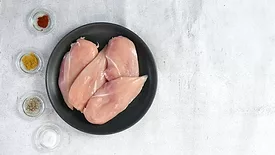
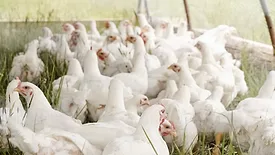
McMaster University researchers have developed a rapid, inexpensive test for Salmonella contamination in poultry and other food. The test provides accurate results in an hour or less without the need for accessories or a power source.
The U.S. Food and Drug Administration (FDA) has released a report on its investigation of a Salmonella Typhimurium outbreak linked to cantaloupes that occurred during July–September 2022, and has highlighted food safety recommendations for melon growers and distributors.
The U.S. Department of Agriculture’s Food Safety and Inspection Service (USDA’s FSIS) released a proposed determination to declare Salmonella an adulterant in breaded stuffed raw chicken products, building upon the proposed regulatory framework to reduce Salmonella infections linked to poultry products.
The University of Illinois, Cornell University, and Perdue Farms are partnering on a project to study policy and management approaches to further reduce Salmonella cases linked to raw poultry.
The U.S. Department of Agriculture’s Food Safety and Inspection Service’s (USDA’s FSIS) has announced that is granting a pilot project to Pilgrim’s Pride in Mount Pleasant, Texas to examine the merits and logistics of excluding Salmonella poultry vaccine strains from the FSIS Salmonella performance categorization calculation.
In a recent study, the U.S. Centers for Disease Control and Prevention (CDC) has identified non-typhoidal Salmonella (NTS) as one of the top five pathogens contributing to foodborne illnesses in the U.S. Cases of salmonellosis were largely associated with beef products, despite implementation of interventions at slaughter and processing facilities to reduce contamination.
In this episode of Food Safety Matters, we talk with Martin Wiedmann, Ph.D., D.V.M., the Gellert Family Professor in Food Safety and Food Science at Cornell University, about his research on Listeria and Salmonella, his work to strengthen foodborne illness surveillance and response, his use of whole genome sequencing (WGS), and other topics.
Antimicrobial resistance (AMR) data on from humans, animals, and food are compiled annually by the European Center for Disease Prevention and Control (ECDC) and the European Food Safety Authority (EFSA) in a yearly EU Summary Report. Alongside the report, EFSA has also published data visualization tools and resources on AMR on zoonotic pathogens in Europe.
The Canadian Food Inspection Agency (CFIA) has published a guidance document for the Pathogen Reduction Monitoring Program (PRMP) for Salmonella and Campylobacter in raw poultry, which provides a means to verify that overall food safety control measures are effective in reducing Salmonella and Campylobacter contamination in raw poultry and poultry products to maximum pathogen limits described by CIFA.
The U.S. Department of Agriculture’s Food Safety and Inspection Service (USDA’s FSIS) published a report that highlights multi-year trends for antimicrobial resistance among Salmonella from data collected by the National Antimicrobial Resistance Monitoring System (NARMS) during 2014–2019.