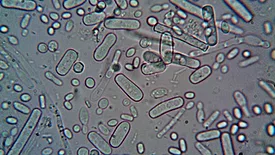
The vaccine provided 89 percent protection against S. sonnei infection compared with the placebo. Vaccinated participants also experienced less severe symptoms and lower levels of bacterial shedding. The vaccine is being developed as drug resistance among Shigella continues to increase.
The label claim “STABILIZED” would indicate that a ready-to-eat (RTE) product had been formulated or processed to inhibit Listeria monocytogenes growth. The researchers advocate for formulation and process changes as listeriosis rates climb in Europe and stricter EU Listeria regulations come into effect.
According to the researchers, treating PFAS as a single class of contaminants may overlook important differences in how individual compounds move through water systems and respond to remediation. Treatment strategies should be designed based on molecular structure, especially chain length.
Although the overall global burden has decreased, persistent and increasing burdens from specific foodborne parasites and in certain regions warrant continued public health attention.
The Center for Produce Safety (CPS)-funded study also found that some produce items may naturally inhibit Listeria monocytogenes growth and that peracetic acid may sometimes promote Listeria growth during storage.
Researchers from Purdue University conducted focus groups with Indiana produce growers who qualified for exemptions from the Food Safety Modernization Act Produce Safety Rule, examining the beliefs and practical constraints that shape on-farm food safety practices.
When a certain protein pathway was disrupted in the assembly of extracellular matrices, normal Bacillus cereus biofilm formation was impaired, but compensatory responses enabled a level of matrix plasticity that could help explain why biofilms are difficult to eradicate.
Reoccurring, emerging, and persisting (REP) strains cause foodborne illnesses over extended periods of time, rather than through isolated outbreaks. The REP framework was jointly developed by CDC, FDA, and USDA-FSIS through the Interagency Foodborne Outbreak Response Collaboration.
The Arkansas-based study showed that repeated mid-season soil aeration events significantly reduced arsenic concentrations in rice grain without increasing cadmium levels, providing field-scale evidence that water management can help mitigate arsenic accumulation.
Real-world data from meat processors show Clostridium perfringens is rarely detected in fully cooked meat and poultry products and remains uncommon even when deviations from USDA-FSIS Appendix B parameters are reported, challenging assumptions underlying regulatory limits for growth during stabilization.