Food Safety
search
Ask Food Safety AI
cart
facebook twitter linkedin
  • Sign In
  • Create Account
  • Sign Out
  • My Account
Food Safety
  • NEWS
    • Latest News
    • White Papers
  • PRODUCTS
  • TOPICS
    • Contamination Control
    • Food Types
    • Management
    • Process Control
    • Regulatory
    • Sanitation
    • Supply Chain
    • Testing and Analysis
  • PODCAST
  • EXCLUSIVES
    • Food Safety Five Newsreel
    • eBooks
    • FSM Distinguished Service Award
    • Interactive Product Spotlights
    • Videos
  • BUYER'S GUIDE
  • MORE
    • ENEWSLETTER >
      • Archive Issues
      • Subscribe to eNews
    • Store
    • Sponsor Insights
    • ASK FSM AI
  • WEBINARS
  • FOOD SAFETY SUMMIT
  • EMAG
    • eMagazine
    • Archive Issues
    • Editorial Advisory Board
    • Contact
    • Advertise
  • SIGN UP!
ManagementProcess ControlWhite PapersRecall/Crisis ManagementIntervention Controls

Sponsored Content

Five Reasons Why You Need X-Ray Inspection
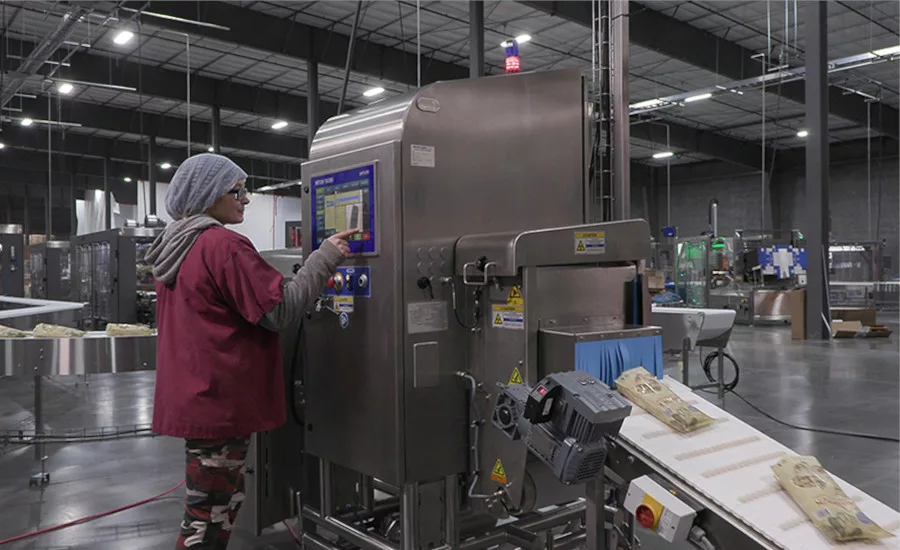
X-ray Inspection

Image Credit: Mettler-Toledo. 

October 8, 2024

Detection of foreign body contaminants is clearly the first task of an X-ray system, but it can also offer much more besides. Mike Pipe, Head of Global Sales of Mettler-Toledo Safeline X-ray outlines some of the many reasons to invest in X-ray inspection.

X-ray inspection has been proven to effectively detect a wide range of physical contaminants in food manufacturing and packaging, but this technology’s capabilities stretch way beyond just the product inspection field. 

Many food manufacturers are already benefiting from deploying X-ray inspection systems to carry out a wide range of quality control and compliance duties and these additional capabilities also should be factored into the equation when considering the cost of an X-ray inspection system. In fact, the cost savings that X-ray inspection can deliver are significant, offering major benefits to manufacturers and brands.

Here are five key areas where X-ray inspection can make an important contribution:

  1. Detect contaminants and uphold food safety

    Foreign body detection is a critical aspect of any food manufacturer’s product inspection operation. While there are alternative technologies for contaminant detection – most notably metal detection – X-ray inspection systems are the most suitable choice for many food products. It works by measuring differences in absorption between low and high-density matter. X-ray can provide exceptional detection of contaminants such as metal, glass, calcified bone, mineral stone, and certain plastics and rubbers, regardless of the contaminant’s shape, size, or location within the product. However, it does have its limitations for product inspection. For example, contaminants of lower density, such as insects, wood, and polyethylene film are not detectable.

  2. Avoid product recalls

    For food manufacturers, product recalls represent a twin-headed peril: the costs of wasted products and production time on the one hand; the damage to its good name on the other.  While the costs of the former are often quickly absorbed, the negative effects on brand reputation can be much more long-term.  

    The effective detection and removal of foreign body contaminants therefore falls squarely in the category of good business, as well as good customer care. 

    Implementing a well-designed X-ray inspection program can cut the risks and the costs involved in product recalls, with real-time data collection potentially helping to isolate smaller contaminated batches that need to be recalled, instead of an entire production run. 

  3. Protect brands

    The absence of good product inspection can endanger consumer health and safety, and such incidents can lead to major legal action being taken. If a consumer has choked on a bone that was not detected in a food product, and a HACCP or HARPC audit shows that this risk of contamination should have been identified and mitigated against with X-ray inspection, then there will be very serious questions to answer. The relationship between manufacturer and retailer will also be put under severe strain.   

    X-ray inspection also provides the production documentation needed to prove that operating standards were maintained, which might prove critical in legal proceedings. 

    Increasingly, food manufacturers are highlighting their use of X-ray systems as a means of maintaining high quality, so that both customers and consumers can have greater confidence in products from that manufacturer. In some cases, this might even be starting to factor in the decisions that retailers and supermarkets make on the products they stock. 

  4. Comply with regulations and retailer specifications

    A number of standards and codes of practice that have emerged from regulatory bodies such as the Global Food Safety Initiative (GFSI) and Good Manufacturing Practice (GMP), requiring food manufacturers to make their processes as safe and transparent as possible, and advocating inspection of all food and related products by X-ray inspection – an acknowledgment perhaps that X-ray is capable of providing the highest levels of product inspection available.

    These standards are being embraced by retailers and in some instances are beginning to be used as a basis for supplier selection by these retailers. In addition, retailers and brand custodians are developing their own codes of practice for suppliers, while more and more supermarkets are insisting that suppliers implement a formal X-ray inspection program throughout their supply chain. 

    X-ray inspection systems assist with record keeping, providing an audit trail of activity that allows for disputes and queries to be quickly and transparently dealt with, and documentation easily produced for audit purposes. 

  5. Ensure product and packaging integrity

    X-ray inspection is capable of a wide range of additional quality control tasks which it carries out simultaneously to detecting foreign body contaminants, amongst these tasks are:

    • Counting components, identifying damaged components – knowing how many items should be in a pack. 
    • Identifying damaged packaging, inspecting seal quality to detect product trapped in the seal, and identifying missing components such as screw-caps.   
    • Measuring product mass – the sum of all the greyscale values in an image is proportional to the mass of the product, and this can be compared to a known mass value for a reference pack.  
    • Checking fill levels – the X-ray inspection image shows clear discrepancies in fill levels between packs, where perhaps one is under-filled and one over-filled, making the overall pack weight seemingly correct. 

As we have seen, while X-ray inspection starts with food safety, it is also capable of adding much more, bringing value and transparency to the food supply chain. Planned and managed properly, X-ray inspection will quickly show itself to be invaluable, way beyond its core functionality. 

For more information: www.mt.com/pi-pr

Looking for quick answers on food safety topics?
Try Ask FSM, our new smart AI search tool.
Ask FSM →


KEYWORDS: recalls x-ray inspection

Share This Story

Recommended Content

JOIN TODAY
to unlock your recommendations.

Already have an account? Sign In

  • people holding baby chicks

    Serovar Differences Matter: Utility of Deep Serotyping in Broiler Production and Processing

    This article discusses the significance of Salmonella in...
    Testing & Analysis
    By: Nikki Shariat Ph.D.
  • woman washing hands

    Building a Culture of Hygiene in the Food Processing Plant

    Everyone entering a food processing facility needs to...
    Food Prep/Handling
    By: Richard F. Stier, M.S.
  • graphical representation of earth over dirt

    Climate Change and Emerging Risks to Food Safety: Building Climate Resilience

    This article examines the multifaceted threats to food...
    Best Practices
    By: Maria Cristina Tirado Ph.D., D.V.M. and Shamini Albert Raj M.A.
Manage My Account
  • eMagazine Subscription
  • Subscribe to eNewsletter
  • Manage My Preferences
  • Website Registration
  • Subscription Customer Service

More Videos

Sponsored Content

Sponsored Content is a special paid section where industry companies provide high quality, objective, non-commercial content around topics of interest to the Food Safety Magazine audience. All Sponsored Content is supplied by the advertising company and any opinions expressed in this article are those of the author and not necessarily reflect the views of Food Safety Magazine or its parent company, BNP Media. Interested in participating in our Sponsored Content section? Contact your local rep!

close
  • Salmonella bacteria
    Sponsored byThermoFisher

    Food Microbiology Testing Methods: Salmonella species

  • a diagram explaining indicator organisms
    Sponsored byHygiena

    How Proactive Listeria Testing Helps Prevent Six- and Seven-Figure Recalls

  • woman grocery shopping
    Sponsored byCorbion

    Designing Safety Into Every Bite: Proactive Risk Mitigation for Refrigerated Foods

Popular Stories

NRTE breaded stuffed chicken

USDA Indefinitely Delays Enforcement of Salmonella as Adulterant in Raw Breaded, Stuffed Chicken

non-conforming product

How to Handle Non-Conforming Product

spoonfuls of food ingredients

FDA’s Developing Rule to Tighten GRAS Oversight Moves to White House

Events

December 11, 2025

How to Develop and Implement an Effective Food Defense Strategy

Live: December 11, 2025 at 2:00 pm EDT: From this webinar, attendees will learn common areas where companies encounter challenges in their food defense strategies and how to address them.

May 11, 2026

The Food Safety Summit

Stay informed on the latest food safety trends, innovations, emerging challenges, and expert analysis. Leave the Summit with actionable insights ready to drive measurable improvements in your organization. Do not miss this opportunity to learn from experts about contamination control, food safety culture, regulations, sanitation, supply chain traceability, and so much more.

View All

Products

Global Food Safety Microbial Interventions and Molecular Advancements

Global Food Safety Microbial Interventions and Molecular Advancements

See More Products

Related Articles

  • 10 Reasons Why You Should Be Using Chlorine Dioxide

    See More
  • Exposing Recent Improvements in X-Ray Inspection for Food Inspection

    See More
  • poultry under x ray

    Mettler Toledo to Host Free X-Ray Inspection Webinar

    See More

Related Products

See More Products
  • 9781138198463.jpg

    Food Safety Management Programs: Applications, Best Practices, and Compliance

  • Food-Forensics-3D.jpg

    Food Forensics Handbook Practice, Instrumentation, Case Studies

  • 1444333348.jpg

    Handbook of Food Safety Engineering

See More Products

Related Directories

  • Eagle Product Inspection

    Eagle Product Inspection is a leading manufacturer of hygienically designed x-ray equipment & inline fat analysis systems. Eagle specializes in complex x-ray inspection solutions using dual energy photon-counting technology for bone detection and inline fat analysis for a wide variety of industries, including meat, poultry and seafood.
  • METTLER TOLEDO Product Inspection

    METTLER TOLEDO provides inspection solutions that boost profits, protect your brand, and help you comply with food safety regulations. Our full range of metal detectors, checkweighers, x-ray and vision inspection systems eliminate metal and foreign material in liquid or packaged products, verify weights, and ensure accuracy and integrity of packaging and labels.
  • Anritsu - Product Inspection & Detection

    Anritsu manufactures product inspection and detection equipment for food and pharma industries. Part of the Product Quality Assurance division of Anritsu Corp., we advance quality control programs with high-performing and reliable solutions. Our X-Ray Systems, Checkweighers, Metal Detectors, Combo Systems, Rejectors, and QuiCCA Software provide a superior ROI and ensure compliance with stringent quality control programs while protecting your brand. Our local branches in the US, Europe, Brazil, and Mexico are equipped with in-house service & parts dept., we deliver, install, and maintain in record time. With over 200,000 installations, we are the brand that is trusted to protect the safety and security of your customers.
×

Never miss the latest news and trends driving the food safety industry

eNewsletter | Website | eMagazine

JOIN TODAY!
  • RESOURCES
    • Advertise
    • Contact Us
    • Directories
    • Store
    • Want More
  • SIGN UP TODAY
    • Create Account
    • eMagazine
    • eNewsletter
    • Customer Service
    • Manage Preferences
  • SERVICES
    • Marketing Services
    • Reprints
    • Market Research
    • List Rental
    • Survey/Respondent Access
  • STAY CONNECTED
    • LinkedIn
    • Facebook
    • Instagram
    • X (Twitter)
  • PRIVACY
    • PRIVACY POLICY
    • TERMS & CONDITIONS
    • DO NOT SELL MY PERSONAL INFORMATION
    • PRIVACY REQUEST
    • ACCESSIBILITY

Copyright ©2025. All Rights Reserved BNP Media.

Design, CMS, Hosting & Web Development :: ePublishing